I got a call in February 2024 from an installer who'd bought forty of our MPPT charge controllers. "They're failing," he said. "All of them. Randomly."
That's a gut-drop moment for a quality manager.
We pulled units off his shelf, bench-tested them in the lab, logged every failure mode we could think of. Nothing. The controllers were fine—which was somehow worse, because it meant the problem was in his system, and he'd already told his customer the hardware was defective.
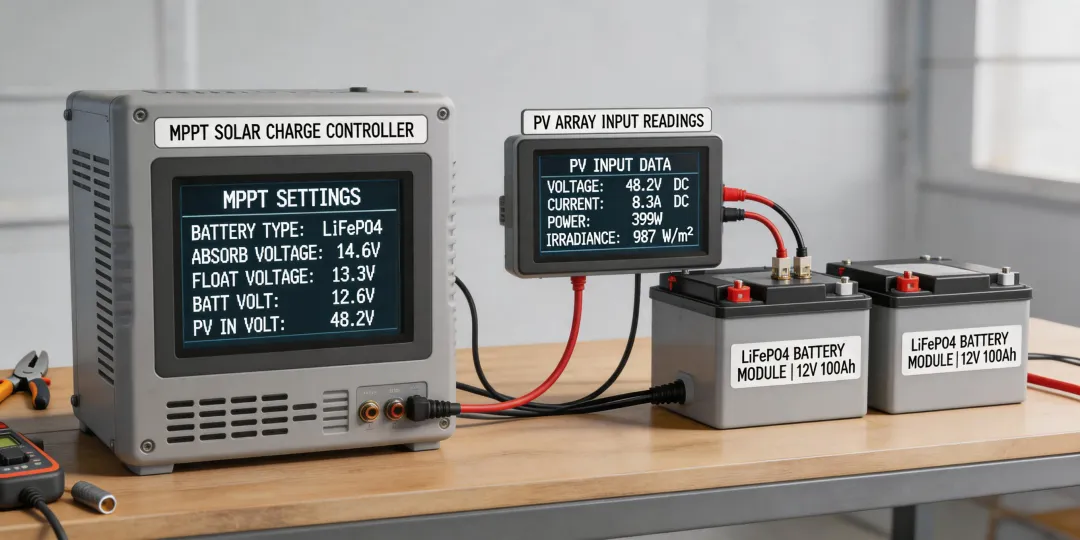
Then we checked the battery settings.
He had a 48V sealed lead-acid bank, and the controllers were set to the lithium profile. The units weren't failing. They were doing exactly what they were designed to do—protecting the batteries from a charge curve they didn't need and a voltage ceiling they didn't have.
One setting. Forty controllers. A customer who lost faith in the hardware, when the hardware was never the problem.
I'm a quality and brand compliance manager in the renewable energy space, which is a polite way of saying I spend my days reviewing specifications, signing off on deliverables, and occasionally rejecting entire batches of systems that don't meet spec. Over the past four years, I've reviewed roughly 200+ unique system configurations a year. In Q1 2024 alone, I rejected 11% of first-pass delivery specs.
Almost none of them were rejected because the hardware was bad.
The Problem Isn't The Controller. It's What's Around It.
When people tell me their solar setup "isn't working," they almost always blame the biggest, most expensive component in the chain. The inverter. The battery. The charge controller. That's understandable—it's the piece with the blinking red light.
But in my experience, the blinking light is rarely the root problem. It's a symptom. And the root problem usually happened before the system was even switched on.
I could list a dozen things that go wrong in off-grid designs, but honestly, they cluster into three patterns. Once you see them, you'll start spotting them everywhere.
Sin #1: The Battery Chemistry Mismatch
The most common issue—and the one that bit that installer in February—is battery chemistry.
It's tempting to think a battery is a battery. But the charging profile that keeps a lead-acid bank healthy will actively damage a LiFePO4 bank, and vice versa. Lithium batteries want a constant-current/constant-voltage (CC/CV) charge with a specific absorption voltage and no equalization. Lead-acid wants equalization charges and can tolerate a higher float voltage. Get the profile wrong and you don't get a slow degradation; you get sudden capacity loss, swollen cells, and in some cases, a battery bank that's dead within months.
That's why every MPPT controller worth buying—including epever units—has battery-type settings. The feature isn't a bonus. It's the difference between a system that lasts six years and one that lasts six months.
I'll admit, I've made this mistake myself. Early in my career, I signed off on a spec that paired a 24V lithium bank with a controller set to the default lead-acid profile. The batteries lost about 30% of their rated capacity before anyone noticed. Looking back, I should have made battery-type verification a hard gate in our review checklist. At the time, I trusted the integrator's word that he'd "already set everything up." I should have checked. Now every contract we review includes battery chemistry verification as a non-negotiable step.
Sin #2: The Sizing Delusion
The second pattern is more subtle, and to be fair, it comes from a reasonable place. We've been trained to think bigger numbers mean better products.
A 100A MPPT charge controller—say, the epever 100A MPPT charge controller—is rated for 100A of output current. But that rating only matters if the input voltage matches the controller's window, if the array is wired correctly, and if the battery bank can actually absorb that current. Wire a PV array that pushes the input voltage past the controller's maximum and you'll cook the input stage. Feed it below the minimum and the controller won't start charging at all.
The "100A" number on the box is real. But it's incomplete without context.
I see this in the field all the time: someone installs an oversized controller because they think it "covers all contingencies." Then they leave the settings at factory default, wire the array with the wrong gauge, and wonder why the system underperforms. The hardware didn't fail. The design did.
Sin #3: The Manual Paradox
Here's a pattern I see over and over, and I'll admit it kind of baffles me.
People will happily spend an evening reading Anran Q3 Max 5MP solar battery camera reviews before buying a $60 security camera. They'll compare pixel counts, scroll through real-world screenshots, check the IP rating. Then they'll install a piece of equipment that manages thousands of dollars worth of batteries and panels, and—I'm not exaggerating—never open the manual.
The epever MPPT manual, for example, has a full section on battery type selection, a wiring diagram, a troubleshooting table, and a parameter quick-reference. It takes about fifteen minutes to read. But a huge portion of our support tickets are questions answered on page 12.
I get why it happens. Manuals are dry. Reviews are social and full of opinions. But the review tells you what another person experienced with their batteries, their panels, their loads. The manual tells you what the hardware actually expects. The review is a story. The manual is the spec. When you're deciding what to buy, the review helps. When you're deciding how to install it, the manual is non-negotiable.
The Real Cost Of Skipping The Spec
Let's talk money, because that's usually what gets people's attention.
When someone asks me how much a solar system costs, I don't give them a per-watt figure. The honest answer is: the cheapest system is the one that works the first time. The real cost isn't the panels, the controller, or the batteries. It's the rework.
Consider a setup that keeps blowing its charge controller. From what I've seen in procurement, a decent 100A MPPT controller runs somewhere in the $300 to $500 range depending on the brand and features. The battery bank it's connected to? Easily $1,500 to $3,000 for a lithium iron phosphate bank. When a controller fails because it's been running at the edge of its ratings for four months, you replace the controller. Three weeks later, you replace the battery it damaged. Then you pay an installer for a site visit, pay for re-terminating the wiring, and lose a weekend of uptime.
I went back and forth on this exact math with a client last year. The cheaper controller was $180 and handled lead-acid fine. The slightly more expensive unit was about $340 and supported LiFePO4 profiles natively. On paper, the cheaper option made sense—their batteries were lead-acid at the time. But my gut said they'd switch to lithium within eighteen months, and they did. We spent $340 once instead of $180 twice, plus the difference in installation time and shipping.
And here's where solar battery technology news actually matters. Lithium iron phosphate (LiFePO4) has become the default choice for off-grid storage—for good reason. It's safer, cycles deeper, and lasts significantly longer than lead-acid. But the chemistry shift happened faster than installer habits changed. A lot of people are running 5-year-old mental models against brand-new battery chemistries. They're setting controllers like it's 2019 on batteries that need 2025 settings.
That mismatch is expensive. A LiFePO4 bank isn't a bigger version of a lead-acid bank. It's a different animal with a different charging philosophy. The good news is, the technology has matured enough that this is no longer a niche concern; it's a standard one. The bad news is, standards don't help if nobody reads them.
Also—and this one's worth saying directly—don't trust a marketing page more than your own verification. Per the FTC's Green Guides (ftc.gov), environmental claims on products have to be substantiated before they can appear in advertising. I'd love to see buyers apply the same standard to technical specs. "100A MPPT" is a claim. Verify it against the datasheet. The datasheet is the legal document; the product page is a brochure.
The Fix: 5 Minutes Of Verification Beats 5 Days Of Correction
If you've made it this far, you've already done more reading than most system owners. Here's the payoff. The solution isn't a stack of new hardware—it's a short checklist.
- Set the battery type before you connect the battery. Open the manual that came with your controller—yes, the epever MPPT manual, or whatever manual came with your specific unit—and set the battery chemistry to match what's physically installed in your system. Not what you think is installed. What's written on the label.
- Size the controller to the array and the battery, not to your ego. A 100A MPPT charge controller is a tool, not a status symbol. If your array can't feed it, or your battery bank can't absorb it, you're paying for capacity you'll never use.
- Verify every spec before you buy. Check the input voltage range, the output current rating, and the battery type compatibility. Look for units with proper safety certifications—UL 1741 or IEC 62109—and cross-check the datasheet. If you're choosing an epever unit, both the datasheet and the manual are on the product page.
- Put a reminder on your calendar. Once a year, open the controller's status screen and confirm the parameters are still correct. Settings get changed during maintenance, firmware updates reset parameters, and batteries get swapped without telling the controller. It takes five minutes.
5 minutes of verification beats 5 days of correction. The cheapest insurance you'll ever buy for a solar system is a few minutes with the manual.
I've reviewed over 200 system configurations a year for the past four years, and the pattern hasn't changed. Almost every "failed" system I've seen was preventable. Not preventable with a crystal ball—preventable with a checklist.
Your solar system isn't unreliable. It's unverified. That's better news than you think, because it means you can probably fix it without replacing anything.
And if you still think the hardware is the problem? Check the settings first. The button is right there on the front panel.