I manage procurement for a fourteen-person off-grid EV charging and solar equipment company. I have approved roughly $420,000 in electrical hardware purchases over the last six years, and every supplier quote goes into a cost tracking sheet. That sheet started as a way to stop repeat mistakes. It is also how I learned to compare charge controllers by total site cost instead of invoice price.
This article compares two 20A charge controllers: the EPEVER Tracer 2210AN, a 20A MPPT controller, and a generic 20A PWM controller. The goal is not to declare a universal winner. It is to show why a cheaper controller can sometimes cost more than a controller with an MPPT label and a programmable battery profile.
Dimension 1: Upfront Price
In a Q3 2024 quote sample from our usual distributors, the generic 20A PWM controller came in at less than half the price of the EPEVER Tracer 2210AN. PWM wins the first page of the spreadsheet, which, honestly, is where many purchasing processes end. I am not going to pretend the price gap is imaginary.
That gap buys something visible. The Tracer has an MPPT conversion stage, an LCD, a programming port, and the ability to adjust battery setpoints. If a site only runs one small LED load and uses a sealed lead-acid battery, then a PWM controller is probably the correct call. I do not think every project needs an MPPT.
But a permanent station is not a one-load demo. The next three dimensions are where the invoice gap usually reverses.
Dimension 2: Charging Performance
MPPT extracts power from the panel’s maximum power point and converts the difference between panel voltage and battery voltage into usable current. PWM has no conversion stage; it switches the panel current in a way that roughly approximates a direct connection. In practice, the MPPT advantage changes with conditions. I avoid quoting a magic 20 percent number because it depends on panel voltage, temperature, and battery state.
The important pattern is this: as soon as a site uses higher-voltage panels, a 24V battery bank, or has low-light hours where charging still matters, MPPT tends to bring the battery back to full charge earlier in the day and starts harvesting earlier in the morning. EV charging sites have networking, cellular modems, and inverters drawing power all night. Every extra amp-hour the controller can put into the battery becomes a little more downtime insurance.
Once a site reaches a 5kVA solar inverter and a serious battery bank, the charge controller decision moves one level up. A 20A controller is not the right tool for the main bank of a 5kVA inverter; that bank needs a 40A or 60A MPPT sized to the array. On the same site, the Tracer 2210AN often makes more sense for auxiliary DC circuits such as telematics, contactors, and network switches. The comparison principle remains the same: do not starve a battery bank just to save money on a controller.
Dimension 3: Battery Compatibility
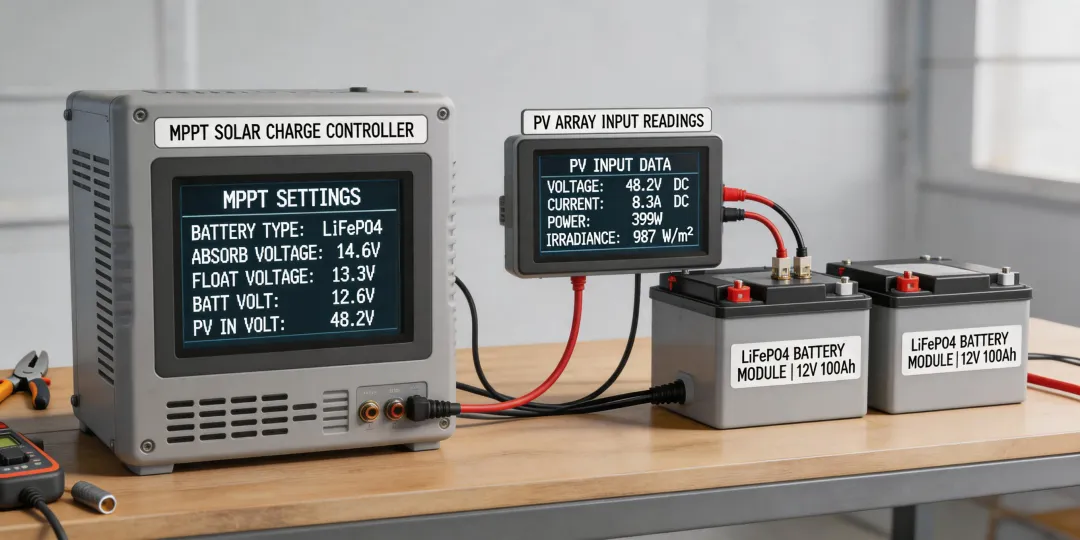
The failure that changed our standard spec happened in 2023. I had chosen a LiFePO4 battery for a charging-related control cabinet. The field crew picked a low-cost PWM controller because the data sheet said LiFePO4 compatible. It was compatible in the broadest sense, but not in the specific sense: the controller had a lithium profile with a fixed 14.6V absorption voltage, while the battery manufacturer required an absorption ceiling of 14.4V. The battery management system disconnected almost every sunny afternoon. That one field visit erased several controller price differences.
Replacing it with an EPEVER Tracer 2210AN and entering the correct setpoints was simple. That is why I am more comfortable specifying an EPEVER charge controller: the person commissioning the site has control over float, absorption, and low-voltage cutoff. Note to self: refuse the phrase LiFePO4 compatible until the setpoints are in writing.
I should be precise. Some PWM controllers also allow adjustable setpoints, so this is not a universal rule. The generic PWM in this comparison does not. That lack of control is what turns a cheap component into an expensive service call.
Dimension 4: Route Planning for EV Charging Station Vendors
For EV charging station vendors, route planning should not stop at the map pin. It has to include on-site availability over time. A station without a reliable charge controller can appear on a map and still be unavailable at 6:00 a.m., when the battery is low and the inverter refuses to start another charging session.
In a route-planning sense, the product is not a charger bolted to a concrete pad. The product is a promise that electricity will be there when the driver arrives. A PWM controller can deliver on that promise in narrow cases. But when a station uses a LiFePO4 battery, a remote monitoring link, and a service budget measured in truck rolls, the controller needs to be programmable and well documented.
That is why I recommend the EPEVER Tracer 2210AN for small auxiliary DC boards and larger EPEVER MPPT models for main inverter battery banks. The common thread is adjustability, not brand loyalty.
Battery Backup vs Surge Protector: Not a Budget Fight
One of the most common questions I see in EV charging work is battery backup vs surge protector. I understand why: both are black boxes in the power path, and both affect station uptime. But they are not substitutes.
A battery backup is an energy-time solution. It lets the station keep running when solar or utility power is absent. A surge protector is a voltage-threat solution. It clamps spikes from lightning or nearby switching and tries to keep transient energy out of sensitive electronics. A battery does not clean up a voltage spike, and a surge protector does not store energy for tomorrow morning.
Our standard design includes both. For North American projects, I distinguish between the inverter listing under UL 1741 and the surge protective device listing under UL 1449. The US National Electrical Code treats surge protective devices in a separate article, Article 285. That tells me not to assume an inverter or charge controller includes enough whole-site surge protection by default.
Earlier, I skipped a DC surge protector on one small station because I calculated the odds as low. The odds did not catch up in the form of a direct lightning strike. A switching transient on the AC side still found a networking board, and the replacement cost more than five surge protectors. The lesson stuck: surge protection should not be the line item removed from a tight bill of materials.
When someone asks me battery backup vs surge protector, I answer with an and, not an or. The battery backup protects the service from gaps in energy. The surge protector protects the equipment from gaps in voltage. A route-planning EV charging station vendor needs both to keep the site available.
My Recommendation After Six Years of Cost Tracking
After tracking hardware costs for years, I do not think the lowest purchase price is the cost that matters. The cost that hurts is the one paid after the battery protection opens, after the station drops offline, or after a surge takes out a communication board.
If this is a temporary trailer, a small lighting circuit, or a lead-acid system with on-site maintenance, a PWM controller can be acceptable. But for permanent off-grid EV charging infrastructure, choose a programmable MPPT controller with monitoring and a battery profile that matches the chemistry. The EPEVER Tracer 2210AN 20A MPPT is a good fit for auxiliary DC loads. For a main battery bank behind a 5kVA solar inverter, step up to a larger MPPT with the same logic: value first, unit price second.
That may sound like a cautious answer. It is. Every dollar saved on a component is real, but every hour spent standing next to a dead battery bank is also real. The second one is the one I remember when I open the cost tracking sheet.