-
First, which solar system are we talking about?
-
1. Is Epever actually worth it, or is the name doing the work?
-
2. Epever Tracer or XTRA—which controller should we stock?
-
3. What should we look for in an Epever inverter review?
-
4. Should we hire a solar battery contractor for our first LiFePO4 jobs?
-
5. What size power inverter (12V to 120V) should we recommend?
-
6. Will third-party LiFePO4 batteries work with Epever charge controllers?
I buy solar equipment for a 14-person off-grid installer. Since 2019, our crew has put roughly 400 Epever charge controllers into projects, plus a couple hundred Epever inverters and LiFePO4 batteries. This FAQ is the honest version of the questions we hear from integrators and small installers.
First, which solar system are we talking about?
If you found us through a search like what celestial objects make up our solar system, here's the astronomy answer in one breath: the Sun, the eight planets, their moons, dwarf planets (yes, Pluto is still one to most of us), asteroids, comets, and the icy bodies in the Kuiper Belt and Oort Cloud.
The solar systems we sell are the other kind. They're built from PV modules, charge controllers, batteries, and inverters. If that's the kind you're planning, the rest of this page is for you.
1. Is Epever actually worth it, or is the name doing the work?
Let me show you the TCO before the hype. Between Sept 2022 and June 2024, our cost tracking system shows 7 warranty returns out of 392 Epever charge controllers. The cheaper generic controllers we used before that were a different story: about 9 failures out of 71. I can't promise those numbers repeat for you—it's our record, not a lab test—but it's enough for a small company like ours to standardize on Epever.
The bigger point: installers often decide based on unit price, but our real cost is the service call. One remote-cabin visit can cost $350 by the time a technician drives out and swaps a controller. A $55 price difference on 60 units looks attractive until three of them die. With Epever, we don't see that pattern. Is it the fanciest controller in the world? No. Are we okay with that? Yes, because our customers need reliable, not bragging rights.
2. Epever Tracer or XTRA—which controller should we stock?
When you search solar controller tracer epever, you've probably already picked the brand and just need the right family. Epever's naming doesn't make that easy.
Our stock is mostly Tracer. The Tracer line gives us more field-adjustable battery settings and the option of a remote display, which matters when customers want to check battery voltage without walking to a shed. The XTRA line is simpler and a little cheaper. If an RV has a basic 12V system, an XTRA will do. For systems we troubleshoot from a distance, I choose Tracer.
Don't choose based on price per amp alone. Check maximum PV input voltage, especially in cold climates. Panels produce higher voltage when cold, and exceeding a controller's Voc limit can fry it. Epever sells different voltage grades for a reason.
3. What should we look for in an Epever inverter review?
First, know what not to trust. Per FTC advertising guidance (ftc.gov), performance claims should be substantiated—but a one-line Amazon review is not substantiation. It's an anecdote. When I search for epever inverter review, I ignore star counts and look for three data points:
- continuous watts versus surge watts;
- measured no-load power draw; and
- pure sine wave or modified sine wave, stated honestly.
Then we buy one unit and test it on the bench. In 2024, we tested Epever inverters against their spec sheets. One unit showed voltage about 2% high on the display—not a deal-breaker, but good to know. The modified sine wave unit we tried made a laptop charger buzz; the pure sine version didn't. That's the kind of detail a spec sheet won't tell you.
If reading reviews is your only testing method, read the negative ones. People who post 1-star reviews often reveal exactly what matters—fan noise, shutdown behavior, or real-world wattage—while 5-star reviewers are still unpacking the box. We mostly use pure sine wave Epever inverters on our small installs. They cost more up front, but sensitive electronics behave properly, and we don't get follow-up calls about buzzing chargers.
4. Should we hire a solar battery contractor for our first LiFePO4 jobs?
Probably yes—at least for the first couple of projects. A good solar battery contractor already has the safety habits built in: proper disconnects, torque settings, charging setpoints. You don't want to learn those on a customer's dime.
We hired a contractor for our first two larger battery installs. It cost us about $900 and $1,150 per job, and it was worth every dollar. Our crew watched, asked questions, and handled the third install ourselves. That's not failure—that's a training budget.
I'll be straight with you: the first time we called, the contractor treated us like a tiny customer. Maybe because we didn't show up with a huge order. We sent them two more projects that season, and by the end of the year we were one of their regulars. Small doesn't mean unimportant; it means unproven. The vendors that treated us well when our orders were small are the ones we call first now that our orders are bigger.
5. What size power inverter (12V to 120V) should we recommend?
The search phrase power inverter 12V to 120V comes up a lot in our 12V off-grid world. The approach that stops people from overspending: make a list of loads that run at the same time, add about 20% headroom, then check the battery side of the equation.
I made the classic rookie mistake in my first year. I sized an inverter for everything a customer owned, assuming it would all run at once. It never did. We sold him a bigger inverter than he needed, with higher idle draw and a bigger price tag. Learned that lesson when he asked why his batteries drained overnight—standby losses from an oversized inverter were part of it.
For many 12V systems, a 1000W continuous inverter is more useful than people think. It runs a fridge, charges laptops, and powers lights. If the customer wants a microwave and a coffee maker at the same time, step up. We choose pure sine wave models for most loads because electronics like laptop chargers and TVs don't like modified sine wave. Also keep in mind: 1000W on the AC side means roughly 90–100A on the 12V side, so the battery cable has to be thick. That wiring detail is where self-built systems fail.
6. Will third-party LiFePO4 batteries work with Epever charge controllers?
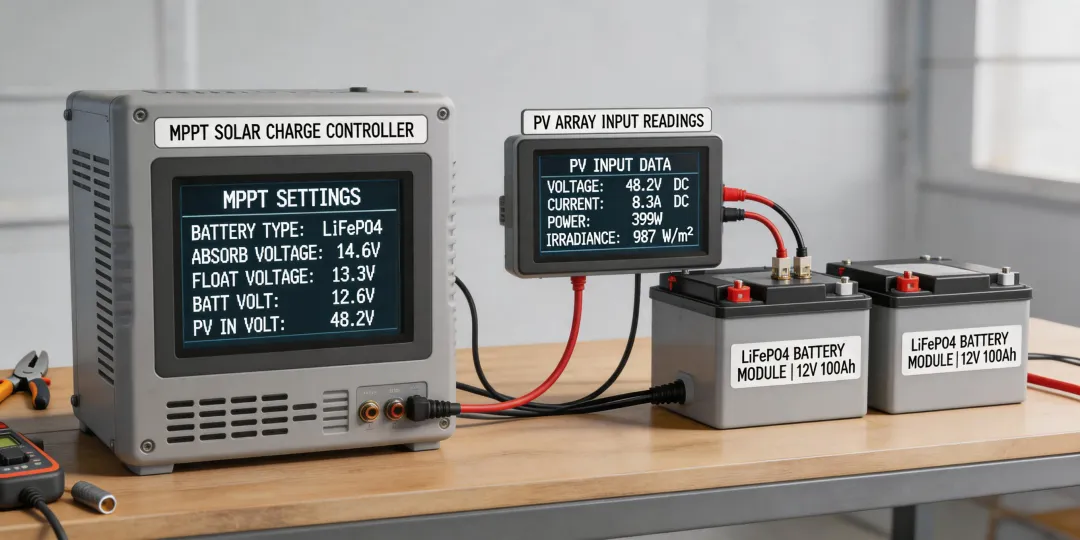
Short answer: usually yes, but only if you configure the controller properly. Epever's advantage is flexibility—you can set absorption and float voltages to match the battery maker's spec. That's more useful than a fancy logo.
The trap is default settings. Many controllers arrive set for lead-acid. Connect a LiFePO4 battery and leave the defaults on, and you may charge at the wrong voltage. Some lithium BMSs respond by disconnecting. It looks like the controller broke, but it's really protecting the battery.
On Epever units, switch the battery type to lithium or user-defined, set the voltage to what your battery manufacturer recommends, and turn off equalization. If you're using Epever's own LiFePO4 batteries, the process is straightforward and documented. If you're using another brand, don't assume one voltage fits all lithium cells. Verify it on paper before trusting the install.