I Review Epever Products, and I'm Comfortable Saying 'Not Our Product'
I'm a quality and brand compliance manager at Epever. I review charge controllers, inverters, and battery products before they reach distributors and system integrators—roughly 200+ product reviews a year. In 2024 I rejected around 3% of first-article submissions. Maybe 3.2% if you count documentation revisions; I would have to pull the exact report. The reason I mention this is not to impress you. It's to explain a lesson I learned the hard way: a supplier that doesn't respect product discipline makes quality control much harder.
When I first started in the solar industry, I assumed the larger the product line, the more established the company. I thought a brand with controllers, inverters, panels, batteries, EV chargers, and micro inverter options was the strongest possible partner. I don't believe that anymore.
Here is my opinion, stated without hedging: a specialist that openly says 'this isn't what we do' is more useful than a generalist that says 'we do everything.' That is not a marketing slogan. It affects how products are tested, how warranty claims are handled, and how confident I can be when I sign off on a product.
What Epever's core product scope actually is
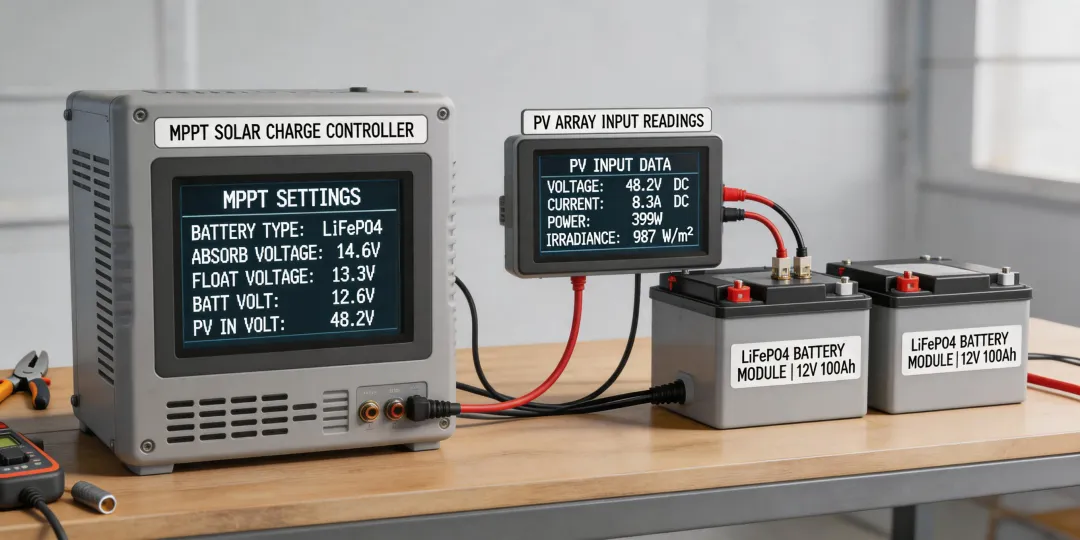
Epever's core expertise is DC power conversion and storage: MPPT solar charge controllers, off-grid inverters, and LiFePO4 battery systems. That means we spend most of our design and testing hours around batteries, panels, and DC loads. The product boundaries are intentional.
Take a common example: the Epever Tracer 2210AN 20A MPPT. It is a charge controller for 12/24V off-grid systems. When someone searches for 'epever tracer 2210an 20a mppt,' they usually need that precise class of product—20A, MPPT, reliable firmware, and straightforward battery settings. I know the Tracer AN series from direct test reviews across multiple batches. I know what its terminals are designed for, how it behaves at elevated temperatures, and which battery types it supports. That knowledge comes from repeating the same tests on similar hardware over and over.
If Epever suddenly released a flexible solar panel kit, a micro inverter sourced from a China contract manufacturer, and an EV charger, I would not be able to say the same thing. Those product categories need different engineering teams, different safety standards, and different installation training. That doesn't make them bad categories. It makes them someone else's specialty.
The 'Epever MPPT charge controller price' question misses a step
One of the most common search terms we see is 'epever mppt charge controller price.' I understand why: if you are buying for a customer or stocking a warehouse, price matters. But when you compare a 20A MPPT controller, price should be read after you check what is inside, not before.
Take the difference between a fully specified charge controller and a generic unit with similar numbers. The generic unit may show 98% MPPT efficiency on the label, but the number is not tied to a test standard. In my field, baseline tests for battery charge controller performance are found in IEC 62509; electrical safety testing is based on IEC 62109. A product that cannot show reports from those standards is just a product with desirable labels.
I have also examined similar-looking controllers with different internal components. A terminal block can look identical from the outside, but with a lower torque rating or thinner metal, it can overheat at the claimed current. The MPPT algorithm can be simplified to the point that it only works well under clear sky conditions. Battery settings might be fixed to flooded and gel, which means a customer with LiFePO4 batteries is not getting the charge profile they need. This is why 'epever mppt charge controller price' is only one part of the specification. Compare test reports, not just price tags.
For B2B buyers, the comparison matters even more. A price difference of five dollars per unit can look attractive on a purchase order. But if the controller fails in the field, the labor cost, downtime, travel time, and warranty handling will wipe out that savings quickly. Total cost of ownership can be more useful than unit price alone.
Times when I send people to another specialist
As the person responsible for quality and brand consistency, I also read questions that land on Epever pages but should not be solved by Epever. Here are three honest examples.
Micro inverters made in China
When someone searches 'micro inverter china,' they are usually trying to source a micro inverter for an AC solar module or for panel-level conversion. Epever does not manufacture micro inverters. I also don't assume every Chinese micro inverter supplier is bad. But micro inverter selection depends on grid standards, anti-islanding protection, rapid shutdown, and warranty execution. Those requirements are a different discipline from off-grid charge control. I would rather tell someone to talk to a micro inverter specialist than approve a product I wouldn't know how to troubleshoot.
Semi-flexible solar panel kits
Another common query is 'semi flexible solar panel kit.' These kits are often installed on RV roofs or curved surfaces where rigid panels are difficult to mount. Epever doesn't make semi-flexible panels, and I won't pretend otherwise. However, the kit still needs a charge controller between the panels and the battery. A semi-flexible solar panel kit can be paired with an Epever MPPT controller like the Tracer 2210AN if the panel open-circuit voltage stays within the controller's input limit. Panel selection itself, though, should be checked with the panel manufacturer because flexible panels have different temperature behavior and mounting requirements.
What is the cost of an EV charging station
Occasionally I see the search 'what is the cost of an ev charging station' on our pages. I understand why people arrive there: home energy plans often include solar, battery storage, and an EV charger in one conversation. But an EV charging station is not an off-grid charge controller product. It has load management, grid interconnection, metering, and electrical code requirements that don't belong in an Epever quote. The trustworthy answer is not a price range; it's a recommendation to contact a licensed EV-charger installer for a site visit. That feels like a lost opportunity, but it prevents a much worse outcome: a customer who budgets based on a number from someone who hasn't inspected their electrical panel.
The objection: isn't that leaving money on the table?
Distributors occasionally ask whether Epever will add more accessories, panels, EV products, or complete kits so they can consolidate suppliers. I understand the appeal. One-stop shopping reduces purchase order overhead. But from where I sit, every product expansion carries a hidden test and compliance cost. When I weigh the upside of completing a solar catalog against the risk of approving a product family outside our expertise, the downside gets worse the longer I think about it: field returns, firmware patches, liability, and a warehouse full of units that don't meet the original spec. That risk is not worth one line item in a catalog.
This is not about making Epever look small. It is about being precise. If you need an off-grid charge controller, inverter, or LiFePO4 battery for a 12V, 24V, or 48V system, I can speak with confidence because we test those products repeatedly. If you need a micro inverter from a China-based supplier, a semi-flexible solar panel kit, or an EV charging station cost analysis, the professional response is to find a specialist who does that every day and ask them for tested evidence.
My experience is based on off-grid DC power products, mostly controllers in the 10A–100A range and related storage and inverter equipment. If your project is utility-scale micro inverters or a commercial EV fleet, my advice may not be the right input. In that case, you need someone with direct experience in that segment.
Bottom line
When you're evaluating any solar supplier, ask them what they don't make. If they can't answer, ask for test reports. If they say yes to every product category and every custom request, check whether they have product-specific knowledge or just an optimistic sales team.
I evaluate quality before market approval, and I have learned to protect product scope as carefully as I protect production quality. An honest boundary is not a weakness; it's a sign that when we say yes, we mean it.