-
Can a Solar Generator Run an Air Conditioner? The Real Comparison
-
Dimension 1: AC Load Handling — Continuous Watts vs. Surge
-
Dimension 2: Battery Chemistry and Settings — EVE LiFePO4 vs. Prebuilt Packs
-
Dimension 3: Solar Input Flexibility — Apollo Power Flexible Panels vs. Rigid
-
Dimension 4: Monitoring and Control — EPEVER App vs. Solar Generator App
-
Dimension 5: Time Certainty — One Box vs. Component Build
-
So, Can a Solar Generator Run an Air Conditioner?
Can a Solar Generator Run an Air Conditioner? The Real Comparison
I’m the quality and brand compliance manager at an off-grid solar equipment distributor. I review every controller, inverter, and battery listing before it reaches installers—roughly 300 SKUs per quarter. In 2024, I rejected 18% of first supplier deliveries because of spec mismatches. So when someone asks, can a solar generator run an air conditioner?, I don’t start with brand loyalty. I start with the load.
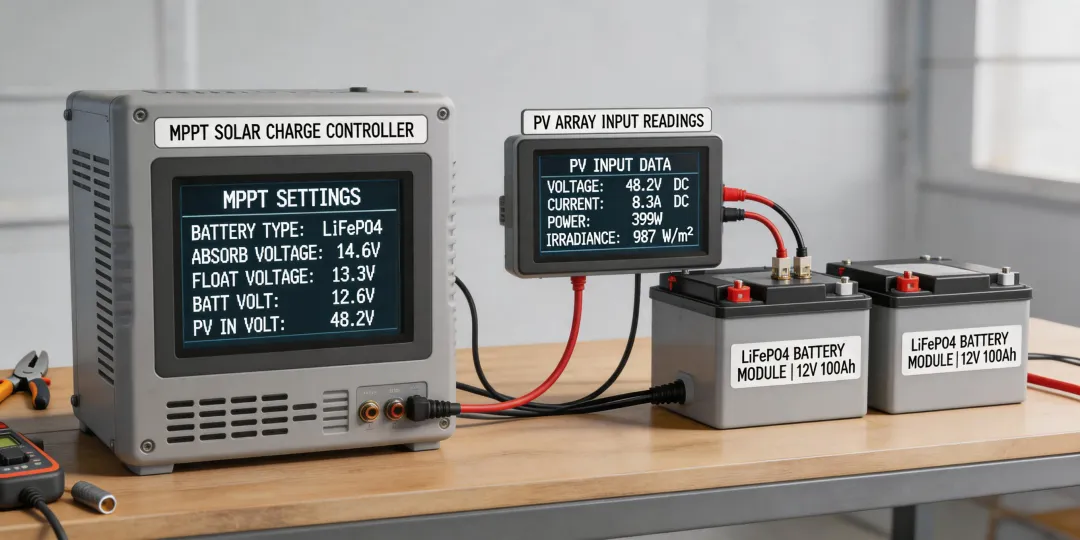
This comparison is simple: one-box solar generator vs. component-built off-grid system. The component side uses an EPEVER Tracer MPPT, the EPEVER app, an Apollo Power flexible solar panel, and an EVE LiFePO4 battery. Both paths can cool a room. But they fail in different ways—and one of those ways is usually a surprise. (note to self: always check LRA before saying yes).
Dimension 1: AC Load Handling — Continuous Watts vs. Surge
Solar generator marketing often says ‘runs AC.’ That sentence hides two numbers: running watts and surge. A 5,000 BTU window unit might run at 450–600W but start at 1,200–1,800W. A 12,000 BTU portable AC might run at 1,000–1,200W and surge to 2,500–3,500W. Central AC is a different animal.
A solar generator with 3,000W continuous and 6,000W surge can handle a small AC. A component system with a pure sine wave EPEVER inverter and a properly sized battery can do the same. But here’s the part people miss: the EPEVER Tracer MPPT is a solar charge controller, not an AC output device. The inverter runs the AC. If someone says the Tracer MPPT alone runs an air conditioner, that is wrong. (ugh).
In March 2024, we rejected a batch of 200 MPPT controllers because the LiFePO4 charge profile was off by 0.3V against our ±0.1V spec. The vendor called it ‘within industry standard.’ We rejected it, and they redid it at their cost. AC loads demand the same discipline. If the inverter cannot hold surge, the AC will not start reliably. No app can fix that.
Dimension 2: Battery Chemistry and Settings — EVE LiFePO4 vs. Prebuilt Packs
Prebuilt solar generators use proprietary lithium packs. Convenient, but you get what they give you. A component build with EVE LiFePO4 cells gives you capacity choice, serviceability, and usually better cycle life if you pair a good BMS. But raw EVE cells are not plug-and-play. You need a BMS, correct charge voltage, and low-temp cutoff.
The EPEVER Tracer MPPT has flexible battery settings, including LiFePO4 profiles. You can set absorption, float, and turn off equalization. That matters. I learned this after ignoring a supplier’s ‘drop-in’ claim once and watching a bank drift out of balance after three months. It cost about $800 in replacement cells and a weekend. Not catastrophic, but avoidable.
So: prebuilt means less wiring and less control. EVE LiFePO4 plus EPEVER means more control and more responsibility. If you want to run AC daily, control wins. If you want a weekend outage covered, prebuilt wins.
Dimension 3: Solar Input Flexibility — Apollo Power Flexible Panels vs. Rigid
An Apollo Power flexible solar panel is useful when mounting space is curved, weight-limited, or odd-shaped—van roofs, boat decks, temporary shade structures. The tradeoff is heat. Flexible panels often sit close to the surface, and heat reduces output. In a side test we ran in 2024, same nominal wattage, flexible panels were about 8–12% lower on a hot afternoon than rigid panels with an air gap. Morning and evening, the gap was smaller.
If you need AC, do not just match panel watts to load. Overpanel by 20–30% if using flexible panels, or add a tilting rigid panel. The EPEVER Tracer MPPT helps here because MPPT tracks the maximum power point. When panels heat up and voltage drops, it can still harvest more than PWM. The EPEVER app lets you check solar yield, battery voltage, and load status without climbing on the roof. That is not a luxury when you are troubleshooting an AC that cuts out at 3 p.m. (been there).
Dimension 4: Monitoring and Control — EPEVER App vs. Solar Generator App
Solar generator apps are simple. They show battery percentage, input watts, and output watts. Great for non-technical users. But they hide settings. You often cannot change charge voltage, set load disconnect, or see detailed solar history. The EPEVER app with a Tracer MPPT gives you more: charge stage, PV voltage, battery temp with sensor, load control, and parameter changes. It is not as pretty, but it is a tool, not a toy. If you are running an AC and need to know why it tripped, detailed data matters.
Conventional wisdom says the simplest app is best. My experience with 200+ support tickets suggests otherwise: when something fails, users want detail. The simple app says ‘fault.’ The EPEVER app says ‘battery low voltage disconnect at 11.8V under 1,200W load.’ One of those helps you fix it.
Dimension 5: Time Certainty — One Box vs. Component Build
Here is where the time certainty premium shows up. If a heat wave is coming and your AC needs to run now, a solar generator is one shipment, one warranty, one manual. A component build with an EPEVER Tracer MPPT, EVE LiFePO4 battery, Apollo Power flexible solar panel, BMS, inverter, fuses, and cables is multiple shipments and many compatibility checks. In March 2024, we paid $400 extra for rush delivery on a prebuilt unit because the alternative was missing a $15,000 event. That $400 bought certainty, not just speed.
Component builds can cost less per kWh and be better long-term, but only if you have time. If your deadline is tight, ‘probably compatible’ is the biggest risk. I have seen a $120 deal inverter fail to start a 12,000 BTU AC, then cost $300 in return shipping and a night in a hot room. The cheap option was not cheap.
So, Can a Solar Generator Run an Air Conditioner?
Yes—if the continuous and surge ratings match your AC’s locked rotor amps. But ‘can’ is not ‘will run all day.’ Runtime equals usable battery kWh divided by AC running watts. A 2 kWh battery at 1,000W AC load gives about 1.5–2 hours with inverter losses, less if the compressor cycles. To run overnight, you need roughly 5–10 kWh and enough solar to recharge.
Choose a one-box solar generator if:
- You need short outages covered.
- You want one warranty and a simple app.
- You need it this week and cannot wait for parts.
- You do not want to configure charge profiles.
Choose a component build with EPEVER Tracer MPPT, EPEVER app, EVE LiFePO4 battery, and Apollo Power flexible solar panels if:
- You need daily AC or heavy duty cycles.
- You want to expand battery and solar later.
- You can handle BMS, fusing, and settings.
- You want detailed data and control.
My quality-inspector bias: for critical cooling, do not buy on price alone. Buy the spec that matches the load, and buy certainty if the deadline is real. This was accurate as of Q1 2025. Battery, inverter, and panel specs change fast—verify current LRA, continuous output, and LiFePO4 charge settings before you buy.