-
Who This Checklist Is For
-
Step 1: Run the load audit before you open a single vendor PDF
-
Step 2: Size the MPPT controller against cold-temperature Voc, not the panel's sticker
-
Step 3: Read the LiFePO4 spec sheet like a suspicious accountant
-
Step 4: Confirm the controller firmware supports your chemistry — and your settings
-
Step 5: Build a TCO sheet, not a price sheet
-
Step 6: Verify certifications against your jurisdiction — as of the current code cycle
-
Step 7: Order a pilot unit before you commit to a container
-
Step 8: Log every spec, quote, and test result in one place
-
Notes Before You Order
Who This Checklist Is For
If you're an installer, integrator, or distributor speccing domestic solar energy storage systems for the first time — or you've done a dozen and still get surprised by the final invoice — this is the sequence I run before I sign anything. Eight steps. Roughly two hours in a spreadsheet. It's how we quote residential storage projects without eating a change order in month three.
It doesn't cover rooftop mounting or permit paperwork. Different checklist, different headache.
Step 1: Run the load audit before you open a single vendor PDF
Most buyers start by browsing battery catalogs. That's backwards. Load profile first — continuous draw, peak draw, daily kWh, and how many days of autonomy the customer actually wants when the grid's down for three days straight.
You can pull irradiance data from a google solar system query (Project Sunroof and similar tools give you a rough production estimate per roof), but treat that as scenery, not spec. It tells you what the array might produce. It says nothing about what the house consumes at 7 a.m. in February.
Write the numbers down. Date them. You'll reference them for every step after this one.
Step 2: Size the MPPT controller against cold-temperature Voc, not the panel's sticker
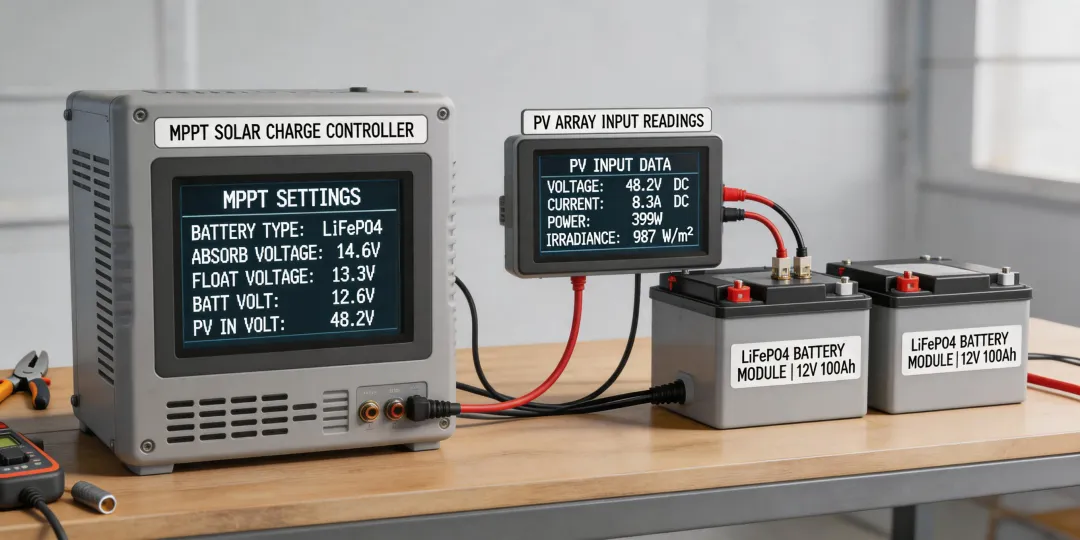
Here's the thing: a lot of installers size an epever mppt controller by adding up panel watts and dividing by nominal voltage. That works on paper and fails on the roof.
Panel Voc rises as temperature drops. A 400W panel rated at 49V at STC can hit 55V at -10°C. Three in series, and you're at 165V — inside the controller's 150V limit? No. That's a warranty claim waiting to happen.
Check three things before you order:
- Series string Voc at your region's recorded minimum temperature (not "typical winter").
- Battery bank voltage the controller will actually see under load — a 48V nominal pack sags well below 48V under heavy draw.
- Whether the current rating covers the array's Isc with a 25% derate for cloud-edge effects (the brief spike when the sun pops out from behind a cloud).
A 40A controller is not "close enough" to a 45A array. Serviceable, yes. On a bad day, no.
Step 3: Read the LiFePO4 spec sheet like a suspicious accountant
The epever 48v 100ah lithium battery, for example, is spec'd at 5.12 kWh nominal. That's the headline. The number that actually matters for your TCO is what's left after the BMS derates for discharge rate, depth of discharge (DoD), and temperature.
The question everyone asks is "how many kWh?" The question they should ask is "how many usable kWh at 0.5C, 80% DoD, at 0°C?"
Two identical-looking 48V 100Ah packs can differ by 15-20% in real deliverable energy once you account for BMS cutoffs and C-rate. That's not a rounding error. On a 5 kWh system, it's the difference between running the fridge overnight and not.
Step 4: Confirm the controller firmware supports your chemistry — and your settings
"Lithium compatible" on a datasheet is a marketing phrase until you read the actual charge profile menu. LiFePO4 wants a specific absorption voltage range (typically 3.45–3.65V per cell, so 55.2–58.4V for a 16S pack). Some controllers ship with a generic "lithium" preset that runs slightly hot, and some users report reduced cycle life after a few years of that.
What you want:
- Named LiFePO4 profile, not just "lithium".
- User-definable absorption, float, and equalization-disable.
- Temperature compensation that you can turn off for lithium (lead-acid needs it, LiFePO4 generally doesn't).
If the manual doesn't spell this out, email support before you buy. A one-line reply from a human tells you more than a spec sheet.
Step 5: Build a TCO sheet, not a price sheet
This is the step people skip, and it's the one that bites. Unit price is maybe 60% of the total. The rest hides in plain sight:
- Shipping (lithium cells ship as dangerous goods — the surcharge is not small).
- Import duty and customs clearance (varies by region; check current rates).
- BMS communication cable and monitoring dongle (often not included).
- Commissioning labor — first-time lithium setup is not a 20-minute job.
- One spare controller and one spare BMS board per site, if uptime matters.
In Q3 2024 I compared two quotes on a 15 kWh residential system. Vendor A: $6,800 all-in. Vendor B: $5,900 plus $340 freight, $210 customs handling, $180 for the monitoring kit, and a 4-week lead time that blew a client milestone. Vendor B came in $830 more expensive and one month late.
The lowest quoted price often isn't the lowest total cost. Build the sheet.
Step 6: Verify certifications against your jurisdiction — as of the current code cycle
This isn't my expertise, and I won't pretend otherwise. I'm not a compliance engineer. What I can tell you from a procurement seat is that the certification list changes, and a unit that was fine last year may not be fine today under a new local requirement.
Get the current certificates in writing, from the vendor, dated. Don't accept a website badge. Check: UL 1741 (inverters), UL 9540 or UL 9540A (energy storage systems), IEC 62109 (charge controllers), and whatever your AHJ is asking for this quarter. Verify current requirements with your local authority before you commit to a pallet of hardware.
Step 7: Order a pilot unit before you commit to a container
This is where the small-order question comes up, and it's the step most procurement teams refuse to take.
Look — small doesn't mean unimportant. It means potential. When I was building our vendor list years ago, the suppliers who took my $200 test order seriously — returned emails, sent a real invoice, hit the delivery date — are the ones I still use for $20,000 POs six years later. The ones who brushed me off because I "wasn't big enough" never got a second call.
So when you're evaluating a new controller or battery line, order one. Install it. Run it through a full charge/discharge cycle. Watch how fast support answers a stupid question. If you're the small buyer here, you're allowed to insist on this. If you're the vendor reading this — that's the whole game.
Step 8: Log every spec, quote, and test result in one place
If you don't, you'll re-litigate the same decision next quarter and lose the comparison history. Six fields per unit is enough: model, price, spec-sheet numbers, test result, support responsiveness, and a one-line "would I order again" verdict.
Invoices and memory disagree often. The log wins.
Notes Before You Order
Common mistakes I've seen (and made):
- Sizing the controller to panel wattage instead of string Voc at minimum temperature.
- Assuming "lithium ready" means "LiFePO4-ready." Different things.
- Forgetting the dangerous-goods shipping surcharge in the budget.
- Buying one extra controller but zero spare BMS boards. Guess which one fails first.
- Comparing kWh stickers without asking about DoD and C-rate.
The "lithium is too expensive" thinking comes from an era when cells cost $800/kWh and cycle life was speculative. That's changed. As of 2025, LiFePO4 is often the cheaper option on a 10-year TCO basis for residential storage — not the premium one.
So is it the best residential battery storage option? Depends on the load profile you wrote down in Step 1. If you skipped Step 1, no chemistry is going to save you.
Run the checklist. Then order.