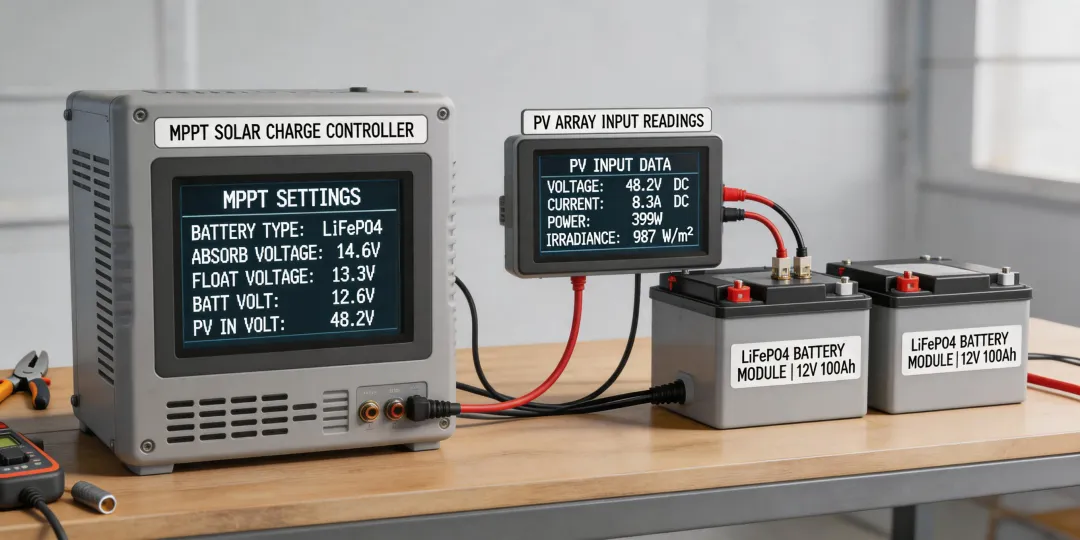
Just so we’re clear: this is not the Snapchat best friends solar system post. If that’s why you found this page, there are friend-planets and emoji rankings, and that’s not what you’re going to get here. The solar system I work with is the one on a roof or inside an off-grid power shed—panels, batteries, wires, and the charge controller trying to keep everything balanced.
I’m a technical support lead for a renewable energy distributor. I’ve handled more than 100 rush orders in the past five years, including same-day turnarounds for sites with penalty clauses and no backup power. This piece is not a generic MPPT vs PWM explanation. It’s a comparison between the EPEVER Tracer 4210AN 40A MPPT and the cheaper 40A PWM controllers that still get sold with lithium batteries.
In March 2025, I had to help an installer replace a failed controller 36 hours before a remote site was due to come online. The original controller was a 40A PWM unit. The battery was a 12V LiFePO4 bank. The installer said the controller had a lithium profile, but the BMS kept disconnecting. The swap we sent included an EPEVER Tracer 4210AN. The fix wasn’t overnight shipping—it was a charge controller that let us set the actual absorption voltage to what the battery manufacturer wanted.
What I’m Comparing and How I Judge It
On one side: the EPEVER 40A MPPT solar charge controller, specifically the EPEVER Tracer 4210AN 40A MPPT. On the other side: a basic 40A PWM controller. I’ve stocked, sold, and replaced both.
The comparison isn’t about brand loyalty. I use three criteria:
- How much usable energy gets into the battery in real weather.
- How safely it charges modern lithium batteries.
- What happens when a controller failure turns into an emergency.
If that seems too obvious, stick around. One of the three results will surprise you.
Energy Harvest: The MPPT Advantage Is Real, But Context Matters
A PWM controller connects the solar panel to the battery almost directly. When your battery is 13.5V and your panel is capable of producing 18V at its maximum power point, the PWM controller cannot use the extra voltage. The panel gets pulled down and you lose part of the available power. MPPT handles that properly: it tracks the panel’s maximum power point, and it converts the higher panel voltage into extra charging current.
In my experience, cold, cloudy, or partially shaded conditions make MPPT more useful. How much gain does it give? I won’t pretend to give you a universal number. Some days I see 10 percent improvement, and some cold winter days it feels much higher. If someone promises a fixed 30 percent, they’re guessing.
Conclusion: MPPT wins for most battery charging, but only if your system actually produces enough surplus energy to justify it.
Lithium Charging: Where the EPEVER Tracer 4210AN Earns Its Keep
Most of the emergency calls I get are not because the controller failed. They’re because the controller couldn’t be told what kind of battery it was connected to.
If you bought a lithium battery, you’ve probably seen UN 38.3 on the spec sheet. A lot of installers search for the UN 38.3 lithium battery Wikipedia page, because it seems like the standard that confirms the battery is good enough to install. It is a transport safety standard. It covers tests that make sure a lithium battery can survive shipping without catching fire. It does not tell you the correct charge voltage for your specific battery.
That distinction matters. Fixed lead-acid profiles often push 14.4V absorption for hours, and some LiFePO4 batteries will disconnect through their BMS at lower voltages or after a voltage threshold. Then the controller sees no battery, and strange things happen.
The EPEVER Tracer 4210AN is a 40A MPPT controller that lets an installer override the standard sealed/gel/flooded settings and use user-defined charging parameters. For me, that is the main reason to choose it for lithium.
How to charge a lithium battery with the EPEVER Tracer 4210AN
Here is the simplified process I use for most 12V LiFePO4 off-grid batteries:
- Find the real voltage specification from the battery manufacturer.
- Use the User battery type on the controller and enter those numbers.
- Set the absorption/bulk voltage to the manufacturer’s charge recommendation, typically 14.2V to 14.6V for a 12V LiFePO4 battery.
- Set float voltage to around 13.6V to 13.8V if the battery datasheet calls for a float stage. Some lithium batteries don’t want continuous float, so keep the datasheet close.
- Disable equalization or set it to zero. LiFePO4 cells do not need routine equalization.
- Check the maximum charge current. A 40A controller can push 40A into the battery. If your battery pack is rated for only 20A charging, you need to adjust the array or the controller settings so you stay within that limit.
- Connect the battery before connecting the solar panels, so the controller starts with a clean battery voltage reading.
I should add that the Tracer 4210AN is designed for 12V and 24V battery banks. If you are building a 48V off-grid system, this model is not the right controller, no matter how much you like the price.
Conclusion: For lithium, the EPEVER Tracer wins because voltage setpoints can be changed, while the typical PWM controller cannot adapt.
Cost and Emergency Risk: The Answer That Might Surprise You
Here comes the part that makes some distributors uncomfortable. If all you need is a small system with one panel and a lead-acid battery that rarely gets deeply discharged, you don’t need an MPPT controller. A simple PWM controller works fine. MPPT’s energy advantage in that case might only produce a few extra watt-hours per day—not enough to pay for the price difference. I have recommended cheap PWM controllers to small customers many times.
But if the system powers critical loads, uses lithium batteries, or runs all winter, the cheapest controller can become the most expensive repair you ever ship. A fixed profile may overcharge or undercharge the battery. A 40A MPPT solar charge controller with configurable setpoints gives you a margin of safety. In an emergency, I can configure the EPEVER Tracer quickly without reading a thick manual.
That’s what my 100+ rush orders taught me: hardware reliability is only half the battle. The other half is whether the controller can be made to match the battery chemistry on site.
Conclusion: PWM wins the upfront-price argument in tiny lead-acid systems. The EPEVER Tracer 4210AN wins when you need predictable charging, lithium compatibility, and remote support.
Which One Should You Buy?
Use a small PWM controller if:
- Your battery is lead-acid and your panels are small.
- Your loads are simple and a few days of poor charge won’t kill anything.
- You value low upfront cost above long-term efficiency.
Choose the EPEVER Tracer 4210AN 40A MPPT or another configurable MPPT if:
- You are charging LiFePO4 or lithium batteries and want the battery manufacturer’s voltage settings respected.
- Your panels face cold winters or partial shade.
- You’re building a 12V or 24V system with 300W or more of panels and you expect it to actually run loads.
- You are a small contractor and want equipment that won’t create an emergency call a month after installation.
That last one matters to me, both as a support person and a buyer. I still remember how it felt to be the small client. The distributor who treated my single controller order seriously is the distributor I stayed with. Small doesn’t mean unimportant, and a one-off sale might become a 20-site roll-out next year.
If you take one thing from this article: UN 38.3 is about shipping lithium safely. You still need a controller that can charge it correctly. The EPEVER 40A MPPT does that because it doesn’t force one lithium profile on every battery. It gives you control—and when you’re in a hurry, that’s exactly what you need.