-
EPEver 20A MPPT vs PWM: What Actually Matters for Small Off-Grid Systems
-
1. Charge Harvest: MPPT vs PWM
-
2. Battery Compatibility: LiFePO4 Settings
-
3. Safety, Standards, and Documentation
-
4. Monitoring and Support
-
5. Total Cost: Controller vs Home Battery System
-
Selection Advice: EPEver 20A MPPT or PWM?
EPEver 20A MPPT vs PWM: What Actually Matters for Small Off-Grid Systems
I am a quality and brand compliance manager at a renewable energy distributor. I review every product spec and marketing claim before it reaches customers—roughly 200+ items annually. Maybe 180, I'd have to check the system. If I remember correctly, we rejected around 18% of first deliveries in 2024, though I might be misremembering the exact number. The main reasons: mismatched lithium profiles, inflated MPPT claims, and missing certification files.
This is a comparison-driven look at two options for small off-grid systems: an EPEver 20A MPPT charge controller (Tracer series) and a PWM controller. I am using a 30Ah LiFePO4 battery as the common battery because that is where installers get burned. I will also touch on solar panel information and how much a home battery system costs, because those questions usually arrive together.
The short version: MPPT and PWM are not the same product with a different label. The right choice depends on panel voltage, battery chemistry, monitoring needs, and total system cost.
1. Charge Harvest: MPPT vs PWM
A PWM controller connects the solar panel almost directly to the battery. If the panel is 18V and the battery is 12V, the extra voltage is mostly lost. An MPPT controller (maximum power point tracking) converts that extra voltage into additional current. With a 100W panel and a 12V battery, the difference can be meaningful—especially in cold weather when panel voltage rises.
People think MPPT costs more because it is better. Actually, the better harvest comes from the DC-DC conversion and firmware tracking. The higher price is a consequence of the extra inductor, capacitors, thermal design, and testing. The causation runs the other way.
The surprise wasn't the price difference. It was how often a 30A PWM controller delivered less usable charge than an EPEver 20A MPPT in real winter conditions. Amp ratings matter, but so does voltage headroom.
For a 30Ah LiFePO4 battery, MPPT is probably the better fit if your panel is above 15V and you want to maximize charge on cloudy days. PWM might be acceptable for a tiny 10W panel and a lead-acid battery, but that is a different system.
2. Battery Compatibility: LiFePO4 Settings
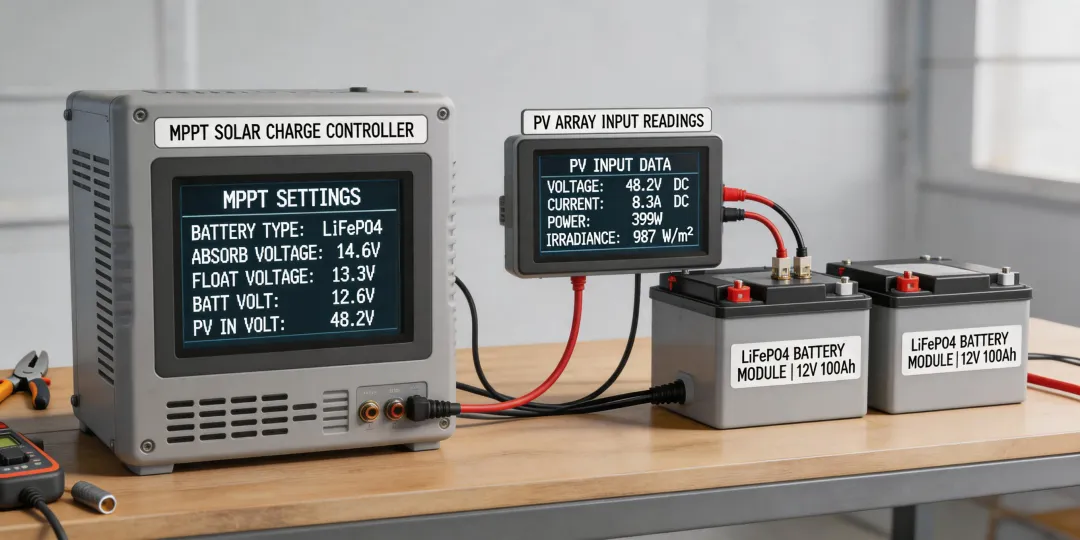
This is where I see the most returns and support calls. A 30Ah LiFePO4 battery needs a charge profile: absorption voltage (the constant-voltage stage before float), float voltage, and no equalization. Many PWM controllers only offer lead-acid profiles or a crude user setting. Some EPEver Tracer MPPT solar charge controllers include lithium profiles and user-defined settings, but you still need to verify the exact model and firmware.
The most frustrating part of vendor management: 'lithium compatible' often means the controller has a user-defined profile, not a tested LiFePO4 preset. You'd think compatible means you can select LiFePO4 and walk away, but often you have to enter absorption and float voltages manually (ugh, again).
Saved about $50 by using a PWM controller without a proper LiFePO4 profile. Ended up spending $180 on a replacement 30Ah LiFePO4 battery after the BMS kept disconnecting during charge. The root cause was likely an incomplete absorption stage and cell imbalance—not a defective battery. The 'cheaper' controller choice looked smart until the customer lost a weekend of power.
If you use an EPEver 20A MPPT or an EPEver Tracer MPPT solar charge controller, check the battery manufacturer's spec. For a 12V LiFePO4 battery, absorption is often around 14.2–14.6V and float around 13.5–13.6V. Do not rely on generic lead-acid defaults.
3. Safety, Standards, and Documentation
For B2B installers and distributors, documentation is not paperwork—it is risk control. IEC 62509:2010 covers performance and functioning for photovoltaic battery charge controllers. UL 1973 is the standard for batteries used in stationary applications. NEC 690 covers PV electrical installations in the US. These are not marketing slogans; they are the baseline for a system that can be inspected and insured.
Per IEC 62509:2010, battery charge controllers for photovoltaic systems have defined performance and functioning requirements. Verify the specific model's certificate and the edition that applies in your jurisdiction.
A PWM controller with no certificate file is a hard stop in our incoming quality audit. An EPEver Tracer MPPT unit with documented specs is easier to approve, but I still check the exact model number, firmware version, and lithium profile. I am not 100% sure every EPEver model has the same profile options, so always confirm before ordering 500 units.
4. Monitoring and Support
An EPEver 20A MPPT usually gives you more data: PV voltage, battery voltage, charge current, and often RS485/Modbus for remote monitoring. That data matters when a customer calls about a 30Ah LiFePO4 battery that is not charging. With a basic PWM controller, you might only get LEDs. You cannot diagnose from a red light.
In our Q1 2024 quality audit, the top support issue was not controller failure. It was misdiagnosis because the controller gave no useful data. Installers replaced batteries that were fine. Distributors ate the return shipping. That cost us maybe $3,000—no, $4,000, I'm mixing it up with another project.
If you are a system integrator, choose a controller that supports the monitoring layer your customer expects. If you are a distributor, check whether the EPEver Tracer MPPT solar charge controller you stock can be updated and documented.
5. Total Cost: Controller vs Home Battery System
How much is a home battery system? That question is too broad without capacity and installation scope. A small off-grid cabin with a 30Ah LiFePO4 battery, a 100W panel, an EPEver 20A MPPT, and a small inverter might be a $400–$700 hardware project. A 5–10 kWh whole-home battery system is a different category.
As of January 2025, hardware for a 5 kWh LiFePO4 home battery system often starts around $3,000–$6,000. Installed whole-home systems with inverter, transfer equipment, permits, and labor commonly range from $10,000–$20,000+. Verify current pricing with local installers and check available incentives. I do not quote market averages without checking current sources.
The controller is typically 2–5% of the total system cost. Saving $40 on a PWM controller to protect a $150 30Ah LiFePO4 battery might be fine. Saving $40 to risk a $5,000 battery bank is not. That is the penny-wise, pound-foolish pattern I see most often.
Solar panel information matters here too. A 100W panel with a low-voltage PWM controller may underperform compared to the same panel with MPPT. If you are comparing quotes, compare the charge controller, battery chemistry, and panel voltage—not just the headline price.
Selection Advice: EPEver 20A MPPT or PWM?
There is no universal winner. Use the scenario to decide.
- Choose an EPEver 20A MPPT or EPEver Tracer MPPT solar charge controller if: your solar panel voltage is well above battery voltage, you use a 30Ah LiFePO4 battery or larger lithium bank, you need monitoring/RS485, or you want better harvest in cold and cloudy conditions.
- Choose PWM if: you have a very small panel close to battery voltage, you use a basic lead-acid battery, you do not need data, and the system is truly low-stakes.
- Verify either way: lithium charge profile, voltage setpoints, temperature compensation, certification file, and firmware version.
When I switched from budget PWM controllers to documented MPPT units for our lithium kits, customer support tickets dropped noticeably. The cost increase was small per system. The brand perception improvement was not.
Quality is not an abstract ideal. It is what the customer sees when the system works on day one and still works after a week of clouds. A 30Ah LiFePO4 battery and an EPEver MPPT controller are not the whole system—but they are often the parts that decide whether the customer trusts the installer again.