Two Things Called a Solar System
Type "solar system" into a search engine and you can end up in two completely different places. Mars—the red planet behind a lot of "solar system mars planet color" searches—gets its reddish color from iron oxide. Just plain rust. The Milky Way, another one of those solar system searches, is a barred spiral galaxy roughly 100,000 light-years wide, holding a few hundred billion stars. The other kind of solar system is the one on a client's roof: a few panels, a charge controller, and a battery bank doing its best to run a cabin or a house.
Both run on the sun. That's about where the similarity ends.
I'm the quality compliance manager at EPEver. I've spent the last four years reviewing controller specifications, battery compatibility documentation, and field failure reports before they reach our distributors—roughly 200+ unique product configurations per year. In Q1 2024, I rejected 2.3% of first-pass production documents for spec sheet inconsistencies. Overly optimistic derating curves are a particular pet peeve of mine. So when a system integrator asks whether to spec an EPEver component stack or a Tesla Powerwall 3, I bring a specific set of questions: what exactly are we promising, and will it survive contact with a real installation?
Here's the framework I use when I have to make that call:
- Cost transparency — where the money goes, and what's hidden
- Flexibility — how much the system adapts to the actual site
- Spec integrity — whether the 20A MPPT rating is real or just printed on a label
- Repairability — what a failure actually costs in time and money
This looks like a quality audit because it is one. A purchase decision should be an audit.
Cost Transparency: The Numbers, and What They Hide
Let me answer the direct question first: how much does a Tesla Powerwall 3 battery cost? Based on publicly listed pricing in early 2025, a standard Powerwall 3 installation runs roughly $15,000–$20,000, including gateway, permits, and typical labor. Multi-unit configurations go higher. It's a complete energy storage appliance: battery, inverter, monitoring, cooling, and software in one sealed unit.
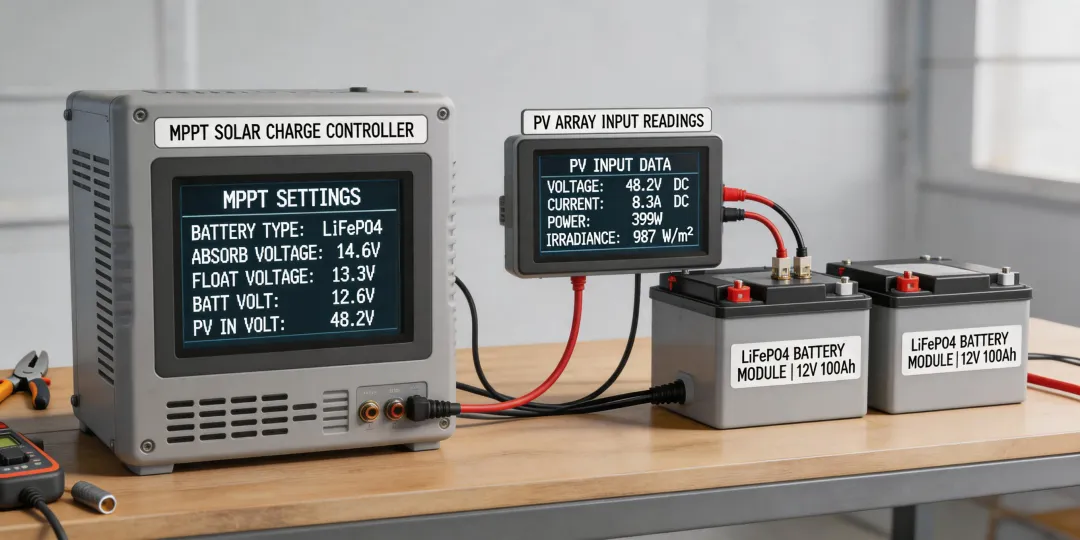
Now the EPEver side. A 10A EPEver MPPT charge controller—the Tracer AN series—lands around $70–90. The EPEver 20A MPPT solar charge controller runs about $110–140. A 40A unit stays under $200. Pair one of those with an EPEver LiFePO4 battery bank and a suitable inverter, and you can build a fully functional off-grid system for $2,000–$5,000, depending on battery capacity. Upfront, it's not close.
But here's the part that cost me a few bad recommendations to learn. The numbers said "EPEver stack wins, no contest." My gut said something was off. What was off? I wasn't counting engineering time. A component system needs to be sized, voltage-matched, and commissioned. On a small cabin, that's 10–20 hours for a competent installer. At a modest $75/hour, you're adding $750–$1,500 of labor to that $2,000–$5,000 stack.
Does the EPEver system still win on cost? Yes—but the margin is closer than the sticker comparison suggests, typically 50–60% below the Powerwall for a small off-grid site, not 75%. The counterintuitive part is that the cheaper system is still cheaper after real accounting—it just doesn't look as dramatic on a napkin.
Price references: EPEver controller pricing based on public listings, January 2025. Powerwall 3 pricing based on publicly available US quotes, early 2025. Installer labor varies by region; the $75/hour figure is a planning estimate, not a quote.
Flexibility: Does It Grow With the Client?
A Powerwall 3 is a sealed energy appliance. That's a feature. One vendor to call, one warranty, one app, and it works out of the box with the Tesla ecosystem. But there are real constraints: you can't choose the cell chemistry, can't adjust charge curves, and you can't expand the system piece by piece. Need more capacity? You're buying a second Powerwall—roughly $10,000+ per additional unit.
EPEver controllers ship with configurable profiles for lead-acid, gel, AGM, and lithium batteries—including LiFePO4, which is where the market has moved. You set your own absorption voltage, float voltage, and low-voltage disconnect. This was true for lead-acid five years ago, when lithium support was still a canned profile you couldn't touch. That's changed. Lithium settings today are fully programmable, not just a label that says "lithium."
Why does this matter for an installer? Because the system will change. Clients add panels. They replace battery banks after a hard winter. With an EPEver 10A MPPT controller, you upgrade to a 20A unit—or run a second unit in parallel—without touching the wiring or the rack. The infrastructure stays. With a Powerwall 3, "expansion" rhymes with "replacement" unless the budget accommodates a whole extra unit.
This is the dimension where the component side deserves a dose of honesty: more configurability means more ways to misconfigure. A Powerwall basically can't be misconfigured because you can't configure it. The EPEver answer to that is documentation and conservative defaults. But as a quality person, I'll acknowledge that both are real product design choices with real tradeoffs.
Spec Integrity: When the Label Lies
This is where I'm pickiest, and I'll own that bias. In four years of reviewing MPPT controllers, I've rejected more datasheets than I can count for one recurring sin: optimistic derating.
A cheap "20A" controller might pass 20A at 25°C in a lab, then derate to 14A at 45°C inside a sun-blasted enclosure. On the hottest, sunniest days of the year—exactly when a system needs to work hardest—it throttles. Or it doesn't throttle and quietly cooks its own components. EPEver's approach is to publish the derating curve and rate conservatively. The EPEver 20A MPPT solar charge controller is designed to sustain 20A at realistic operating temperatures, not just at room temperature with a desk fan on it.
The Powerwall 3 is a different quality model entirely. It's a closed box, so there's no datasheet rabbit hole. Tesla specifies 13.5 kWh usable energy and around 11.5 kW of continuous power output—measurable claims made by a company with a lot more legal exposure if those numbers were wrong. What you can't do is inspect the cells, the BMS, or the inverter, or substitute any of them. Quality control is delegated entirely to Tesla.
I don't think that's automatically worse. But it's a different kind of trust, and I want integrators to recognize which one they're buying. EPEver gives you enough information to do your own verification; Powerwall gives you a sealed guarantee instead. Both can be true quality products. They just ask the buyer to trust in different things.
Repairability: Cold Swap vs Sealed Brick
Let's talk about failure—because if you're installing systems for a living, you think about failure more than you admit to clients.
With an EPEver component stack, every part has a line-item replacement cost. A 20A MPPT controller dies? It's around $110 and a 15-minute swap. A LiFePO4 module underperforms? You replace the module—not the whole bank. The client's system is down for an afternoon, not a month.
With a Powerwall 3, a failure—even a rare one—means the sealed unit gets serviced or replaced. Tesla's warranty handles the cost, but downtime is scheduled around technicians, shipping, and permits. If the system is at a remote cabin 40 road-miles from anywhere, that difference outweighs every watt-hour spec in the datasheet.
The counterargument, and it's a fair one: integrated systems genuinely reduce the number of failure points. Fewer components means fewer things to break, and remote monitoring means a lot of faults can be diagnosed before anyone drives out. But "fewer components" and "impossible to service" have a similar shape at the point of failure. One is simplicity; the other is a sealed brick with a warranty. They're not the same thing.
Which One Should You Actually Spec?
I'm not going to give you a one-line "pick EPEver" answer, because it would be wrong for a chunk of real clients.
Spec the EPEver component system when:
- The site is off-grid and remote, where cold-swap repairability isn't a luxury—it's the difference between lights and no lights.
- The client's load will grow within 3–5 years.
- You need battery flexibility, especially LiFePO4, and want to set your own voltages instead of accepting a canned profile.
- The budget is staged. A 10A EPEver MPPT system can run a shed today and grow into a 20A system next year without re-wiring everything.
- You want your own engineering to be visible in the final result—not hidden behind a glossy cover.
Recommend the Tesla Powerwall 3 when:
- The site is grid-tied and "it just works" is the top priority.
- The client wants exactly one warranty, one app, one number to call.
- There's no appetite for commissioning complexity, and the budget comfortably covers the premium.
- Local permitting or HOA requirements favor a certified, pre-packaged energy system over a custom assembly.
Honestly, I went back and forth on this recommendation for a few weeks after drafting it. What if I was just defending my own engineering bias? Watching the service records from a year of clients settled it: both types occasionally fail, but they fail differently. The question is never "which never fails"—it's "which failure can your client survive."
For a suburban homeowner, the Powerwall 3 is often the right call. For a remote off-grid site with a growing load list, an EPEver stack isn't the "budget alternative." It's the engineering-grade alternative.
Mars is red because of iron oxide—rust, a material failure. It's also a reminder that even in the literal solar system, materials matter. The Milky Way, over 13 billion years, accumulated what worked and discarded what didn't. That's actually a decent metaphor for building energy systems: spec components you can trust, verify what you can measure, and let the system prove itself over time.