Last week, a junior installer asked me how many asteroids are in our solar system. According to NASA/JPL data I last checked in January 2025, the known count is above 1.3 million. I like that question because it has a single, verifiable answer. The same cannot be said for which MPPT controller should go on a purchase order. But after four years of procurement data and warranty records for a regional solar integrator, I have a practical second-best answer: If LiFePO4 batteries are in the bill of materials, choose the charge controller before the batteries. When the voltage range matches, the EPEver Tracer MPPT series is the default on our spec sheet.
That choice looks simple, but it took real pain to learn. A controller that lacks a true lithium profile can shorten the life of a $2,500 LiFePO4 battery bank by maybe a third. Spending an extra $150 on a controller that supports that chemistry is a small fraction of one avoided replacement.
Where I am coming from
I manage procurement for a 42-person off-grid solar company in the Southwest. We install roughly 100 systems per year and service another 200 off-grid sites under annual contracts. Since early 2021, I have controlled about $4.8 million in component spend, processed more than 600 purchase orders, and logged every invoice in the same cost tracking system. I am an accountant of the process, not the lead engineer. That is exactly why field failures bother me: they show up on a worksheet.
When I audited our 2023 callbacks, 13% involved charging parameters. Many of those sites had LiFePO4 batteries connected to controllers that did not have usable lithium settings. The fix was not always replacing hardware, but several times it was. That audit led to a simple policy: if a quote says LiFePO4, the charge controller must support that exact chemistry.
Two myths that keep showing up in the field
Myth 1: A good lead-acid charger can charge lithium
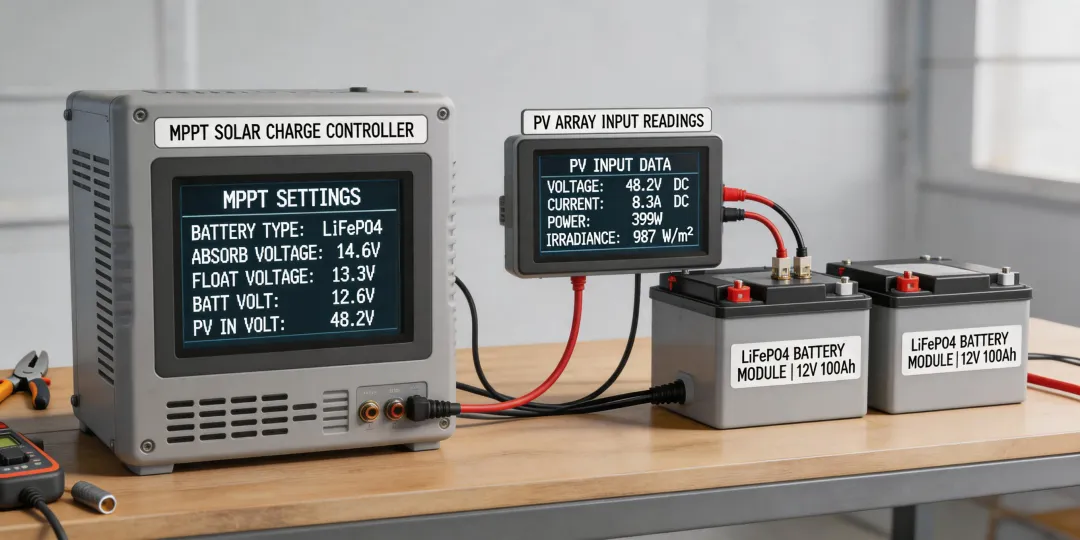
This belief is a leftover from the pre-lithium era. Fifteen years ago, almost every off-grid bank was flooded lead-acid and most controllers used the same basic three-stage profile. Today, a LiFePO4 pack has a different voltage window, typically around 14.2V to 14.6V for a 12V battery, and it does not want a long equalization stage. A charger built for lead acid can push too high or stop too early. It might run for a year before the pack loses capacity. The charger is then the silent culprit.
Myth 2: A higher price means better electronics
People often think the price causes the performance. It does not. Products that cost more usually involve more engineering time, more testing, and clearer manuals. The price tag is the result of that effort. When I stopped guessing from price and started comparing field failure rates, a few cheaper units stayed cheap, and a few expensive units were not worth the margin. The deciding factors were not the logos.
What I look for before writing a quote
Today I compare controllers against a short checklist: a real MPPT algorithm rather than a PWM controller with a good paint job, an adjustable LiFePO4 profile, a screen or display that lets the installer set parameters without a laptop, and a manual that says what happens when you combine the device with lithium. These items do not sound dramatic, but they catch more bad fits than any brand conversation. I am also a sucker for process efficiency. One clear manual saves two phone calls; a display that does not require a laptop saves an hour on the truck.
Why the EPEver 30A manual became part of our onboarding
The EPEver 30A MPPT solar charge controller manual is one of the better documents in this price class. It lists voltage settings, explains the charging sequence, and shows which battery type to choose at the display. The exact model is not suitable for every array, but for many 12V and 24V systems in the 300W to 800W range, it is a solid fit. Its manual and LCD setup flow reduce the time a new installer spends on troubleshooting.
A charge controller in an off-grid solar system is not just another black box. When the sun is up, it is the main LiFePO4 battery charger for the bank. If it cannot be configured to the battery manufacturer's specs, the system is depending on luck. On sites with generator backup, I still specify a separate LiFePO4 battery charger with the same voltage table, so the night charge does not conflict with the daytime solar charge.
Small inverters and the big mistake they hide
For small AC loads, there is a different item on the quote. A Foval 150W power inverter can handle a laptop or a test meter from a 12V supply. I keep a few on the shelf. It is a load-side convenience, though, not a battery charging device. If a client asks for an emergency 150W AC outlet and no attention is paid to the charger side, the system is incomplete. That is not a comment on the brand; it is a comment on the system design.
The same logic applies to inverters that do include a charger. They are a different category. I want a charger with a lithium profile, whether it sits inside an inverter or next to a generator. The failure point is almost never the product name on the front. It is the missing behavior in the battery charging algorithm.
Our numbers after the change
In 2022, before we standardized the EPEver Tracer MPPT for LiFePO4 systems, we replaced 11 lithium battery packs under warranty. In 2024, after the standard and a stricter configuration checklist, we replaced 3. Charge-related service tickets dropped by about 40%. Our average install time for a standard off-grid system also went down close to half a day, because the manual, the LCD menu, and the clear battery settings reduced commissioning calls. I list these numbers because they helped me justify the switch to the leadership team.
Where this advice has limits
I do not recommend the EPEver Tracer MPPT for every project. A 48V industrial system with a 5kW PV array may need a higher current rating, advanced monitoring, or a hybrid inverter with integrated charging. If the project only uses lead-acid batteries, a simpler controller can be the smarter buy. Procurement is about matching the tool to the actual risk, not about building a shrine to one supplier.
The asteroid question is a helpful reminder. If you check the count next month, it will probably be higher. Observatories keep discovering new objects. Controller firmware and battery recommendations change the same way. I trust the EPEver Tracer for the systems we install today, but I still check the latest manual before recommending a configuration. That habit is half the battle.