I've been handling off-grid solar orders for six years. I've personally made (and documented) eleven significant mistakes, totaling roughly $18,000 in wasted budget. Now I maintain our team's checklist to prevent others from repeating my errors. This article is the result of those mistakes, applied to the question I get asked more than any other: wind turbine vs solar, which should I build my system around?
We install a lot of EPEVER charge controllers in our systems, so I'll talk about that where it matters. But the comparison isn't about brand loyalty. It's about what a customer's energy needs do over ten years, not what's shinier on day one.
The Comparison Framework
I judge every energy source on four dimensions: predictability of generation, maintenance and failure modes, system integration and cost, and expandability. The last one is where most "solar vs wind" articles go quiet. I'll explain why.
Dimension 1: Predictability of Generation
Solar is boring. Sit a panel in the sun, and it makes a predictable amount of power for that time of day and season. If you're designing a system, a free solar panel planning tool like NREL's PVWatts (I used it as recently as December 2024) gives you a defensible monthly estimate for your exact coordinates. That boring predictability lets you size a battery bank without padding too much.
Wind is the opposite. The power in the wind is proportional to the cube of wind speed. That's a basic physics fact, and it's why small wind turbines are rated to IEC 61400-2, not to "burst speed" stickers. A site with 4 m/s average sees roughly one-third the energy of a site at 6 m/s. For a small turbine, that's the difference between charging your phone and charging your water heater.
I only believed this after ignoring it. In 2019, I approved a turbine for a cabin without checking a single season of local wind data. The supplier's "cut-in speed" looked fine on paper. The site did not cooperate. The client's batteries were dead by February. Replacing that mistake was $3,700 in labor and new charge controllers, plus a two-week delay. (I still have the spreadsheet.)
For solar, the data is already there. A solar panel planning tool like PVWatts asks for location, system size, and tilt, and it gives you a monthly production chart. It also gives me a consistent starting point, so I don't design by guesswork—that shift cut our design time from two days to a few hours. For wind, DOE WINDExchange has maps, but the data is often at 100 meters. Your 30-meter tower is not the same atmosphere.
Dimension 2: Maintenance and Failure Modes
Here's where the comparison gets uncomfortable for wind fans. A solar array has no moving parts. Panels sit there and make power until a branch goes through them. You wash them occasionally, and that's about it.
A small wind turbine has bearings, blades, a generator, and a tower. Every one of those is a potential failure point, especially on a tower in a windy valley. A bearing failure can stop the rotor and, if the brake isn't designed well, take out the dump load too.
I once told a customer, "This turbine needs a yearly inspection, maybe every two years." They heard "occasionally." The first bearing failure cost a weekend of crane rental and an afternoon of climbing. That was the moment I added maintenance hours to every wind proposal.
Lightning also favors wind turbines. It sees a tall metal tower as an excellent path to ground. Solar arrays can suffer from surges too, but when a surge hits a solar system, it usually takes out the charge controller—and swapping an EPEVER MPPT is a 15-minute job, not an all-afternoon tower descent.
I'm somewhat skeptical of any turbine supplier that promises "silent" and "zero maintenance" in the same sentence. In my experience, those two words don't appear together in a wind industry datasheet for a reason.
Dimension 3: System Integration and Cost
This is where many "wind vs solar" comparisons go wrong. They compare generators, but forget you also need a charge controller. Solar panels need a solar charge controller. Wind turbines need a wind charge controller with a dump load or diversion controller to handle overspeed. They are not interchangeable.
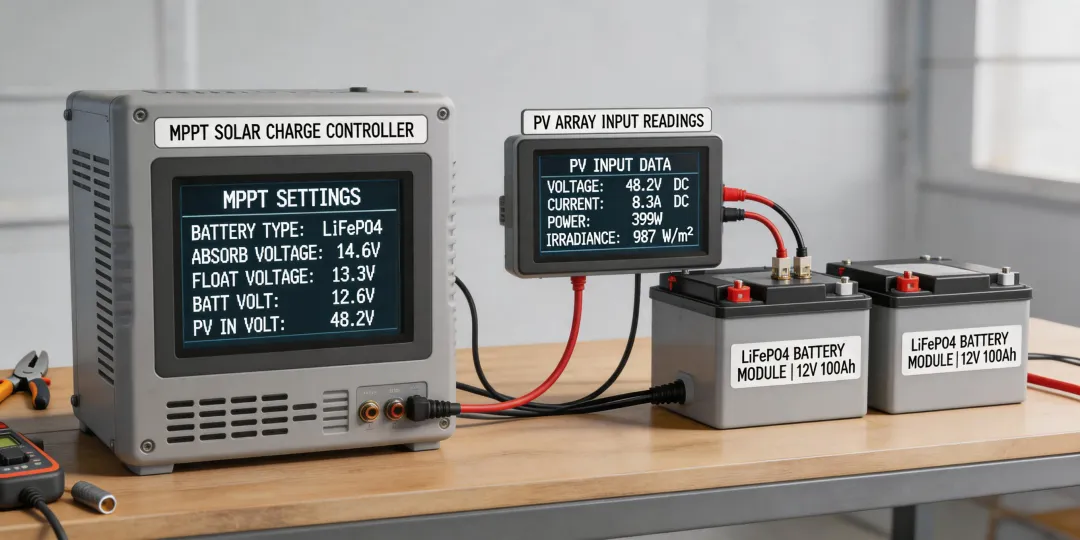
For solar, I default to EPEVER MPPT controllers. The 10A EPEVER MPPT is my go-to for small 12V systems—like a cabin with a fridge and a couple of lights. It handles a small array, gives you decent stats, and, critically, lets you set LiFePO4 battery profiles. If you're using lithium batteries, that ability matters far more than a fancy display. The EPEVER charge controller manual shows exactly which battery chemistry to select and how to set the absorb and float voltages.
Don't copy my luck here. I once had 2 hours to pick a controller before a shipping cutoff for a remote site. Normally I'd run a full load calculation, but there was no time. I chose the 10A EPEVER MPPT based on panel wattage alone. It worked, but that's survivorship bias. The manual's sizing tables would have taken five minutes.
For wind, the controller and dump load add real cost. A good wind charge controller is not just a rectifier; it needs to manage overspeed, brake the turbine, and protect the batteries. On one order in 2024, I spec'd a 58-foot tower, a 600W turbine, and all the disconnects. The turbine itself was the cheapest part. The wiring, tower, and controller were more than the turbine. The customer could have had a 4kW solar array for the same price and gotten three times the annual energy in their sunny climate. The upside of the tower was more winter generation. The risk was climbing a 58-foot tower in January. I kept asking myself: is that worth potential back injury? In the end, the answer was no—but only after the client agreed to solar instead.
That's when the "expandable solar generator" idea started making sense in my head. In an expandable solar generator, you start with a controller and battery bank sized for future growth. Add panel modules next year, add more batteries the year after that, and the same controller still works as long as it was sized large enough. A wind turbine doesn't offer that. Once you buy the tower and turbine, you're locked in.
Dimension 4: The Surprising Part—Expandability
I expected this comparison to be closer. When I compared our Q1 and Q2 installs side by side—same budget, one wind, one solar—I finally understood why the details matter. The solar system grew with the customer's needs. The wind system couldn't.
That's the counterintuitive bit: for off-grid, "bigger" isn't just about capacity. It's about what you can add without replacing the whole backbone. An expandable solar generator built around modular MPPT controllers and a good battery bank is easier to scale than any wind turbine. The turbine is a single moving machine; once you've bought it, you've bought it.
I say that as someone who likes wind turbines. But I also say it as someone who has made the mistake of selling dreams. In 2022, I designed a hybrid system with a modest wind turbine and a solar array. The wind half never produced enough to justify its own wiring. The solar half carried the load.
"Hybrid-ready" is a real spec, but it means the controller can accept a second source later. It does not mean the second source is included.
I said "hybrid-ready" to a client in March 2024. They heard "plug and play." Result: a confused electrician, an extra $700 in parts, and a delay. Now that blockquote appears in every proposal.
So Which Should You Choose?
If your site has even moderate sun, and you want to add capacity as your budget grows, solar is probably the better fit. Pair it with an EPEVER MPPT charge controller sized for future expansion. Set the battery type correctly—LiFePO4 profiles if you're using lithium. Use a solar panel planning tool like PVWatts to size the array before you buy anything.
Download the EPEVER charge controller manual before commissioning. I know that sounds like homework, but the manual includes the dip switch table and load control settings. Getting those wrong can make a perfectly good controller behave like a cheap timer.
If your site is truly dark and stormy, with proven wind speeds, a small wind turbine can complement solar. Just budget for the tower, the maintenance, and the possibility that the turbine will be down when the storm is strongest. Pair it with a proper wind controller and a dissipation load. And never assume a turbine "just works." It won't.
In my experience, for 80% of off-grid homes, solar wins on predictability, maintenance, and expandability. That's not because wind is bad. It's because solar is boring. And boring is what you want when you're a hundred miles from the nearest supplier.