The number wasn't in my contacts, which in this business usually means one of two things: a cold sales call, or someone's system is down and the weekend is about to get complicated. It was the second one.
"Hi. I need solar that can charge an electric car," she said, fast. "It's a lodge. No grid. And the guy I hired... didn't work out."
That's how, 55 hours before a Sunday deadline, I ended up designing an off-grid system for a lakeside lodge in northern Ontario, a Mercedes-Benz GLA E, and a client who'd already blown her budget once. In my role coordinating off-grid installs for a small solar company, I've handled close to 50 rush orders in the last three years. This one nearly became the cautionary tale I tell at dinner parties. Actually, it kind of did anyway.
Here's the background. The previous owner ran the lodge on a generator and a worn-out golf-cart battery bank. She bought the place in early 2024 with a vision: solar on the roof, the car charging by the dock, no diesel smell. So she did what everyone does—she asked around. The default answer from two contractors was a Tesla setup. When she searched "how much are tesla solar panels and powerwall," the quotes came back around $25,000 to $30,000 installed, plus a 6-to-8-week wait. One contractor shrugged. The other pivoted to a "cheap and simple" route.
The cheap route was a 1,500W PWM charge controller, two 12V gel batteries, and an inverter that barely ran the kettle. The gear showed up in two days. By day three, the batteries were reading half empty. By day four, the inverter was beeping. By Thursday, the contractor told her lithium batteries were "too complicated" and she should just buy a bigger generator. That's when she fired him and found us.
The kicker? The PWM kit cost $1,900. Then it cost her another $4,200 for us to remove it and start clean. She saved a couple hundred on the controller and paid triple to undo the shortcut. That math shows up in a lot of our emergency calls.
The Plan (55 Hours Left)
Here's what we spec'd by Friday noon:
- An EPEver MPPT controller—the Tracer AN, 60A. I've built around these on maybe 30 off-grid jobs. They're not the flashiest, and the app is honestly a bit clunky, but they let you set a custom battery profile, which is make-or-break with lithium.
- A high capacity LiFePO4 battery bank—four 48V 100Ah modules. That's 19.2 kWh. Enough for the lodge's overnight loads plus a meaningful charge for the car.
- An 8kW inverter to run the lodge loads and feed the EV charger.
- 2,880W of panels. Eight 360W modules. That's around the EPEver's input limit for a 48V system, so we had headroom, but not a ton.
One detail I don't want to skip, because it's the other half of every rush order: freight. The batteries normally take five business days from the distributor. We paid $480 in air freight on top of the $4,800 battery cost, and they landed at the lodge gate at 11 a.m. Friday in plywood crates, packed like instruments. I signed for them myself.
The Mercedes-Benz GLA E was honestly the easy part. Her daily round trip to town was about 40 km—8 to 9 kWh. Her car's portable EV charger let us adjust the current, so we set it to 16A, about 3.8 kW. The bank would carry that overnight; the panels would refill it the next day. We weren't building a public charging station. We were wiring a dedicated circuit for the Mercedes-Benz GLA E EV charger, sized to her driving pattern.
I want to say we had it all solved by Friday evening. We didn't.
The Night Nothing Worked
Saturday, 9:14 p.m. Panels mounted. Racking torqued. Wiring terminated. I flipped the inverter on, the EPEver Tracer lit up, and six minutes later every charge LED on the battery bank went dark. The BMS had disconnected. Not the controller, not the inverter—the batteries had thrown the switch.
We spent two hours testing interconnects, re-torquing busbars, re-reading the inverter manual. I should add: we also blamed the inverter. Twice. Then I actually looked at the EPEver's battery type setting. It was still at the factory default: a lead-acid profile with equalization enabled. In our hurry to get the array charging before dark, we'd never changed it.
Here's what the industry doesn't say loudly enough. People assume "lithium ready" means you plug a LiFePO4 battery into any modern controller and walk away. From the outside, that's the whole promise. The reality is that lithium is less tolerant of voltage abuse than the lead-acid bank it replaces. The equalization stage—meant for flooded batteries—pushes a 48V bank toward 62V. A 16-cell LiFePO4 battery's over-voltage protection typically sits around 60V. So the BMS did exactly what it was designed to do: it opened the circuit and saved the cells.
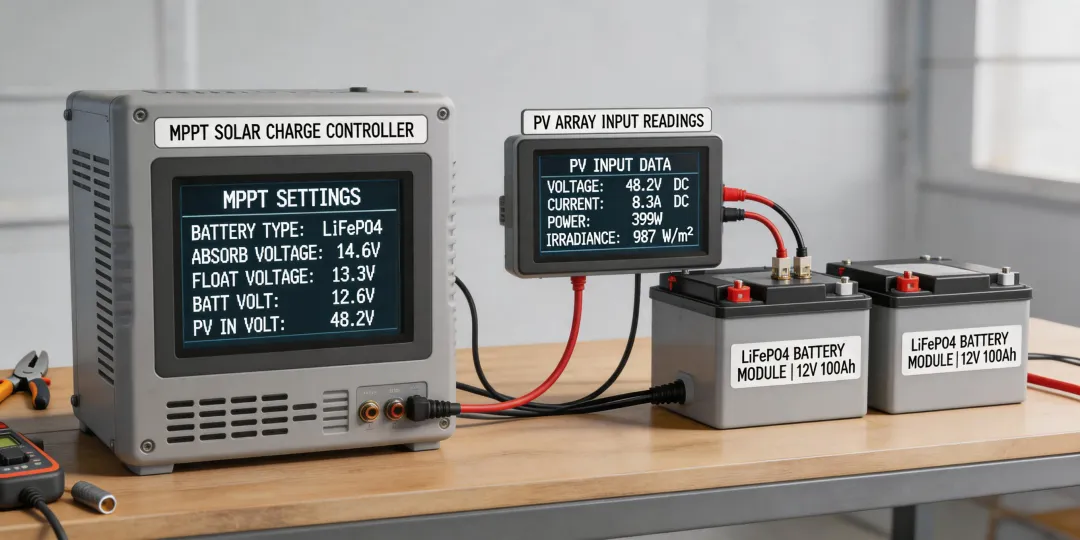
The fix took forty minutes once we diagnosed it. We switched the EPEver Tracer to user-defined battery mode and entered the LiFePO4 settings from the battery spec sheet: absorption 57.6V, float 55.2V, equalization off. For a 48V bank, that's 3.6V per cell group during absorption—high, but within spec for most LiFePO4 cells.
And here's the part I'm not proud of: our pre-commissioning checklist has a line for battery chemistry, but it was written back when we mostly installed lead-acid. It assumed you'd remember. We didn't. The checklist now starts with: "If lithium: verify absorption, float, and equalization before connecting, not after." We learn slow, but we learn.
Sunday Morning
7:12 a.m. A photo from the client. The EPEver Tracer's display, locked in Float. The inverter readout showing the lodge running—kettle, toaster, heat trace—off a bank that had already recovered to 87% before breakfast. Second photo: the Mercedes-Benz GLA E's charge light, blinking green.
"This is the best thing we've ever bought," she wrote.
I replied that it was technically a loaner until the final sign-off. She offered the rush fee without me asking. I took it. We delivered with 11 hours to spare, and the final project bill landed just under $17,000—hardware, freight, labor, and my Saturday night. Her original Tesla quote had started at $25,000.
What That Weekend Taught Me
The solar industry in 2025 isn't the solar industry of 2019. What was best practice in 2020—lead-acid banks, PWM controllers, one battery profile for everything—is now the exception in off-grid work. The fundamentals haven't changed: you still match the charge profile to the battery chemistry, and you still size storage against honest daily loads. But the execution has transformed. MPPT controllers like the EPEver Tracer give you user-defined settings that used to require a programmer. High capacity LiFePO4 battery modules deliver a decade of cycles with zero maintenance. That's real progress.
But the tools got better faster than the training did. Almost every rush job we take involves somebody applying old lead-acid habits to lithium gear. Equalization that should be off. Float voltages copied from an AGM manual. The equipment isn't the problem. The muscle memory is.
So if you landed here looking for EPEver Tracer LiFePO4 settings specifically: switch to user-defined mode, set absorption to about 57.6V (or 14.4V per 12V section), float around 55.2V, and disable equalization. Confirm with your battery manufacturer's spec sheet, because voltages vary a little between brands. That twenty minutes of setup is a lot cheaper than the Saturday night I just described.
On the Tesla question, because it keeps coming up: I'm not going to pretend $25,000 to $30,000 for a Powerwall system is absurd. It isn't, if you're paying for polish, support, and not having to think. I can't speak to Tesla's full install experience from my own work—we don't carry it. What I can tell you, from a system designer's perspective, is that for a remote lodge with a specific car and no grid at all, a modular LiFePO4 bank and a good MPPT controller covered the same ground for less money, in a weekend, without the scheduling wait. That's not a universal answer. It was just the right answer for this job.
My experience is based on maybe 50 off-grid projects, most of them in the 3-to-30 kWh range across Ontario and northern Manitoba. If your system is bigger, or your vehicle is hungrier, your numbers will differ. But the settings mistake—that one shows up everywhere.