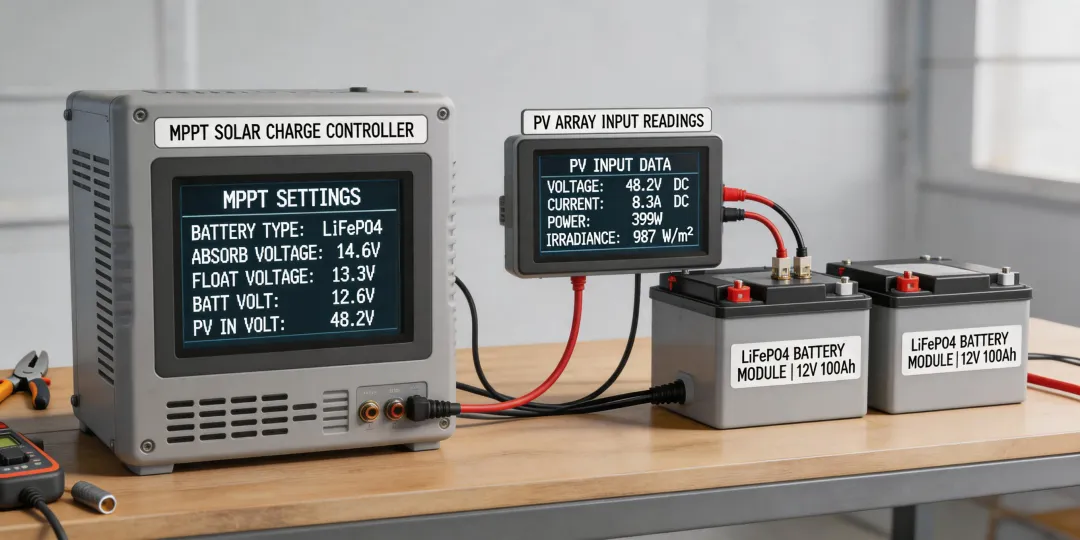
When I took over equipment purchasing in 2020, I thought a charge controller was a charge controller. Then I spent two years eating the cost of my own ignorance. My position is simple: for small off-grid lithium systems, the EPEVER 30A MPPT solar charge controller is the best value in the segment—but only if someone actually sets the lithium parameters correctly. The hardware is fine. The settings are where it falls apart.
I'm the office administrator for a 25-person solar integration company. I handle equipment ordering—roughly $600K annually across eight vendors—for installers building remote cabins, farm sheds, and light commercial DC systems. I report to operations and finance, so I care about invoice accuracy just as much as I care about not getting a 9pm call from an installer whose LFP battery won't wake up.
The Lithium Setting Problem Is a Knowledge Problem, Not a Hardware Problem
People assume lithium batteries need a special "lithium" charger. Actually, lithium batteries need a charger with adjustable voltage setpoints. The causation runs the other way. A controller that can't be told what to do can't charge lithium safely, no matter how many stickers it has.
The EPEVER charge controller lithium settings are not hidden. On the Tracer AN series, you can set the absorption voltage, the float voltage, and the low-voltage disconnect to match the battery manufacturer's spec. For a 12V LiFePO4 bank, I usually see profiles around 14.4–14.6V absorption and 13.6–13.8V float. But the battery datasheet wins every time. If a vendor can't give you a datasheet with a charge voltage, that's a red flag.
According to the EPEVER Tracer AN manual (epever.com), the controller lets you define custom battery parameters instead of forcing you into a fixed lead-acid profile. That's the difference between a controller that "works with lithium" and one that is actually usable with lithium. (Note to self: put this on the commissioning checklist for every new installer.)
The $40 Mistake That Made Me Stop Buying Price-First
Here's a story I don't tell often because it makes me cringe.
In late 2023, a new vendor pitched a 30A MPPT controller at $28 less per unit than the EPEVER. The spec sheet said "lithium compatible." I ordered 20 for a housing project. On paper, it looked fine. In the field, the absorption voltage was fixed at 14.2V and the low-voltage disconnect couldn't be adjusted. The batteries never reached full charge, and the system shut down early on cloudy days. The property manager was not happy.
We swapped all 20 units. Saved $560 upfront. Spent about $1,180 in replacement freight and technician time. The "budget vendor" choice looked smart until we saw the actual behavior. Net loss: my patience and a chunk of the project margin.
That's the classic penny-wise, pound-foolish lesson. The purchase price isn't the total cost. A quote that's much lower than the rest is often the most expensive option once commissioning and callbacks are included.
Why Grid Battery Storage News Today in the U.S. Matters to a Small Off-Grid Buyer
Here's another thing I watch every week: grid battery storage news today in the U.S. At first, utility-scale storage had nothing to do with our small off-grid projects. But the same lithium-ion chemistry curve is driving down prices for everyone.
According to the U.S. Energy Information Administration (eia.gov, January 2025), the U.S. added more utility-scale battery storage in 2024 than in any prior year. That scale matters. When utilities and commercial developers buy megawatt-hours of LiFePO4 cells, the manufacturing cost falls for the smaller cells we order too.
I also keep an eye on companies like Sungrow. Sungrow's solar battery and storage products are aimed at bigger commercial and industrial projects, but their pressure on the market means every lithium supplier has to price more carefully. Even if you never install a Sungrow product, you're benefiting from that competition.
About That "Solar System Snapchat" Search
Okay, one quick detour. A surprising number of referrals to our site come from people searching "how to use solar system snapchat." I can't help you with the Snapchat solar system feature—the one where your friends are planets—but the phrase is a useful reminder that "solar system" means completely different things to different people.
If you're asking how to use a solar system (the energy kind), start with the loads, then the battery, then the charge controller. If you buy the controller first, you're working backwards. I did that once. It didn't end well.
What About the Premium Brands?
I know what some integrators are thinking: "Why not just spec Victron and avoid the hassle?" I'm not going to argue with that. Victron makes excellent equipment, and if the client has the budget, you won't regret it. But mid-market projects are real. A 30A MPPT with adjustable lithium settings fits a 400–800W array and a 12V/24V battery bank. That's a huge chunk of the off-grid market, and it doesn't need a premium price tag.
But then again, EPEVER isn't right for every project. If you need 48V, AC-coupled hybrid storage, or local factory service, look elsewhere. I'm not saying it's the best controller ever made. I'm saying it's the right tool for a specific, common set of jobs.
Before I place an order for a lithium off-grid system, I check four things:
- Does the controller have adjustable lithium voltage setpoints? No "lithium-ready" marketing fluff.
- Is the max PV input voltage higher than the cold-temperature Voc of the panels?
- Does the battery manufacturer publish a recommended charge profile? If not, I ask why.
- Has the installer verified the low-voltage disconnect against the customer's loads?
If all four pass, the EPEVER 30A MPPT solar charge controller is usually in the running. If not, no brand saves you from a bad design.
Bottom Line
So here's my point: don't blame the charge controller when the battery settings are wrong. Learn the EPEVER charge controller lithium settings, choose the 30A MPPT when the system calls for it, and keep an eye on grid battery storage news because it affects battery prices and technology choices.
I'd rather spend ten minutes explaining lithium settings than deal with mismatched expectations later. An informed customer asks better questions and makes faster decisions. That's the whole reason I'm writing this down instead of just sending a quote. And if you came here from a Snapchat search—welcome. The real solar system is just as interesting, and the planets are actually useful.