I Thought I Had It Figured Out
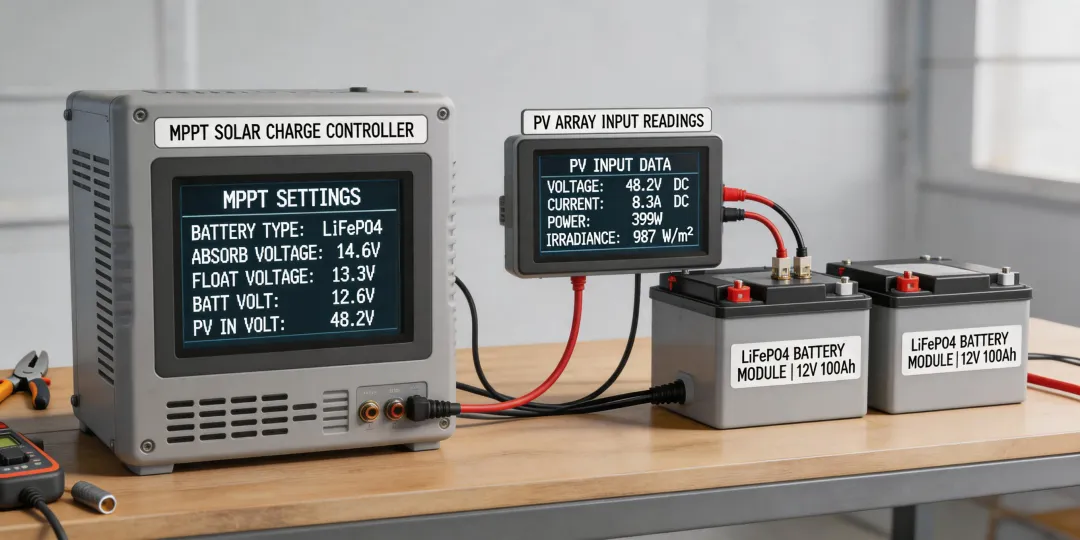
Back in Q3 2022, I spec'd a small off-grid cabin system. 300W of panel, 12V battery bank, and what I thought was a perfect match: a 10A EPEver MPPT charge controller. On paper, it worked. 300W / 12V = 25A max input, but with a 10A controller, I figured the panels would just clip on the rare sunny day. No big deal, right?
Wrong. The thing went into thermal derating by 10 AM on the first real sunny day. The owner called me, frustrated, asking why his batteries weren't charging past 60%. I felt like an idiot. (Note to self: never assume MPPT efficiency is 100%.)
That mistake cost me a return trip, a replacement controller (upgraded to an EPEver 20A just to be safe), and a bruised ego. Here’s what I learned about matching controllers to real-world conditions — and why you might need that EPEver 50A MPPT charge controller sooner than you think.
The Surface Problem: "My Controller Keeps Cutting Out"
Most people come to me with the same symptom: their solar charge controller shuts down or reduces power in the middle of the day. It's not a fault code, exactly, but the output drops. They think they got a defective unit. But that's rarely the case.
The real issue is almost always overheating in real-world conditions. The ratings on the box are tested at 25°C (77°F) in a lab. Your roof or RV is probably 40-60°C (104-140°F) on a sunny afternoon. Electronics hate heat. MPPT controllers derate their output to protect themselves.
"I went back and forth between the 10A and the 20A for a week. The 10A offered lower upfront cost; the 20A offered a safety margin. I chose the 20A because the project was too important to risk a midday shutdown."
So the question isn't "Why is my controller failing?" The real question is: "Did I size it for lab conditions or for real life?"
The Deeper Problem: Why 10A (or Even 20A) Might Not Cut It
Let's get into the math — the kind you don't usually see in the spec sheet.
The Temperature Derating Curve Nobody Mentions
Most MPPT controllers, including EPEver units, will start to derate output at around 45°C internal temperature. By 60°C, they might be delivering only 70-80% of their rated current. That means your supposed 10A controller might only output 7-8A in a hot RV roof installation.
If you have a 200W array and a deeply discharged battery, you need that sweet, sweet MPPT efficiency. But a 10A controller, hot and derated, can't deliver. You end up with a trickle charge instead of a bulk charge. Your battery never gets full before the sun goes down.
The "Bypass Mode" Misconception
I've also seen people assume that if their controller fails or goes into protection, the solar panels will just pass through to the battery. That's not how MPPT controllers work. They need active electronics to regulate voltage. A dead controller = no charge. Period.
"One of my biggest regrets: not calculating for temperature derating. The 15% power loss on paper turned into 25% in the field — missing daily charging capacity I'm still paying for with generator runtime."
Here's the thing: If you're installing in a hot climate, a bigger controller isn't about handling more solar panels. It's about maintaining rated output despite the heat. An EPEver 50A MPPT charge controller running at 60% output still delivers 30A — more than enough for most 400-600W arrays.
The Cost of Not Understanding This
Let me give you a real example from a project I fixed last month. The client spec'd a 10A controller on a 200W panel setup for a small trailer. Installation mid-2024.
- The symptom: Trailer batteries always at 60% by evening.
- The diagnosis: Controller was hitting 55°C by noon and derating to 6A output. The 200W panels (which could produce 10A max) were wasted.
- The fix: Replace with an EPEver 30A unit. Total hardware cost: ~$120 more. But the owner saved over $400 in potential battery replacements from chronic undercharging.
That error — saving $30 on the controller — cost $400 in practical terms. The client learned the hard way that an EPEver MPPT solar charge controller priced with a proper margin is an investment, not an expense.
What About the Inverter Side?
People ask me about what does a power inverter do in a truck or RV. It's simple: converts your DC battery power to AC for electronics. But here's the nuance nobody talks about — the synergy with your controller.
If your inverter runs heavy loads while your controller is trying to charge, you have a conflict. The batteries discharge faster than the controller can recharge. This, combined with an undersized or derated controller, leads to that frustrating "never full" battery state.
And please, don't confuse my recommendation with a pitch for a Victron solar generator. Victron is a different ecosystem (and they make great equipment). But the principle applies: if you're running a system with an inverter, your charge controller must be sized to keep up with the draw, not just the solar input. That's another argument for the 50A unit — it gives you headroom to charge while loads are on.
The Solution: Stop Sizing by Watts; Start Sizing by Heat
You have three choices, and they rank by difficulty:
- Easiest: Buy a physically larger controller. The EPEver 50A MPPT runs cooler because it has more heat sink and better airflow. It's just built to shed heat. I think of it as the "get out of jail free" card for install uncertainty.
- Harder: Install your controller in a shaded, ventilated space. Never inside a sealed battery compartment or under an RV bed. That mistake cost me a weekend of my life.
- Hardest: Do the math. Calculate your expected max solar current. Multiply by 1.25 (for temperature margin). Then multiply by another 1.25 to account for the fact that specs are always optimistic. That's your real minimum controller rating.
The EPEver lineup is already a good baseline, but I can only speak to my experience in smaller off-grid systems. If you're dealing with a 48V system or a large-scale installation, the calculus might be different.
"I'd rather spend 15 minutes explaining this than come back for a warranty swap. An informed customer buys the right controller once."
Final Thought
This worked for us in residential and small commercial off-grid setups in moderate-to-hot climates. Your mileage may vary if you're installing in an Alaskan winter with snow load reducing your panel efficiency by 40%. Then maybe a 10A controller would do the job all day long.
But if you're reading this and your system quits at noon — look at the temperature. That's your problem. And the fix? Usually fifty amps of headroom.
— A guy who's still kicking himself for that 10A mistake.