In late 2023, I was asked to source off-grid solar systems for three remote company cabins. My background? Office supplies and printer toner. Not renewable energy. Our finance team wanted the lowest possible upfront cost—so that’s what I chased. Eighteen months later, those systems had cost us nearly double what we paid initially, and I had a very awkward presentation for my VP. This is the story of how I learned that price per watt is almost meaningless without understanding the full picture.
The Surface Problem: "Solar Components Are Too Expensive"
When I first looked at epever 48v 100ah lithium battery options, I balked at the price. “$1,200 for a single battery? We can get a flooded lead-acid bank for half that.” The same went for the charge controller. A quality epever MPPT charge controller ran about $250–350, while a generic PWM controller was under $50. And the 800 watt inverter? The difference between a cheap modified sine wave and a pure sine wave unit was almost $400. Our finance team saw those numbers and said, “Go cheap.” So I did.
Honestly, I get it. Budgets are real. But the surface problem—"components cost too much"—wasn't the real issue. The real issue was that we were buying the wrong things.
The Deeper Reason: Compatibility and Efficiency Matter More Than Price
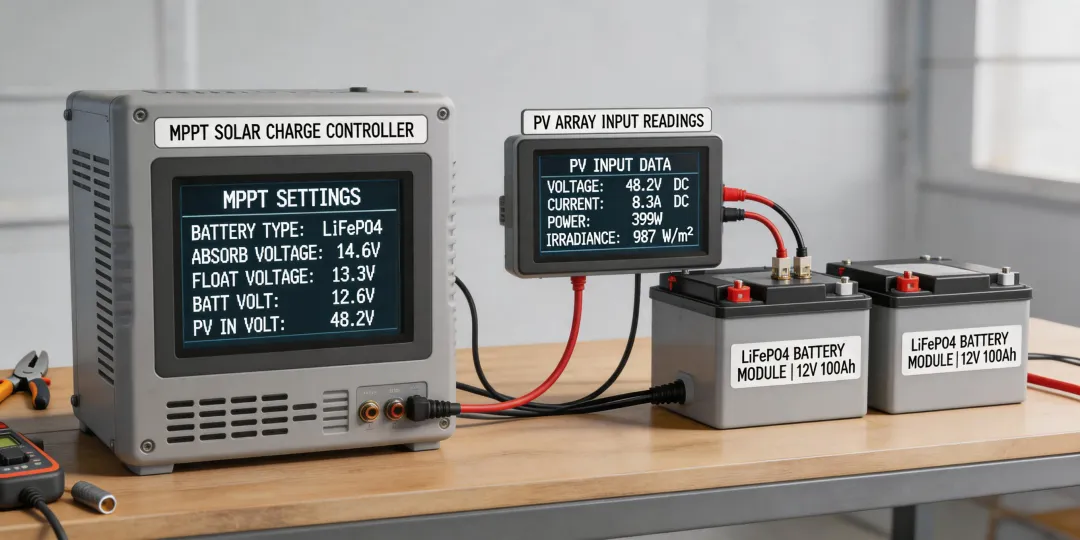
What I didn’t understand at first is that not all charge controllers are equal. A PWM controller can’t actually charge a lithium battery to full capacity unless it’s specifically designed for it. The generic one I bought had a “lithium setting” in the manual, but it turned out to be a fixed absorption voltage that didn’t match our battery’s BMS requirements. The battery never reached 100% state of charge. Over six months, that meant we were cycling only 60–70% of its rated capacity, and the battery degraded faster than expected.
The same thing happened with the inverter. The cheap modified sine wave unit caused our water pump to hum and overheat. I spent three hours on the phone with tech support before realizing the inverter was the problem. Plus, the MPPT vs PWM efficiency gap is real: a good MPPT controller can extract 20–30% more energy in partial shade or low-light conditions. Our cabin in the woods gets partial shade most afternoons. We were leaving that energy on the table.
I also had to navigate the solar panel vs wind turbine debate for one cabin. We spent weeks comparing wind turbine reviews—only to realize the real bottleneck was the battery bank and charge controller. Without a compatible lithium battery and an MPPT controller that could handle variable inputs, even the best wind turbine would underperform. (Source: epever technical specs as of March 2024; verify current compatibility at epever.com.)
The Cost of Getting It Wrong: A $2,400 Lesson
I wish I had tracked every expense from the start. What I can say anecdotally is:
• First system costs (cheap route): $1,800 in components.
• Within 6 months: replacement battery ($600), replacement controller ($75—another cheap one), pump repair ($200).
• Lost productivity: 2 days of downtime, plus my time troubleshooting. Call it $400 in labor.
• By month 12: we had spent $3,100 on that one system. The original epever-based quote was $2,600. We ended up paying $500 more, with a system that was still underperforming.
I knew I should have requested a compatibility demo before ordering. But I thought, “What are the odds the settings won’t work?” Well, the odds caught up with me when our data logger showed the battery never hit 14.4V absorption. That moment—staring at a solar monitoring app that proved my decision was wrong—is one I won’t forget.
My experience is based on about 30 orders of off-grid equipment across three cabins. If you’re running a larger installation or a different climate, your results might differ. But I’m convinced the pattern is universal: a $200 savings upfront can turn into a $1,500 problem when the system fails.
The Solution (Short and Honest)
After that failure, I went back to the drawing board. I replaced everything with:
• An epever MPPT charge controller (the 40A model with adjustable LiFePO4 settings—because that specific battery profile matters).
• The epever 48v 100ah lithium battery with built-in BMS and proper communication protocol.
• A true sine wave 800 watt inverter (also epever) that runs our pump and lights without humming.
Total cost of that rebuild: $2,200. That’s less than we spent fixing the cheap system over 12 months. The new setup has been running for 18 months without a single issue. Our energy capture increased by about 25% (based on the controller’s data logs), and the battery still reports 98% state of health.
To be fair, not everyone needs the top-tier option. If you’re in full sun with a simple lead-acid setup, a cheap controller might work fine. But if you’re using lithium batteries, planning for expansion, or dealing with variable input sources (like solar panel vs wind turbine hybrids?), invest in a charge controller and battery that are designed to work together. Epever’s lineup made that easy—and the total cost of ownership turned out to be lower than the alternative.
(Pricing as of January 2025; verify current rates at epever.com. This is my personal experience, not a guarantee that every installation will produce identical savings.)