Some questions feel simple because the answer usually is. “Which battery terminal to disconnect when working on a car?” Negative. Pull the negative first.
That advice works when the car has one battery and nothing else. But a camper with solar has a second power source that stays alive as long as the sun is out. I learned this the way most procurement lessons happen: through a spreadsheet and a very annoying warranty claim.
The Surface Question Misses a Whole Power Source
I manage purchasing for a small company that deploys off-grid equipment, including camper systems. Over the past six years, I've logged almost every invoice into a cost tracking spreadsheet. That's not because I'm obsessive—it's because small budgeting mistakes compound quietly.
So I get why people ask which battery terminal to disconnect when working on a car. The ground path matters. Pull the negative first, and a dropped wrench won't complete a circuit through the chassis. Pull the positive first, and you're one wrong touch away from sparks. That part of the rule is solid.
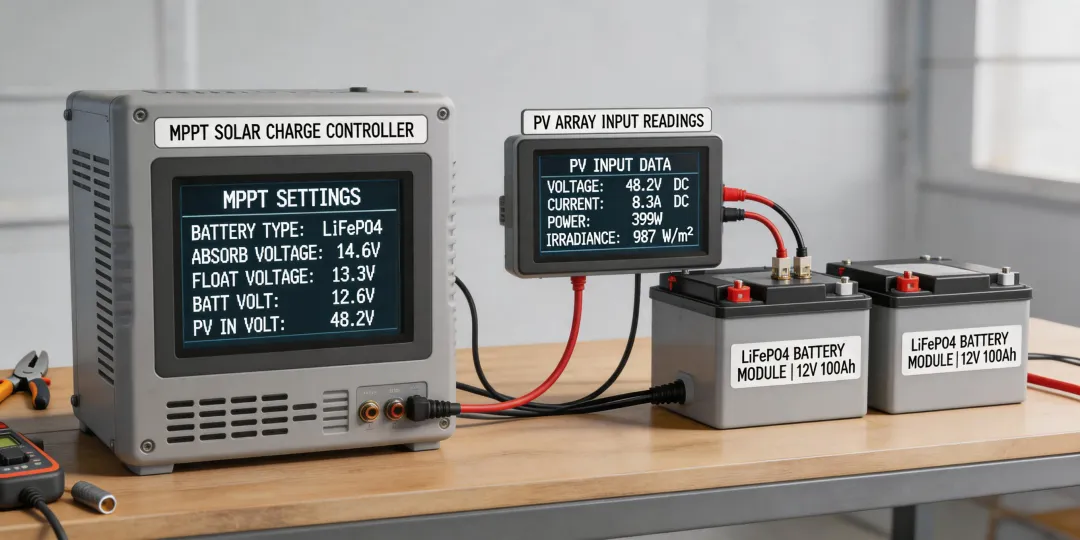
But a solar camper is not a car. There's also the solar panel and the charge controller feeding from it. Even a 100W panel can put out around 18–24V open-circuit in full sun. If you disconnect the battery while the panel is still sending power, the controller can see a voltage spike. On a lithium battery, that spike can reach the BMS, and lithium BMSs are not forgiving.
That's why solar panel safety starts before you touch a wrench: cover the panel or disconnect the PV input first. You're isolating every power source, not just the one with terminals you can see.
Here's What Most Buyers Miss
The question everyone asks is “positive or negative?” The question they should ask is “what else is still live?”
What most people don't realize is that a charge controller isn't just a voltage regulator. It's also the safety boundary between the panel and the battery. If that boundary is poorly designed, the panel's energy has nowhere to go when the battery is disconnected. That's not a philosophical problem; it's smoke.
This is also where I see a lot of people save twenty bucks and then lose two hundred. When you buy a charge controller on price alone, you're buying an assumption that the manufacturer tested it for the situation you're about to put it in. Some budget controllers have decent protection. Some don't. The controller that failed on one of our camper installs was a $24 no-name unit. It didn't survive a battery disconnect while the PV was still active, and it took the battery's BMS down with it.
In 2023, that failure cost us $420 for a replacement lithium battery for camper builds. The controller itself was under warranty, but the shipping, the installation labor, and the lost time were not.
EPEver's installation manual for the Tracer AN series says to connect the battery before the PV array and disconnect the PV before the battery. It's not cautious language for legal coverage. That sequence prevents voltage spikes from hitting the controller input.
The Price Difference Is Smaller Than the Repair Bill
When we compared quotes from four distributors in late 2024, the 10A EPEver MPPT model came in between $38 and $52. The no-name unit was $21. The difference is a lunch; the BMS replacement we logged was many times that.
One thing I always watch for is hidden setup cost—not the kind you see on the invoice, but the kind that comes from a product that needs extra parts before it works with your battery. Some controllers require an external Bluetooth module or a separate programmer just to set lithium voltage parameters. That's fine if you know it going in, but it surprises a lot of camper builders at the worst time.
I didn't switch our fleet to EPEver because they were the cheapest. I switched because the total cost of ownership spread over three years made the $21 controller look ridiculous. Out of about two dozen EPEver charge controllers we've deployed across small builds, one arrived defective, and the vendor replaced it within a week. That's a failure rate I can plan around, because the warranty process was painless.
If you're shopping for an EPEver charge controller, the 10A MPPT version is a good fit for small camper setups. It has adjustable settings for LiFePO4 or a user-defined battery profile, so you're not locked into a sealed lead-acid float voltage that slowly under-charges your lithium pack.
We now use a lithium battery for camper installs in most of our small builds, but only with a controller that can actually charge it. The EPEver 10A MPPT made that transition simple.
So, Which Terminal Do You Disconnect?
For a plain car, negative. For a camper with solar, follow the steps that give you a controlled shutdown:
- Disconnect the solar panel input from the charge controller, or cover the panel.
- Disconnect the battery negative terminal first.
- Disconnect the battery positive terminal.
To reconnect: positive first, negative second, then solar input last. If you have an inverter and you're touching high-current wiring, verify it's off and locked out.
This is the time-certainty part of my job. If you're leaving for a trip tomorrow, a controller with a decent manual and a vendor that answers calls is not a luxury. It's the difference between a $40 part and a $420 repair plus a canceled vacation.
And yes, I did memorize the reconnection order wrong on my first install. The spark was educational. Note to self: labels are worth the extra thirty seconds.