-
Battery Storage Shavington: The Job That Changed My Approach
-
Dimension 1: Upfront Price vs. Total Cost
-
Dimension 2: Energy Harvest—Where MPPT Earns It Back
-
Dimension 3: Battery Compatibility and Flexible Storage
-
Epever MPPT Solar Charge Controller Setup: The Steps I Trust
-
Should I Disconnect Battery If Car Parked Long Term?
-
How Much Is a 400 Watt Solar Panel? It's the Wrong Question
-
When PWM Is Still the Right Call
-
Bottom Line
I've spent the last six years buying charge controllers, inverters, and batteries for off-grid solar installs. In my cost tracking spreadsheet, I've got about $180,000 of component spend across that period. So when I recommend a controller, it's not because I like the spec sheet. It's because I've seen what happens on the job site.
This article is a direct comparison: Epever MPPT solar charge controllers vs. PWM controllers. I'm comparing them the way I compare everything in my procurement role—total cost of ownership, real-world energy harvest, battery compatibility, and the hidden costs that don't show up on a quote.
Battery Storage Shavington: The Job That Changed My Approach
In early 2023, an installer from Shavington asked me to price battery storage for a holiday let. It was a small system: one 400W solar panel, two 100Ah lead-acid batteries, and a 20A PWM controller. On paper, it should have been fine. In practice, the batteries were sitting at 11.8V every morning by the end of the first week.
We replaced the PWM controller with an Epever MPPT 40A, changed the battery profile, and the same panel and battery combo started working. That contrast made me realize how much a charge controller actually controls the whole system. The solar panel wasn't the problem. The batteries weren't the problem. The controller was throttling everything.
Now, to be fair: one bad PWM controller doesn't mean all PWM controllers are bad. But that Shavington job is why I started comparing them side by side instead of just picking the cheapest option.
Dimension 1: Upfront Price vs. Total Cost
There's no hiding it—Epever MPPT controllers cost more upfront. In quotes I've seen, a 20A PWM controller runs about $25. A comparable Epever MPPT controller is closer to $70–$90. If you're not careful, that looks like a 3x difference on a small order.
But I don't buy products. I buy systems. And when I compare total cost, the gap shrinks fast. The PWM controller in that Shavington job cost less, but it also cost us a second service visit, a replacement controller, and a customer who nearly gave up on solar. That's not a $40 problem. That's a $400 problem.
My rule: if a controller fails or underperforms, the labor to swap it out costs more than the controller ever saved. That's the hidden line item that procurement spreadsheets miss.
Dimension 2: Energy Harvest—Where MPPT Earns It Back
I'm not an electrical engineer, so I'll keep this simple. PWM charges the battery at roughly the panel's voltage. MPPT adjusts the electrical operating point so the panel can push more power, especially when the panel voltage is higher than the battery voltage.
What does that mean in practice? For a 400W solar panel on a 12V battery, a PWM controller wastes much of the panel's higher voltage. An Epever MPPT controller converts that extra voltage into extra charging current. In cold weather, the effect is even bigger because cold panels run at higher voltage.
When I compared the PWM and MPPT setups side by side on the same panel and battery, the MPPT system harvested noticeably more energy. I don't have a lab-grade number, but in our own tracking, the off-grid sites with MPPT controllers needed less generator backup in winter. That's the metric I care about.
So here's the unexpected part: for a 400W panel, the price difference between PWM and MPPT usually pays for itself in the first year of usable energy. I didn't believe that until I saw it in the spreadsheets.
Dimension 3: Battery Compatibility and Flexible Storage
This is where Epever wins for me.
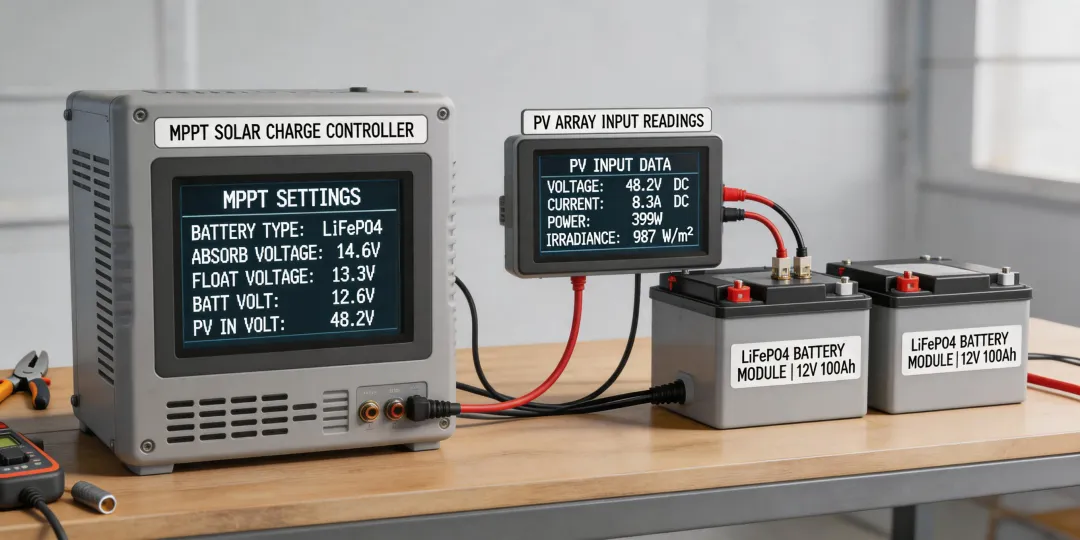
Battery storage is changing fast. Five years ago, most of our installs used AGM lead-acid batteries. Now, LiFePO4 is common. The problem is that LiFePO4 batteries need specific absorption and float voltages. A generic PWM controller with a fixed gel or flooded setting can undercharge or overcharge them.
Epever MPPT controllers let me set custom battery profiles, or select LiFePO4 directly. The Epever app makes this easier because you don't need to press buttons on a tiny screen while standing on a ladder.
Also, if a vendor claims their battery storage is green or recyclable, I ask for documentation. Per FTC guidelines (ftc.gov), environmental claims need to be substantiated. If they can't produce evidence, I treat the claim as marketing, not engineering.
Epever MPPT Solar Charge Controller Setup: The Steps I Trust
Setup is not hard, but it's not plug in and pray either.
- Connect the battery first, then the solar panel. This matters because the controller needs to detect the battery voltage before it can manage charging.
- Open the Epever app and pair it with the controller. Pairing can take a couple of tries if you're too close. Step back a few meters and it usually connects.
- Set the battery type. For LiFePO4, choose the LiFePO4 profile or define custom voltages per the battery supplier's spec. Don't leave it on the default sealed lead-acid setting.
- Set the load mode. If you're running lights or a modem, choose a timer or light-based mode. If you're only charging batteries, set the load to manual on.
The Epever app is okay. It's not the slickest app I've used—what I mean is, it works, but the interface feels like it was designed by engineers. That's acceptable to me, because the data it gives you is useful: daily yield, battery voltage, charging stage.
One more thing: if you skip the battery first step, the controller may boot into the wrong voltage setting. I've done this once on a 24V system and spent an hour wondering why the battery wasn't charging. Actually, it was 90 minutes. Learn from me.
Should I Disconnect Battery If Car Parked Long Term?
I get this question a lot from van builders and caravan owners. Should I disconnect battery if car parked long term? The honest answer: if the vehicle is parked for more than a few weeks with no solar input—yes.
An Epever charge controller has a small standby draw. It's usually only a few milliamps, but only a few milliamps adds up. A 50Ah battery with a 5mA draw loses 3.6Ah over 30 days. On its own, that's not terrible, but add OEM vehicle modules, an alarm system, and a battery that's already halfway down, and you can come back to a dead battery.
If you have a solar panel connected and the controller is actually getting sun, you can leave it connected. But a vehicle parked in a garage in winter? Disconnect the battery or put it on a maintainer. The Epever app can show you the battery voltage before you disconnect, which helps you know if it's worth leaving.
How Much Is a 400 Watt Solar Panel? It's the Wrong Question
In supplier quotes I've seen, a 400 watt solar panel runs between $150 and $250, depending on the brand and warranty. But if you're asking how much is a 400 watt solar panel, you're missing the bigger cost.
The panel is one part of a system. You also need the charge controller, battery, wiring, mounts, and possibly an inverter. A $200 panel paired with a $25 PWM controller can underperform. A $200 panel paired with an Epever MPPT controller can actually supply the battery with closer to its rated power.
So my answer to how much is a 400 watt solar panel is: about $150–$250 for the panel, and then budget another $100–$150 for the controller that makes it work properly.
When PWM Is Still the Right Call
I don't want to overcorrect. PWM controllers are fine for small, simple systems. If you're doing a 50W trickle charger for a shed battery, or a tiny 12V system with a panel whose voltage is close to the battery voltage, a PWM controller is cheaper and simpler.
The line is around 200W, in my experience. Under that, PWM saves money. Above that—especially with lithium batteries, 400W panels, or cold climates—the Epever MPPT controller earns its higher price.
Also, a supplier who tells you that you need an MPPT controller for every single project is not giving you honest advice. I trust a supplier who says this isn't the right tool for that job more than one who says everything I sell is the best. That's why I respect what Epever does well, but I won't pretend it's the only brand anyone needs.
Bottom Line
For off-grid battery storage above 200W, I spec Epever MPPT controllers. Not because they're the cheapest. Not because they're fancy. But because the total cost of ownership is lower when you count labor, battery longevity, and winter performance.
If you're just maintaining a small battery with no load, PWM is fine. If you're building a serious off-grid system, installing lithium battery storage, or asking should I disconnect battery if car parked long term?—start with a controller that actually lets you control the voltages.
The Epever app, the flexible LiFePO4 settings, and the MPPT efficiency are worth the upfront price. I've learned that the expensive mistake is almost never the controller you bought. It's the controller you bought to replace the cheap one.