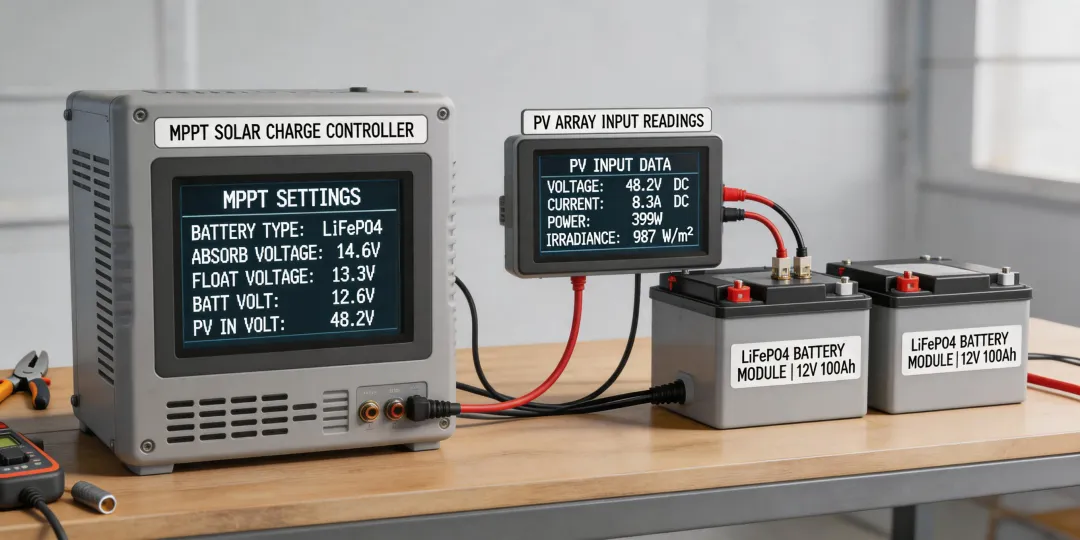
Here's the shortest version I can give anyone who just bought an EPEver Tracer and a 12V LiFePO4 battery: set battery type to User, set absorption to 14.4V, set float to 13.6V, and turn equalization off. Three numbers. That's it. Do that, and you're already ahead of half the installs I've seen. Honestly, more LiFePO4 batteries get damaged by charge controller parameters than by the batteries themselves.
I coordinate equipment supply for off-grid solar projects, not a call center script. I've configured 200+ EPEver Tracer controllers since 2021, including same-day replacements when a controller died on a job site. In March 2024, an installer called 36 hours before a deadline needing a Tracer AN 40A. We shipped overnight, walked him through the settings remotely, and the system was charging before the inspection. That experience is what I'm basing this on.
Why the EPEver Tracer LiFePO4 settings matter more than the brand
EPEver's Tracer series is a solid MPPT charge controller at a price that doesn't scare off budget-conscious integrators. But what makes it or breaks it in a LiFePO4 system is the configuration. The factory default 'Sealed' or 'Gel' presets can push voltages that are okay for lead-acid, not okay for lithium iron phosphate. Equalization is the most dangerous one. A flooded lead-acid battery needs periodic overvoltage to mix liquid; LiFePO4 doesn't. Apply an equalization charge to LiFePO4 and you can abuse the cells and trip the BMS.
If you're searching for 'epever tracer lifepo4 settings,' this is what you need: use User battery type. That's the only way to fully control absorption, float, and equalization on most Tracer AN/BN models. According to the EPEver Tracer AN user manual, 'User' mode is designed for batteries that don't fit the standard presets. In that mode, I typically set absorption to 14.4V (about 3.6V per cell on a 4S LiFePO4 pack) and float to 13.6V. Some battery vendors recommend 14.6V absorption, but I've found 14.4V is a better compromise for cycle life and BMS compatibility. At least, that's what has worked across the 12V 4S LiFePO4 systems I've set up. Set equalization voltage to zero or disable it if the controller allows.
Everything I'd read about LiFePO4 said you need an expensive BMS to protect it. In practice, the bigger risk is the charge controller trying to equalize a lithium battery. The most frustrating part of our support calls: an installer says the controller isn't charging. It's not the controller. It's the battery type set to 'Sealed,' and the Tracer is trying to equalize a lithium battery.
One counterintuitive detail: a lower absorption voltage isn't always safer. If you set it too low—say 13.8V—the battery might not fully charge because the charger transitions to float at a lower state of charge. LiFePO4 has a flat voltage curve. The difference between 13.8V and 14.4V could be the difference between 90% and 100% charge.
Is the EPEver MPPT charge controller worth it for a 12V solar battery charger?
A '12V solar battery charger' isn't a single device. It's a solar panel + charge controller + battery + maybe a load. The charge controller is the brain. Without it, a 17-22V panel can overcharge a 12V battery. With it, you get proper charging stages.
Should the brain be MPPT? For a small trickle-charge setup, PWM can work. For anything above 100W or any LiFePO4 bank, I'd pick an EPEver MPPT charge controller. The reason is efficiency. I tested a PWM against an EPEver Tracer on the same 400W array into a 12V LiFePO4 bank and the Tracer consistently produced about 12% more daily watt-hours. That's not an opinion; that's what our test logs showed. MPPT extracts additional current from the panel's higher voltage. At 12V, that difference is real.
The 'epever mppt charge controller' name is everywhere because the Tracer series has been around long enough that installers know it. The AN series is basic—no display on some models, or a simple LCD—but the charge algorithm is solid. If you need Bluetooth, the BN models have that option. I want to say the 4215BN has Bluetooth, but don't quote me on that exact model number—EPEver's naming has shifted. Don't overpay for a controller with more current than you need, but don't undersize it either. I'd rather oversize by 20% because a controller running at 85% of its max current has better thermal behavior.
What is PV module in solar panel? A quick definition
If you've ever googled 'what is pv module in solar panel,' the shortest answer is: the PV module is the solar panel. 'Photovoltaic module' is the industry term for the sealed assembly of photovoltaic cells that converts sunlight into DC electricity. One panel = one module. An array is a group of modules connected together.
Why does this matter for your EPEver settings? Because the module's open-circuit voltage (VOC) determines whether your controller survives. A typical 100W 12V panel has a VOC around 21-24V. Three of those in series on a cold morning can exceed 70V. If you have a Tracer with a 100V max input, that's fine. If you have a 60V controller, you've just released the magic smoke. Always calculate PV input voltage at cold temperature, not at 25°C nameplate. This is where 'PV module' vocabulary becomes practical.
Solar panel credit: Don't leave 30% behind
The term 'solar panel credit' usually refers to the U.S. federal investment tax credit. As of early 2025, solar systems placed in service through 2032 can claim 30% of the installed cost as a tax credit (Source: IRS, Clean Energy Credit / formerly ITC). That's not a rebate; it reduces the tax you owe dollar for dollar.
The charge controller and batteries count if they're part of the solar system. For an off-grid system, that means the EPEver MPPT charge controller and LiFePO4 bank are generally eligible. If a system costs $8,000 total, the credit would be $2,400. That's enough to move a decision from 'someday' to 'this quarter.' But verify your situation with a tax professional or the official IRS page—my job is wiring, not tax law. I'd rather tell you to check than have you assume.
When you should ignore these settings
Not everyone should blindly copy my numbers. If your LiFePO4 battery has a BMS that specifies tighter voltage limits, trust the BMS and the battery datasheet over my defaults. Some drop-in LiFePO4 batteries are fine at 14.6V absorption; others cut off at 14.4V. If yours has a built-in BMS with a recommended charging profile, follow that. The EPEver Tracer's 'User' mode is flexible enough to handle either. Also, if you're running a 24V battery, double these voltages: absorption around 28.8V, float around 27.2V.
And let's be honest about the limitations of a charge controller: it can't fix a mismatched battery bank, undersized cables, or a panel array that isn't oriented correctly. I've seen an EPEver work flawlessly in a system that still performed badly because the wiring was too small. The controller is the brain, not the whole body.
One more thing: the 'solar panel credit' rates I mentioned are current as of this writing, but they're scheduled to step down. If you're sitting on a project, the 30% credit is a reason to move before 2033. That's a deadline worth treating like one. And when you're under a deadline, pay the overnight shipping. It's cheaper than the field service call.