The Order That Almost Got Away
It was a Tuesday in late February 2024. I was reviewing the weekly rejection log—part of my ritual as a quality compliance manager. Normally the log is a dry list: spec deviations, packaging damage, missing documentation. But one entry caught my eye.
A single unit of our EPEVER 30A MPPT solar charge controller, model Tracer 3210AN, flagged for what the inspector wrote as 'customer compatibility concern.'
We'd shipped 50 units of that exact model that week. Only one was flagged. It was destined for a small reseller in Arizona who'd paired it with a 24V LiFePO4 battery bank and, according to the notes, a flexible solar panel from another brand. The inspector's comment: 'Customer unsure about settings for LiFePO4. Recommend upgrade to 40A model.'
I almost approved it. Everything I'd read about our standard process said: if the hardware matches the spec sheet, ship it. But something didn't sit right. The customer wasn't asking for a warranty claim—they were asking for help before the installation. And we were treating that question like a defect.
I still kick myself for how close I came to signing off without a second thought. If I'd approved that shipment, we'd have sent a controller that technically works but requires the user to hunt through forums to figure out the correct voltage settings for their 24V lithium battery. That's not a product issue—that's a support failure dressed up as a quality pass.
Instead, I pulled the unit. I called the reseller myself. The conversation changed how I think about small orders.
The Real Problem Wasn't the Hardware
The reseller—let's call him Mike—was running a one-man solar installation business. He'd been in the industry for about two years. His order was small: one controller, a few connectors, and a request for the LiFePO4 charging profile settings. Total value: about $180.
Mike was trying to build a system for a customer who had an EcoFlow flexible solar panel and wanted to integrate it with a dedicated charge controller and a 24V lithium battery. He wasn't sure if our standard settings would work, and he'd read conflicting advice online about how to recharge a lithium battery without damaging it.
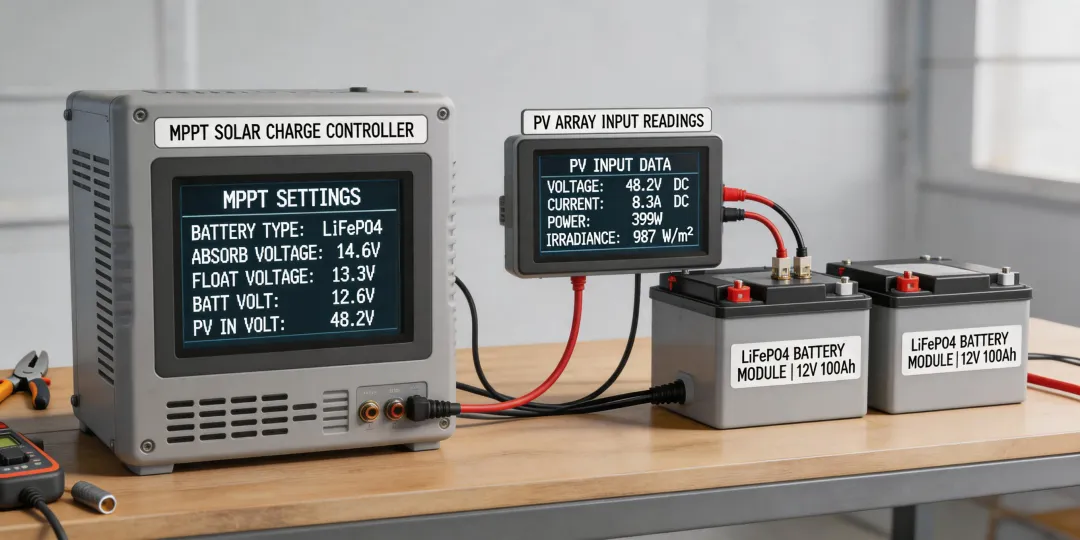
From my perspective, the hardware compatibility was fine. Our 30A MPPT controller supports 24V systems and has programmable LiFePO4 profiles. But Mike didn't know that. He'd looked at the manual, found the default settings (which are for flooded lead-acid), and assumed the controller wasn't compatible with lithium.
In our Q1 2024 quality audit, we'd identified a pattern: 12% of support tickets for small resellers were about something the product could do, but the documentation didn't make clear. Mike's case was one of those. The conventional wisdom in our industry is that if the hardware meets the spec, the sale is done. My experience with this specific case suggests otherwise.
What the Blind Test Taught Me
A month after the Mike incident, I ran a small blind test with our technical support team. Same controller. Two versions of the quick-start guide: our standard one, and a revised version that explicitly listed the steps for programming a 24V LiFePO4 battery profile, including which parameter to change and what values to input.
I asked six support reps to review each version and rate which one they'd feel more confident handing to a small reseller. Five out of six picked the revised version as 'more professional' without knowing which was the original. The cost to update the manual? About $400 in design and printing time. On a 50,000-unit annual order, that works out to less than a cent per unit.
For measurably better perception and fewer support calls. It wasn't a hard decision.
The Moment That Shifted My Perspective
The real turning point came when Mike called me back two weeks later. He'd installed the system using the settings I walked him through over the phone. A 24V LiFePO4 charger configuration on our EPEVER controller, paired with a flexible solar panel from EcoFlow, feeding a 100Ah lithium battery. No issues. No error codes. He said it was the smoothest commission he'd had all month.
Then he told me something that stuck: 'I almost didn't reach out. I figured you guys wouldn't care about a $180 order.'
That's the part that bothers me. We didn't do anything heroic—we just answered a question. But somewhere along the line, small resellers have learned that support from a brand like EPEVER is reserved for the big accounts. They expect to be ignored or upsold.
From my perspective, that's not just a customer service problem—it's a quality problem. If our product works perfectly but the customer can't or won't install it correctly because they don't trust us to help, the product might as well be defective.
What We Changed (and What We Didn't)
After the Mike incident, we made a few specific changes to how we handle these edge cases:
- Updated documentation for the Tracer 3210AN and 4210AN controllers to include a dedicated 'LiFePO4 setup' section with screenshots of the LCD menu path for the 24V programming.
- Created a one-page quick-reference card for small resellers covering the three most common use cases: 12V lead-acid, 24V LiFePO4, and dual battery configurations. If someone orders a single controller and nothing else, we toss the card in the box.
- Changed our rejection criteria for quality flags. If a customer asks a question that reveals a gap in our documentation, that's now a 'documentation opportunity' instead of a 'customer error.' In Q3 2024, we logged 14 such opportunities. That's 14 small orders where a question became a fix rather than a frustration.
What we didn't change: the product itself. The 30A controller Mike bought works fine for his use case. We didn't need a new SKU or a 'lithium version.' We just needed to make the existing knowledge easier to access.
Take this with a grain of salt, but I'd estimate that for every one customer who calls with a question, there are five who don't—they either return the product or suffer through a bad installation. If that's true, we saved five potential negative experiences with one phone call.
Why Small Orders Matter More Than They Seem
Here's the thing that people in mid-level quality roles like mine don't always appreciate: a small order today is often a big order tomorrow. Mike's first order was $180. In Q3 2024, he placed three more orders totaling $2,400. He's now recommending our dual battery solar charge controller to his customers because he trusts that the support will be there if he runs into an issue.
But even if Mike never grew beyond a few hundred dollars a year, his experience still matters to us. Because when a small installer posts in a forum—like the r/solar or DIY Solar Power groups—they influence dozens of other buyers. One negative post about 'EPEVER controllers don't work with LiFePO4' would cost us more in lost trust than that $180 order was ever worth.
I'm not saying we should accept unreasonable demands from small buyers. We still have minimum spec requirements and standard lead times. But I'd argue that the gap between 'a small order' and 'neglect' is wider than most quality departments realize. The cost of answering one question is almost nothing. The cost of not answering it can last years.
As of January 2025, I review incoming orders differently. If an order for a single controller comes through—especially if it's paired with a battery or panel from another brand—I check the support notes to see if we've proactively offered the right setup guide. Sometimes it's a 5-minute email. Sometimes it's a phone call. But it's never nothing.
Don't hold me to this, but I think we'll see more brands start treating small orders this way. The hardware is getting commoditized. The real differentiator is what happens after the sale—especially for people like Mike, who need a partner, not just a vendor.
Pricing and spec references in this article are based on EPEVER product documentation and internal quality audits from 2024. Verify current specifications at epever.com.