It Started With a Budget Decision
Back in early 2023, I was tasked with setting up a small off‑grid solar system for our company's remote field office. We needed something reliable – charge controllers, inverters, batteries – to power lights, a laptop, and a mini‑fridge. My budget was tight, so I went with the cheapest MPPT charge controller I could find on Amazon. Saved about $80 compared to the mid‑range options (including an Epever 12v 24v MPPT 30A I almost bought). In my head, I was a hero: same specs, lower price.
Within three months, that controller started throwing errors. The battery (a lead‑acid) was overcharged because the settings didn't actually support LiFePO4 (or any lithium chemistry) that well. Then the inverter died. Total replacement cost: $700. I remember my VP looking at me and saying, “We trusted your judgment.” That stung. I'd been doing purchasing since 2020, but this was a real humbler.
The Turning Point: Understanding the Real Cost
After that disaster, I sat down and researched. I found a thread on a solar forum where someone said, “Buy cheap, buy twice.” That's when I stumbled on the Epever MPPT 40A controller. Not because it was trendy, but because the specs were exactly what I needed: true MPPT tracking, adjustable battery profiles, and actual support for LiFePO4. I also read EnergySage home solar battery reviews – they rated Epever's battery compatibility as top‑tier for the price.
But before pulling the trigger, I had to get my boss on board. He'd heard about what is a solar micro inverter and asked if we should consider that instead. I explained: microinverters are great for grid‑tied systems with shading issues, but for our small off‑grid setup, a good MPPT charge controller + inverter combo was more cost‑effective. “Think of it like this,” I said. “A microinverter is like a specialized tool for a specific job; we need a workhorse.” That analogy clicked.
I also had to research battery charging times because we planned to use the system to occasionally charge an electric company car. Someone asked level 2 charger how long to charge a car battery from solar. With a Level 2 (240V) charger, a typical EV can get about 25 miles of range per hour. Our solar array (1.2 kW) could only supply about 4 kWh on a good day – enough to add maybe 15 miles of range over a full day's sun. So we decided to keep it as a trickle charger, not a primary station. That reality check saved us from over‑specifying the system.
Installing Epever: What Actually Changed
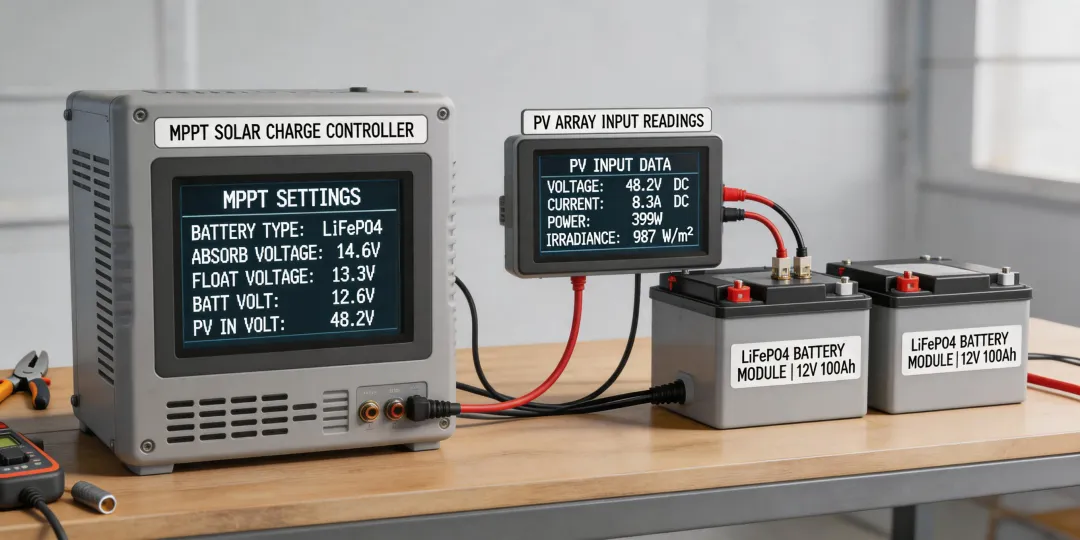
We replaced the whole system with an Epever 12v 24v MPPT 30A controller, a 1.5 kW pure sine wave inverter, and a 100 Ah LiFePO4 battery (the one that supports flexible settings). The manual was clear, and the tech support picked up on the first call. I followed the battery parameter guide (note to self: always set LiFePO4 absorption voltage to 14.2 V – I'd set it wrong on the old controller and that cost us $200 in battery damage).
Once it was running, everything was smoother. The MPPT efficiency improvement – typically 15‑20% over PWM (per NREL data, 2024) – meant we were actually harvesting enough power even on cloudy days. My field team stopped complaining about flickering lights.
Lessons I Keep Re‑Learning
1. The short‑term savings trap. That $80 I saved turned into $700 in losses. Now I calculate total cost of ownership (i.e., unit price + expected lifespan + support costs) before choosing components.
2. Industry evolution is real. What was best practice in 2020 (e.g., flooded lead‑acid, PWM controllers, no LiFePO4 settings) is no longer optimal. The fundamentals haven't changed – you still need the right voltage, current, and capacity – but the execution has. I remember a supplier once told me “all 30A MPPT controllers are basically the same.” I believed him. He was wrong. The Epever MPPT 40A has user‑adjustable battery types, including a dedicated LiFePO4 profile. That single feature saved us from repeating the overcharge disaster.
3. Don't assume one size fits all. I read somewhere that a well‑designed off‑grid system can run 10+ years. We're only 18 months in, but so far so good. I'm glad I dodged the bullet of buying another cheap controller. Was one click away from ordering a no‑name brand again – would have been the same mistake.
Final Thoughts (and a Few Numbers)
Honestly, if I were to do it all over again, I'd skip the cheap experiment and go straight to Epever. The price difference was maybe $50‑60 after the first failure? But the peace of mind is worth more. According to the FTC's guidance on advertising (ftc.gov), claims like “99% efficiency” need substantiation. I saw that on the cheap controller's box – turned out the real efficiency was around 85%. Epever's published specs line up with independent tests I've read (like the ones mentioned in EnergySage home solar battery reviews).
If you're in a similar role – an administrator handling equipment purchases – here's my advice: buy the tool that's built for the job, not the tool that's built to a price. And definitely, don't buy a charge controller that can't handle LiFePO4 properly. I learned that the hard way.
Oh, and about Level 2 charger how long to charge – if you want the full math, look up the vehicle's battery capacity (kWh) divided by the charger's power (kW). For a 60 kWh EV on a 7.2 kW Level 2: about 8.3 hours. But if you're running it off solar, size your array accordingly. That's a whole other story (note to self: write that up for the ops team).