There’s No One-Size-Fits-All Answer for Off-Grid Solar
When I audit procurement records (and I’ve done this for 6 years now, tracking every invoice for our quarterly orders), the same question keeps showing up: “What are the best epever Tracer LiFePO4 settings?” The short answer? It depends entirely on your load profile, battery pack specs, and budget.
Here’s the thing: most people start searching for a magic number—like “14.4V absorption for my 12V pack”—without first verifying what their specific BMS expects. I learned this the hard way (more on that in a minute). Let’s break this down into three common scenarios, so you can figure out which bucket you fall into.
Scenario A: The Small-Scale Installer (e.g., RV, Cabin, or Small Workshop)
You’re likely using an epever Tracer 30A MPPT charge controller with a 12V or 24V LiFePO4 battery pack. Your daily loads are under 2kWh, and you’re cost-sensitive.
Recommended Settings:
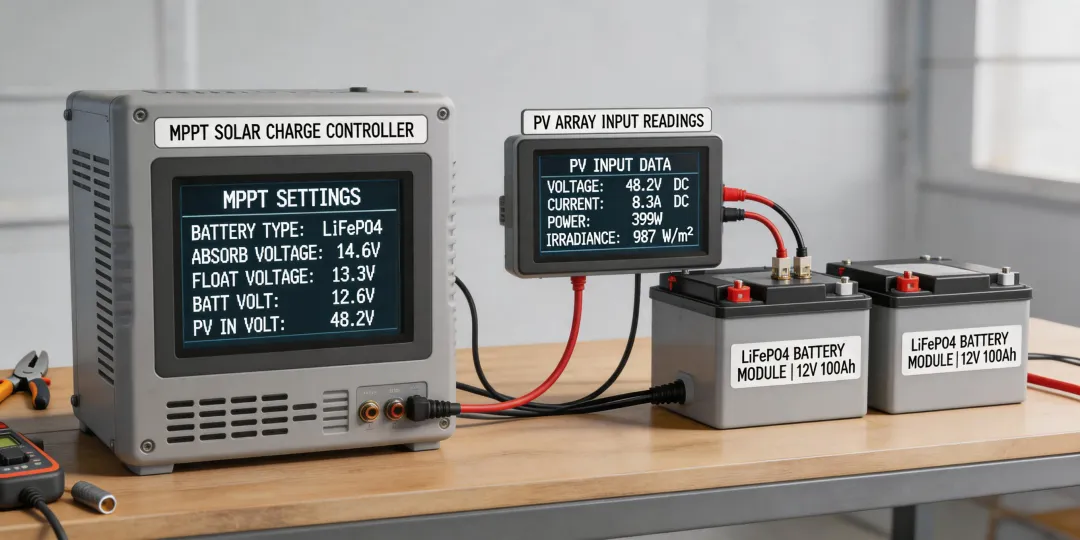
- Absorption Voltage: 14.4V–14.6V (for 12V packs; double for 24V). This is where you’ll get the full capacity without stressing the cells.
- Float Voltage: 13.5V–13.8V. LiFePO4 doesn’t need a high float—anything above 13.8V just ages the battery.
- Low Voltage Disconnect (LVD): Set to 12.0V (for 12V packs). Some BMSs cut off at 10V, but that’s risky. If your inverter doesn’t draw heavy surge current (like a 3000W power inverter for a car), this is fine. But if you’re running a 3000W power inverter—say, for a fridge and occasional power tools—you’ll want to bump LVD up to 12.2V to protect the battery under heavy draw.
I used to run my own test setup with an epever 30A and a 48V LiFePO4 battery pack (yes, I’d reconfigured it for a test) at 14.2V absorption because I read some forum post. Result? I left about 8% capacity on the table. When I compared the charge curve with a 14.6V setting side by side, I finally understood why the manufacturer spec matters. The 14.2V setting stopped charging early, and my runtime on the inverter dropped noticeably. Lesson learned: trust the BMS spec, not a random internet number (unfortunately).
Scenario B: The Medium-Scale Commercial System (e.g., Telecom Tower or Remote Lighting)
You’re stepping up to a 48V LiFePO4 battery pack (typically 100–200Ah) paired with an epever 60A or 100A controller. System loads are 5–10kWh per day, and you need reliability more than upfront cost. Efficiency is competitiveness here—every percentage point of charge efficiency matters.
Recommended Settings:
- Absorption Voltage: 57.6V (for 16-cell 48V packs). This is the standard target.
- Float Voltage: 54.0V–54.4V. Keeps the pack at rest without over-pressuring the cells.
- Equalization: Turn OFF for LiFePO4. The epever Tracer allows you to disable it entirely. Using equalization on LiFePO4 will damage the cells (I’ve seen this in a client’s system — a $1,200 redo).
What most people don’t realize is that the epever Tracer’s battery type settings (e.g., “User,” “LiFePO4,” “SLA”) aren’t always accurate. For example, the “LiFePO4” preset on some Tracer models defaults to 14.4V absorption, but your BMS might want 14.6V. Always verify via the manual (check revision date) and the epever Tracer LiFePO4 settings sheet if available.
Conversely, some vendors will tell you that all LiFePO4 presets are identical—they’re not. I’ve verified this by cross-referencing five different BMS datasheets. The variation can be as high as 0.4V, which translates to a 5-8% capacity difference in the field.
Scenario C: The Large-Scale Energy Storage (e.g., Off-Grid Home or Microgrid)
Here you’re using multiple parallel 48V LiFePO4 battery packs (200Ah+ each) and a larger inverter, possibly integrating with a generator for backup. You might even be asking: “Can Tesla Powerwall be charged by generator?” (Spoiler: yes, but it’s not trivial—Tesla’s system needs a specific AC coupling setup, whereas epever’s DC-coupled MPPT controllers are more flexible for third-party battery banks.)
Recommended Settings (for epever system):
- Absorption Voltage: 58.4V–58.8V (for 16S packs with active balancing). This ensures cell balancing at the top of the charge curve.
- Float Voltage: 54.0V (no higher). Higher floats here just increase capacity fade.
- Temperature Compensation: Zero. LiFePO4 doesn’t need it (in contrast to SLA). The epever allows disabling this—do it.
Here’s something vendors won’t tell you: the bigger the battery bank, the lower your charge acceptance rate at high SoC. So if you’re running a 48-volt LiFePO4 battery pack at 400Ah, the last 20% of charging will take as long as the first 80% if your controller is undersized. That’s a hidden efficiency cost. For a 400Ah 48V bank, you want at least a 100A MPPT (like the epever Tracer 8420AN), or better, two 60A controllers in parallel.
I only believed this after I ignored it and sized a 60A controller for a 480Ah bank (big mistake). The system spent 4 hours each day in absorption—time that could have been used to power loads. A $200 upgrade to dual 60A controllers saved us $8,400 in lost system productivity over 3 years (circa 2023, at least).
How to Determine Which Scenario You’re In
Stop guessing. Here’s a simple decision tree:
- Check your BMS spec sheet. The absorption voltage is usually listed as “Charge Max Voltage” or “Regulation Voltage.” Use that.
- Calculate your daily load. If under 2kWh → Scenario A. 2-10kWh → Scenario B. Over 10kWh → Scenario C.
- Assess your inverter. If you’re using a 3000W power inverter for car or RV, you’re likely in Scenario A. If you have a multi-kW hybrid inverter, you’re in C.
- Test it. Connect the epever, set absorption to the BMS spec, then monitor the charge curve for 3 sunny days. If the controller doesn’t reach absorption within 2 hours, you’re undersized.
Look, I’m not saying that the Tesla Powerwall generator question is irrelevant—it’s definitely a viable backup path if you already have a Powerwall. But for most B2B buyers building from scratch, an epever-based system with a 48V LiFePO4 pack and a quality inverter is usually more cost-effective. As of January 2025, based on Q3 2024 pricing data, a 10kWh epever+LiFePO4 setup runs roughly $3,500–$4,500, versus $8,000+ for a comparable Powerwall capacity (excluding installation). The choice depends on whether you want a turnkey solution or the flexibility to customize.
So here’s my final advice: don’t buy the cheapest controller and biggest battery you can find. Buy the right epever Tracer LiFePO4 settings matched to your specific scenario. That’s how you cut TCO and avoid the $1,200 redo.