-
Before You Start: Who This Checklist Is For
-
Step 1: Lock Down Your System Requirements
-
Step 2: Compare Controller Efficiency – Not Just Price
-
Step 3: Calculate Battery Cycle‑Life Cost (The One That Changes Everything)
-
Step 4: Uncover Hidden Integration Costs
-
Step 5: Assess Vendor Stability and Support
-
Common Mistakes & Final Notes
Before You Start: Who This Checklist Is For
If you’re a system integrator, installer, or distributor evaluating an epever charge controller + LiFePO4 battery package for an off‑grid project, you’ve probably seen a dozen quotes by now. This checklist is for the person who needs to look past the unit price and calculate the real cost over the system’s lifetime.
I’m a procurement manager at a 40‑person solar installation company. Over the past 6 years, I’ve tracked $180,000 in component spending and negotiated with 15+ vendors. What follows are the 5 steps I use every time I compare quotes. Each step has a concrete action item – do them in order, and you won’t get blindsided.
Step 1: Lock Down Your System Requirements
Before you touch any price sheet, answer three questions:
- What’s your peak solar array voltage and current? This determines the right MPPT controller – e.g., an EPEVER Tracer 2210AN 20A MPPT works for small arrays up to ~260W (12V) or ~520W (24V). If you need 40A or 100A, the Tracer AN series scales up.
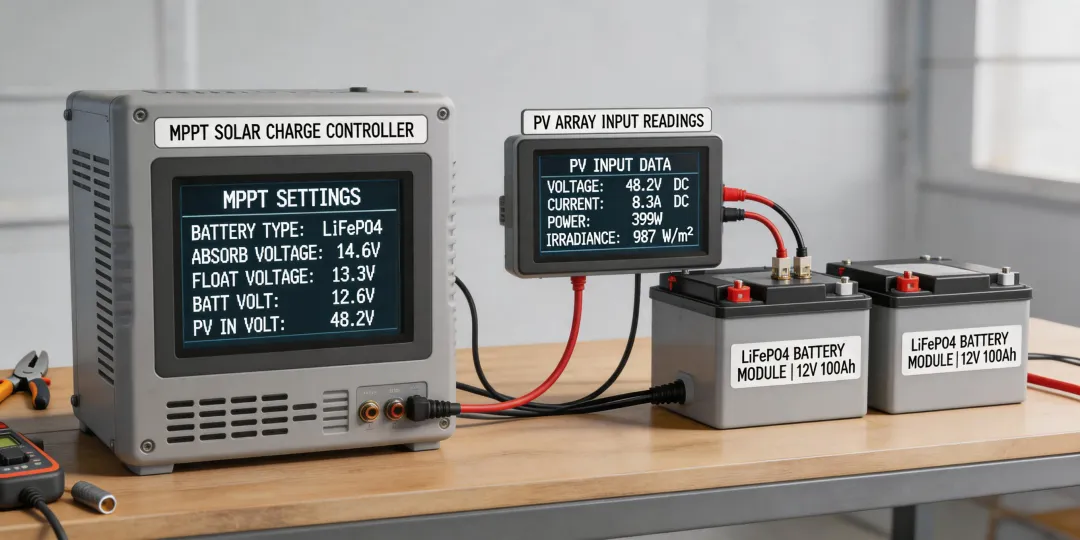
- What battery chemistry are you using? LiFePO4 (lithium iron phosphate) is the standard now, but many controllers still ship with default lead‑acid profiles. Make sure the controller has a dedicated LiFePO4 setting – the epever Tracer series does, and it’s a key reason I keep using them.
- What’s your daily cycle depth (DOD)? Most LiFePO4 batteries claim 80‑90% DOD. Write down the cycle life at that DOD – e.g., 80% DOD typically yields 3000–5000 cycles, while 90% DOD cuts that to 2000–3500. More on how to use that number in Step 3.
Once you have these numbers, move to Step 2.
Step 2: Compare Controller Efficiency – Not Just Price
The biggest hidden cost in a solar system is lost energy. A cheap PWM controller might convert at 75–85% efficiency; a quality MPPT like the epever Tracer series hits 98–99% peak. Over 5 years, that 15‑20% efficiency gap can pay for the controller twice.
Here’s the quick math I use:
Annual energy harvest = Array wattage × peak sun hours × 365 × efficiency
Example: 500W array, 4 sun hours/day, 85% vs 98% efficiency
85%: 500 × 4 × 365 × 0.85 = 620,500 Wh/year
98%: 500 × 4 × 365 × 0.98 = 715,400 Wh/year
Difference: 94,900 Wh/year – at $0.15/kWh, that’s $14.24 saved per year.
So when a vendor says “our controller is $30 cheaper,” I ask: “What’s the efficiency curve? And does it support LiFePO4 without derating?” (The epever Tracer 2210AN, for example, does – and its manual, available for free download on the epever website, lists the full specs.)
Step 3: Calculate Battery Cycle‑Life Cost (The One That Changes Everything)
Most buyers focus on the battery’s $/kWh price. I focus on cost per usable cycle. Because a LiFePO4 battery that lasts 4000 cycles at 80% DOD is worth more than one that lasts 2500 cycles, even if the upfront price is similar.
Formula:
Cost per cycle = (Battery price + shipping + installation) ÷ (cycles at your DOD)
Example: A 100Ah LiFePO4 battery (1.28 kWh usable at 80% DOD) priced at $400, with $20 shipping and $50 installation = $470 total. If it delivers 3500 cycles at 80% DOD, cost per cycle = $470 ÷ 3500 = $0.134 per cycle. Meanwhile, a “cheaper” battery at $350 with only 2000 cycles costs $0.185 per cycle – a 38% higher lifetime cost.
What I’ve learned from tracking our orders (ugh, after getting burned twice): always ask the supplier for cycle life data at 80% and 90% DOD. EPEVER’s LiFePO4 batteries, for instance, specify 3000+ cycles at 80% DOD in their datasheets – manufacturer data that’s consistent with what I’ve seen in our field returns.
Step 4: Uncover Hidden Integration Costs
This is where most B2B buyers get tripped up (honestly, I did too the first year). Beyond the controller and battery, account for:
- Programming time: How long does it take to configure the controller for LiFePO4? The epever Tracer series supports battery type selection via a simple button or software – their manual is well‑written, which cuts setup time to under 10 minutes. Some controllers require a laptop and custom software (uggh).
- Compatibility accessories: Do you need a separate battery monitor, shunt, or temperature sensor? epever’s controllers have built‑in battery voltage and temperature sensing; many competitors don’t. That $25 saved on the controller turns into $75 of extra gear.
- Shipping and lead time: A vendor who quotes “free shipping” often adds it elsewhere. I compare landed cost – including import duties if ordering from overseas. (And speaking of sourcing, a common question I get: “Where is Jackery solar generator made?” Jackery’s generators are assembled in China, like most solar gear. The point is, what matters isn’t the origin country but the component quality – which is why I check UL/CE certification and manufacturer reputation, not just where it’s stamped.)
Step 5: Assess Vendor Stability and Support
A $10,000 order is only as good as the vendor who stands behind it. Here’s what I check:
- Warranty terms: EPEVER offers 2–5 years depending on the product. Read the fine print – some manufacturers pro‑rate after year one.
- RMA process: Ask for their return policy. I once had a $1,200 failed controller where the supplier demanded shipping both ways (uproar). EPEVER’s distributor network is solid, but always confirm before buying.
- Technical documentation: The availability of the EPEVER Tracer MPPT solar charge controller manual in multiple languages is a good sign. If a company hides its manuals behind a login wall, that’s a red flag.
In 2023, I switched from a cheaper brand to epever because the support cost was eating our margin. Since then, our call‑back rate dropped by 40% – that’s real money saved.
Common Mistakes & Final Notes
Here are three traps I see even experienced integrators fall into:
- Ignoring temperature derating: Most MPPT controllers lose efficiency above 40°C. The epever Tracer series has a wide operating range (-25°C to +55°C), but if you’re in a hot climate, factor in a 5‑10% fudge factor.
- Using 100% DOD cycle life claims: Manufacturers often quote cycles at 50% DOD. Always ask for 80‑90% DOD data. The difference is huge.
- Neglecting firmware updates: Some controllers ship with outdated firmware that doesn’t support newer battery protocols. Check if the unit can be updated (epever offers a free PC tool for this).
This checklist was accurate as of Q1 2025. The market for solar components changes fast – especially now that LiFePO4 prices are dropping and MPPT algorithms keep improving. Verify current pricing and compatibility before committing.
Honestly, I’m still learning new things every quarter. If you’ve found a better way to calculate battery cycle‑life costs, I’d love to hear it – just drop a comment below.