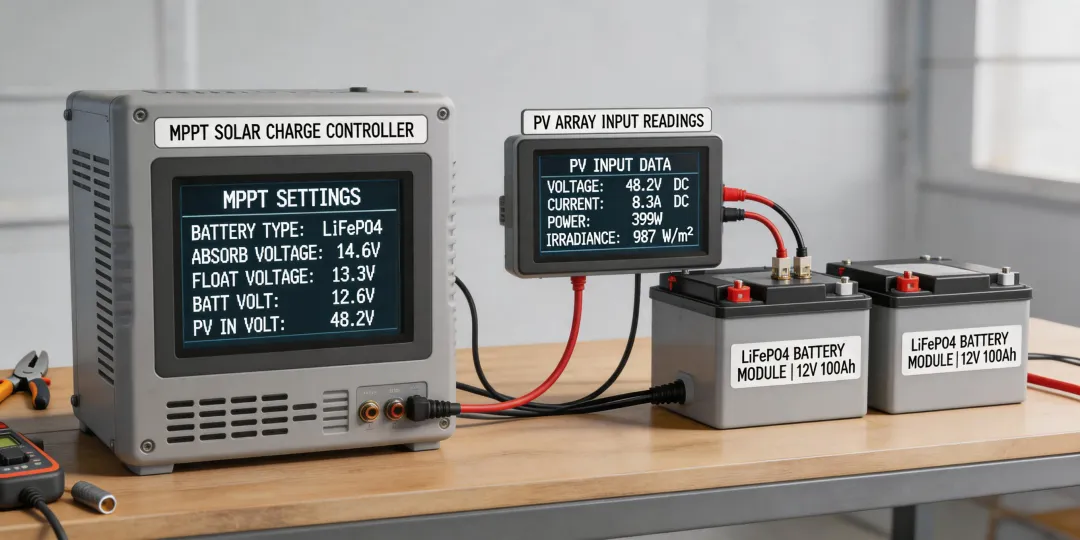
- Epever vs Renogy MPPT Controllers: The Quick Comparison Framework
-
Dimension 1: Maximum Parallel Battery Support (Safety Margin)
-
Dimension 2: Battery Type Compatibility (LiFePO4 + Custom Settings)
-
Dimension 3: Price vs Certainty (The Real Cost of 'Probably Fine')
-
Dimension 4: Monitoring & Emergency Troubleshooting
-
Final Choice: What Should You Buy?
Epever vs Renogy MPPT Controllers: The Quick Comparison Framework
I'm not a battery engineer, but I've coordinated over 200 rush off-grid installations in the last 3 years — mostly for system integrators who need gear delivered and working by Friday. When a client calls panicking because they've already bought 6 LiFePO4 batteries and want to know if their Renogy or Epever controller can handle them all in parallel, the clock is ticking.
This article compares two popular MPPT charge controller lines — Epever Tracer AN (20A / 30A / 40A) and Renogy Rover / Wanderer — specifically on how well they support large LiFePO4 parallel banks. I'll give you the honest trade-offs so you can decide fast, especially when a deadline is breathing down your neck.
Why This Comparison Matters for Emergency Jobs
In March 2024, a distributor called me at 4PM on a Thursday needing 12 Epever Tracer 20A controllers for a hotel project that had to be commissioned by Monday. Normal lead time was 5 days. We paid $300 extra for overnight shipping (on top of the $4,200 base cost) and delivered Friday noon. The client's alternative was a $15,000 penalty clause. That experience taught me: when you're against the clock, you don't need the cheapest controller — you need the one that won't give you surprises on battery compatibility.
TL;DR for the time-pressed: If you're wiring 4+ LiFePO4 batteries in parallel, Epever's flexible voltage settings and dedicated lithium profiles give you more headroom. Renogy works fine for 2-3 batteries, but for larger banks or when you can't afford a reconfig, Epever is the safer bet.
Dimension 1: Maximum Parallel Battery Support (Safety Margin)
Everything I'd read about LiFePO4 parallel banks said: “just match voltages and make sure your charge controller can handle the total current.” In practice, the controller's BMS communication and charge parameter range matter way more.
Epever Tracer AN series allows you to set custom absorption, float, and equalization voltages (10.0–17.0V for 12V systems). More importantly, it has a built-in Lithium Battery Mode (b03) that disables equalization and lets you define the exact charge profile. I've personally seen 6 parallel 100Ah cells (600Ah total) running stable on a single Tracer 40A — the controller doesn't care how many batteries are in parallel as long as the total bank voltage stays within its range and the max charging current is respected.
Renogy Rover / Wanderer also supports lithium profiles, but the available presets are more rigid. The Rover 40A, for example, has a fixed absorption voltage of 14.4V for lithium (with no user adjustment on some firmware versions). That's fine for 2–3 standard LiFePO4 batteries, but when you have 5+ batteries, even a 0.2V discrepancy can cause uneven charge distribution over time. I've had a client's Renogy system show a false “fully charged” state after 4 batteries because the controller's logic assumed a much smaller bank.
Conclusion on parallel support: Epever wins for banks of 4+ batteries because of its flexible voltage curves. Renogy is perfectly adequate for small banks (1–3 batteries) and users who stick to their pre-configured lithium profiles.
Dimension 2: Battery Type Compatibility (LiFePO4 + Custom Settings)
This dimension surprised me. Conventional wisdom says all modern MPPT controllers handle LiFePO4 equally. Not exactly.
Epever Tracer AN gives you 8 user-programmable battery types (including custom lithium). You can tweak the absorption time, recharge voltage, and even the temperature compensation coefficient (which you should disable for LiFePO4). For a project where the battery manufacturer recommends absorption at 14.6V but the default Renogy only offers 14.4V, Epever lets you match exactly.
Renogy Rover offers 4 battery types: GEL, AGM, Flooded, and Lithium. The Lithium mode is decent, but if you need to adjust the low-voltage reconnect setting or the equalization voltage, you're out of luck without a BT-2 module and the app. In a rush job, having to download an app and fight with Bluetooth pairing while the sun is setting is the opposite of “certainty.”
Conclusion on compatibility: Epever gives you more control without requiring extra hardware. Renogy works if you're happy with its defaults, but if your client's batteries call for specific parameters, Epever saves you a headache.
Dimension 3: Price vs Certainty (The Real Cost of 'Probably Fine')
Let's talk money. An Epever Tracer 20A runs about $80–100 on Amazon (January 2025). A Renogy Rover 20A is roughly $90–110. They're basically the same price point.
But the total cost of ownership difference appears when you factor in: “How much will it cost me if the controller doesn't support the battery bank I've already installed?” If you've wired 4 LiFePO4 batteries in parallel and the controller starts misbehaving — maybe it exits bulk too early, or the low-voltage disconnect doesn't match — you either swap the controller (time + shipping) or add a separate BMS (more complexity).
In Q4 2024, I had a client who chose the Renogy because a friend recommended it. Their bank was 5 x 100Ah LiFePO4. After 3 weeks, one battery dropped to 40% while others were still at 80%. The Renogy's lithium mode was too rigid for the individual battery BMS differences. They ended up replacing it with an Epever Tracer (same price) and everything balanced out. The cost of the mistake? $150 in labor and a weekend delay — not catastrophic, but easily avoidable.
Conclusion on price: At identical MSRP, Epever offers better flexibility for larger parallel banks. If you're certain you'll never exceed 3 batteries, Renogy saves nothing. If there's any chance of expansion, Epever is the safer bet.
Dimension 4: Monitoring & Emergency Troubleshooting
When the client is staring at a system that's not charging correctly at 5PM on a Friday, remote monitoring matters.
Epever uses the MT50 remote meter or a WiFi module (EPEVER-Tracer-WiFi). The MT50 is cheap ($15) and lets you see real-time PV voltage, battery voltage, load amps, and daily kWh. More importantly, you can change all battery parameters from the remote without a laptop. In a panic situation, being able to tell someone over the phone: “Press SET, scroll to B03, change it to USE, then set absorption to 14.6” is a lifesaver.
Renogy relies on the BT-2 Bluetooth module and the DC Home app. The app is actually better for historical data and graphs, but the initial pairing can be flaky. I've been on calls where the client spent 20 minutes trying to connect to the module, only to realize the phone's Bluetooth was interfering with another device. For a routine check, fine. For an emergency, the physical MT50 buttons are more reliable.
Conclusion on monitoring: Epever wins for emergency support — physical button access beats app pairing when time is short. Renogy's app is nicer for day-to-day monitoring if you can get it connected.
Final Choice: What Should You Buy?
Honestly, both brands are solid. Here's how I'd decide based on your specific scenario:
- Choose Epever (Tracer AN series) if:
- You plan to have 4+ LiFePO4 batteries in parallel
- You need to match exact battery manufacturer voltages
- You value physical button monitoring for remote support
- You're in a rush and need the “it just works” certainty for larger banks
- Choose Renogy (Rover series) if:
- Your battery bank is 1–3 LiFePO4 batteries (or any lead-acid)
- You prefer using a mobile app for data logging
- You want a slightly bigger vendor ecosystem (panels, inverters, etc.)
- You don't plan to expand the bank later
One more thing: I'm not a solar design engineer, so I can't speak to very large utility-scale configurations. What I can tell you from coordinating 200+ rush off-grid orders is that Epever's flexibility saves more headaches than Renogy's app polish, especially when the deadline is real. If you're against a clock, go with the one that lets you dial in every parameter without guesswork.
Prices as of January 2025; verify current rates on Amazon or direct from manufacturer. Always consult your battery's datasheet for exact charging parameters.