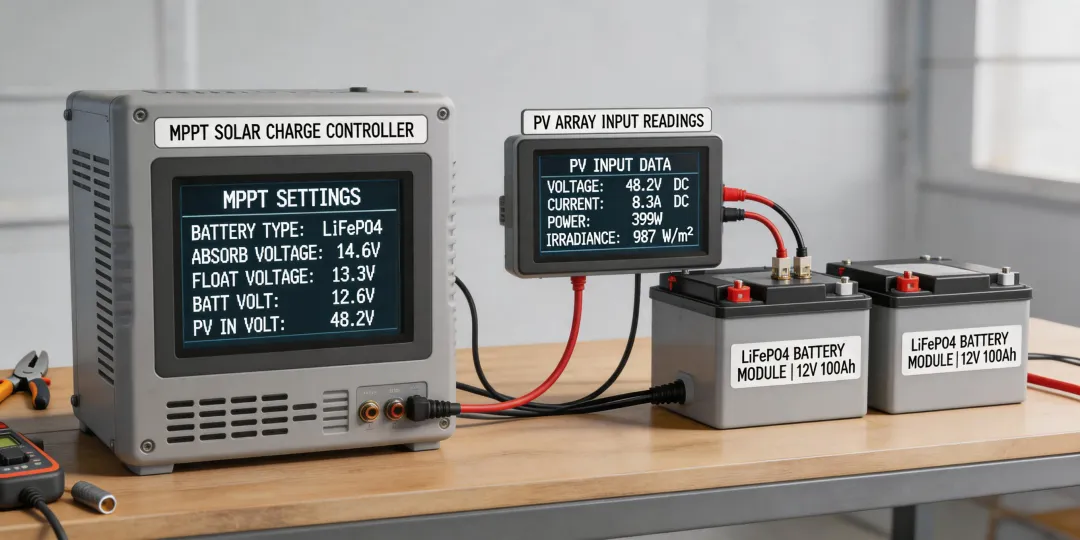
There is no single "best" EPEVER charge controller. The one that's right for you depends entirely on what you're trying to build. I review incoming components for a solar distributor—roughly 200 unique items annually, across brands like EPEVER, Victron, and Renogy. I've seen what happens when a controller is underspecified (fried FETs, melted terminals) and what happens when it's overkill (wasted budget). My job is to catch mismatches before they reach the customer.
So, here's my take on the EPEVER lineup, broken down by use case. I'm not going to tell you one model is universally 'better'. Instead, let's figure out which one matches your actual system.
The Main Contenders
EPEVER's core line-up for residential and commercial systems generally falls into three families:
- Tracer AN Series: The standard MPPT controller. A workhorse for typical 12V/24V systems.
- Tracer BN Series: A higher-voltage version, often used in grid-tie or larger off-grid setups with series-panel strings.
- VS Series: Their PWM (Pulse Width Modulation) controllers. The budget option, but with real limits.
Then there are the hybrids like the EPEVER UP-HW series (combined inverter/charger), but those are a different discussion. Here, I'm focusing on standalone charge controllers.
Scenario A: The Budget-Minded 12V System (Small RV, Cabin, Van)
Best Fit: VS Series (PWM) or Tracer AN Series (MPPT)
This is the most common entry point. Someone has a single 100W or 200W solar panel, a 12V lithium (LiFePO4) battery, and they just want to keep lights and a phone charged.
If your panel voltage is roughly the same as your battery voltage (e.g., a 12V panel for a 12V battery), a VS Series PWM controller will work. It's cheap, simple, and reliable. I've tested dozens of them. They don't offer the efficiency of MPPT, but at this scale, the difference might be 10-20W. Is that worth a $50 premium? For many, no.
But here's the catch: I've rejected several batches of generic PWM controllers where the advertised '10A' rating was only sustainable for 30 seconds before thermal shutdown. The EPEVER VS Series, in my experience, actually meets its specs. They're not flashy, but they're consistent.
That said, if you're using a higher-voltage 'residential' panel (like the 430W Philadelphia Solar bifacial panel mentioned in some searches) or you expect to expand your system later, skip the PWM. The voltage mismatch will kill your efficiency. For that, you need MPPT.
Scenario B: The Grower's System (More Power, Higher Voltage, Expansion Planned)
Best Fit: Tracer AN Series (MPPT)
This is where the Tracer AN shines. If you have, say, four 200W panels wired in a 24V battery bank, the Tracer AN (e.g., 30A or 40A model) is the sweet spot.
From a quality perspective, this is EPEVER's bread and butter. The components are well-sourced—the capacitors and MOSFETs I've seen in teardowns are from reputable manufacturers. The casing is robust. The MT50 remote meter is a nice touch for monitoring.
One thing I always check: The unit's maximum PV input voltage. For the Tracer AN, it's typically 100V or 150V. If you live in a cold climate, solar panels produce higher voltage. I once had a customer wire 3 x 200W panels in series (like 60V each) on a 100V controller. On a cold morning, the voltage spike blew the controller's input stage. It was a $120 mistake. The controller was fine—it did its job and sacrificed itself—but the customer had to replace it. Always check the Voc (open-circuit voltage) of your panels in the coldest expected temperature. Don't exceed 80% of the controller's rating as a safety margin.
Scenario C: The High-Voltage Grid-Tie or Large Off-Grid System
Best Fit: Tracer BN Series (High-Voltage MPPT)
This is for someone running a string of 5+ panels in series. The Tracer BN can handle up to 200V or 300V input, which means thinner wires and less voltage drop from the roof to the controller.
I'm less familiar with the BN series personally—I've only audited a few batches. But from the specs, it's built for this use case. It has more monitoring features and can handle higher current.
Honestly, I'm not sure why someone would pick a BN over a Victron SmartSolar 150/45 at a similar price point. The Victron has a deeper ecosystem (Bluetooth, app, remote monitoring). EPEVER's BN has the MT50, which is functional but less polished. If you're building a complex system and want data logging, the Victron might be easier to live with. But if you just want reliable power conversion for a high-voltage array and you're comfortable with the EPEVER ecosystem, the BN does the job.
How to Decide: A Simple Checklist
Don't rely on guesswork. Here's the process I use when I'm specifying a controller for a customer:
- Battery Voltage: 12V, 24V, or 48V? This dictates the controller's current rating needed.
- Total Solar Wattage: Add up your panel wattage.
- Panel Voc (Voltage Open-Circuit): Look at the panel's datasheet. This determines if you need a standard (100V/150V) or high-voltage (200V/300V) controller.
- Calculate Current: Solar Wattage ÷ Battery Voltage = Approximate Amps. Add 25% safety margin. Buy a controller rated for that current.
- Budget: If the total system budget is under $500, go VS (PWM) or small Tracer AN. If over $1000, invest in the Tracer BN or look at competitors.
For example: Philadelphia Solar 430W bifacial panels (Voc around 49V). Two in series = 98V. On a 24V battery bank, wattage is 860W. Amperage is ~36A. A Tracer AN 40A (rated for 100V input) would be the textbook fit. You'd be at the edge of its voltage limit, so I'd personally prefer a model with a higher Voc rating, like a 150V model, for safety. The BN series would handle it easily.
My Final Take
EPEVER makes solid, reliable charge controllers for the price point. They're not the cheapest—that would be some no-name Chinese PWM unit I wouldn't trust. They're not the most feature-rich—that's Victron. They occupy a good middle ground: reliable, reasonably priced, and with a strong product ecosystem.
I've rejected more cheap controllers than I can count. I've rarely rejected an EPEVER. The ones that do fail in the field are usually undersized for the system. Buy the right one for your scenario, and it should give you years of service. If you're still unsure, pick the Tracer AN 40A. It's the most flexible option for most people.