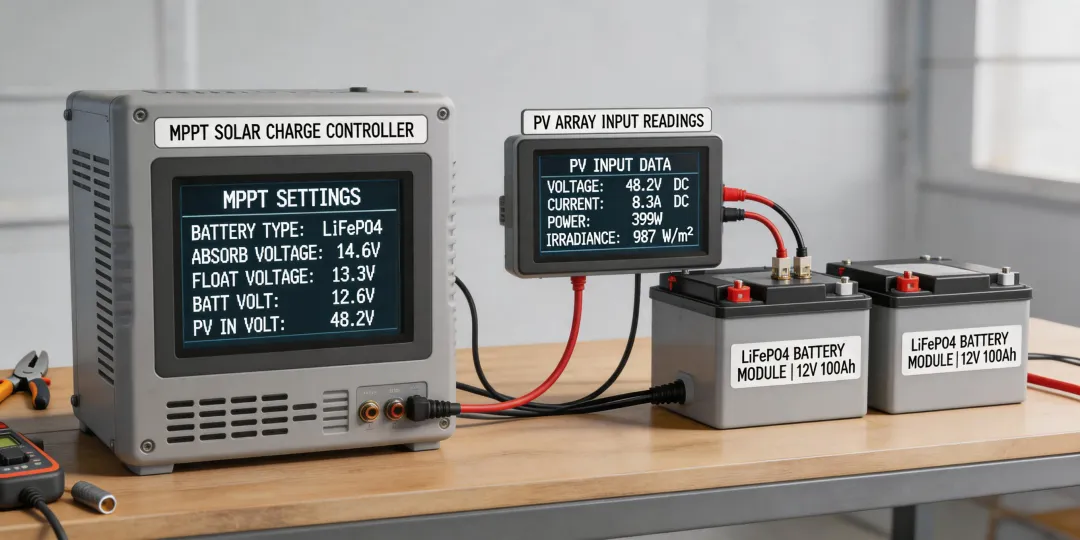
If you’re piecing together an off‑grid solar system, you’ve probably landed on EPEVER for controllers and a 12V 120Ah LiFePO4 battery for storage. Good starting point. But here’s the thing: there’s no one “right” answer. Whether you need the 10A EPEVER MPPT or a bigger model depends on your load, your battery chemistry (yes, there are nuances), and — frankly — how much headache you’re willing to tolerate down the road.
I manage purchasing for a mid‑sized company that does a lot of field installations — think remote monitoring stations, off‑grid workshops, and the occasional RV retrofit. We’ve ordered maybe 60‑80 charge controllers over the last three years, and I’ve had my share of “oops” moments. So I’ll walk you through the scenarios I see most often, and help you figure out which camp you’re in.
First, a quick terminology note: LiFePO4 vs LFP
This still confuses people, and I don’t blame you. “LiFePO4” and “LFP” refer to exactly the same chemistry — lithium iron phosphate. LFP is just the industry shorthand (like calling nickel‑metal‑hydride “NiMH”). The ‘L’ stands for lithium, ‘F’ for iron, ‘P’ for phosphate. I’ve seen resellers list “LiFePO4 battery” on one page and “LFP battery” on another, and buyers think they’re different products. They’re not. If you’re looking at a 12V 120Ah battery labeled either way, the specs are identical. What matters is the voltage profile and whether your controller is programmed for it.
That said, the older belief that you need special “LiFePO4‑only” controllers is mostly a vestige from the days when lead‑acid settings were all you had. Today, most quality MPPT controllers — and especially EPEVER’s lineup — include dedicated LiFePO4 profiles. You just select battery type “Li” or “LFP” in the settings (check the manual, because some older units call it “User” and you set custom voltages).
Three common scenarios, three different recommendations
Scenario A: Small, portable system — 10A EPEVER MPPT with a 12V 120Ah LiFePO4
You’re building a power station for camping, a tiny shed, or emergency backup for a single light and a phone charger. Your daily load is under 500Wh, and you want something simple, light, and cheap. In this case, the EPEVER 10A MPPT (like the Tracer AN series) paired with a 12V 120Ah LiFePO4 battery is actually a great match — assuming your panel wattage is modest (≤150W, ideally 100W–130W).
Why? Because the 10A controller is usually the smallest that still gives you MPPT efficiency (versus a PWM that wastes 20–30% of panel power). The 120Ah battery gives you roughly 1.5kWh usable (if you respect the 80% DoD recommendation for longevity), which is plenty for a few days of light usage. And the whole setup fits in a plastic toolbox.
But be careful: If you ever plan to add a second panel or a bigger inverter, you’ll outgrow the 10A fast. I’ve had to swap out three controllers in one year for a client who started small and then added a mini‑fridge (ugh, always the fridge). So if there’s any chance you’ll expand, go up to a 20A or 30A — the price difference is maybe $20, and it saves you a return trip.
“That $200 savings turned into a $1,500 problem when the undermounted controller kept tripping on startup surge (like a fridge compressor).” — from my notes on a 2024 project
Scenario B: Full‑time off‑grid cabin or workshop — need more than 10A
Here your daily load is 1–3kWh, you’ve got 400–800W of panels, and you’re running lights, a laptop, a water pump, and maybe a TV. The 10A won’t cut it. You need an EPEVER 30A or 40A MPPT (Tracer or Duo series). With a 12V 120Ah battery, you can only draw about 1.4kW max continuous before the BMS shuts down (most 120Ah LiFePO4 have a 100A or 120A BMS, which at 12V is ~1.4kW). If your inverter is bigger than 1000W, you’ll either need to parallel two 120Ah batteries or go to a 24V system.
In my experience, when people buy a single 12V 120Ah LiFePO4 and pair it with a 40A controller, the controller is rarely the bottleneck — the battery is. The controller can push up to 40A × 12V = about 520W from the panels, which is fine for moderate solar. But if you have 800W of panels, you’re leaving some energy on the table (controller clips at 40A). In that case, a 60A controller or a 24V battery bank makes more sense.
One tip I wish someone had told me: Set your EPEVER controller’s absorption voltage to 14.4V–14.6V (for LFP) and float voltage to 13.6V–13.8V. Many default profiles are for lead‑acid and float too high, which can degrade a LiFePO4 over time. The manual shows how, but it’s easy to skip (unfortunately). I’ve seen a client’s battery swell after six months because they left the “Gel” profile on.
Scenario C: Upgrading an existing system — you already have a different controller
Maybe you inherited a system with a cheap PWM controller and a dead battery, and you want to drop in an EPEVER MPPT and a 12V 120Ah LiFePO4. This is where compatibility gets tricky. The old panels might have a high Voc (open‑circuit voltage) that the new controller can handle — EPEVER’s 10A MPPT has a max PV input of 100V, which is generous. But check your panel specs. Also, if your old wiring is thin (e.g., 14AWG for a 10A controller), it’s fine. For larger controllers, you may need to upgrade to 10AWG or 8AWG.
I’d strongly recommend buying an EPEVER with a display or Bluetooth module (the MT‑50 or phone app) so you can verify the battery profile is set correctly. Otherwise, you’re flying blind. I’ve had suppliers ship controllers with firmware that expects a different BMS communication protocol — and without the meter, you’d never know why the battery wasn’t charging (that was a fun $60 troubleshooting mistake).
How to decide which scenario you’re in
Grab a piece of paper and answer three questions:
- What’s your maximum continuous load? Add up everything that could run at the same time (lights + fridge + modem + fan). Multiply by hours you need backup. If it’s under 500Wh/day, Scenario A. Under 2kWh/day, Scenario B. Over that, you probably need parallel batteries or a 24V system.
- Will you expand within 2 years? If the answer is “maybe,” don’t buy the 10A. Go straight to a 20A or 30A. The extra $15–20 now is cheaper than buying a second controller later.
- Do you prefer simplicity or flexibility? If you never want to tweak settings, buy an EPEVER with a preset LiFePO4 mode (most newer models have that). If you’re a tinkerer, get a “User” mode and dial in your own absorption/float voltages.
In every case, remember: the cheapest upfront option often ends up costing more. I’ve seen a $35 PWM “work” for a month and then fail when a cloud passed — leaving the battery undercharged in winter. An EPEVER MPPT (even the 10A) is usually $55–70, and it’ll harvest 20–30% more energy from the same panel. Over a few months, that difference pays for itself. And that’s before you factor in the cost of a dead battery from improper charging.
I can only speak to systems we’ve deployed in temperate climates with predictable sun. If you’re in a tropical environment with high heat or extreme cold, your battery BMS and controller thermal management might behave differently. Your mileage may vary — but the core principle stays: match the controller amperage to your panel wattage, and match the battery capacity to your daily load. Ignore the noise about “LiFePO4 vs LFP” — it’s the same thing. And always, always verify the charging profile against the battery datasheet. Your future self will thank you (especially when the system runs for years without a hiccup).