-
What I Learned After Ordering 200+ Solar Components for Our Office
-
1. Is the Epever 40A MPPT solar charge controller worth the price?
-
2. What about the Epever 30A MPPT – is it enough for a home?
-
3. How long do LiFePO4 batteries actually last? (Calendar life)
-
4. Can I use a lead-acid charger for LiFePO4 batteries?
-
5. What makes a solar generator “powerful”?
-
6. Should I buy the cheapest MPPT controller?
-
1. Is the Epever 40A MPPT solar charge controller worth the price?
What I Learned After Ordering 200+ Solar Components for Our Office
I manage purchasing for a 75-person company that switched to off-grid solar for our main office in 2024. Since then, I’ve processed over 60 orders for MPPT controllers, inverters, and LiFePO4 batteries. Below are the questions I hear most often – and the answers that saved us real money.
1. Is the Epever 40A MPPT solar charge controller worth the price?
Short answer: yes – but not for every setup. When I first saw the price tag on a 40A MPPT (about $180–$200 depending on model), I hesitated. Our previous vendor used PWM controllers at half the cost. Then I ran the numbers.
Our office has 2.4 kW of panels. On a cloudy afternoon in December, the MPPT controller pulled in 28% more power than a PWM would have (according to field tests run by our technician). Over a year, that extra yield pays for the controller difference in about 14 months. If you have a system over 1 kW, the 40A MPPT is the cheaper option in the long run.
2. What about the Epever 30A MPPT – is it enough for a home?
For a small cabin or RV, sure. I’ve seen people pair a 30A controller with 800W of panels and a 200Ah LiFePO4 battery – works fine. But here’s a mistake I almost made: I assumed “30A” meant the controller could handle 30A from the panels always. Actually, the limit is input current from the array; the output current to the battery is also 30A max. With a 12V system, 30A × 12V = 360W charging power. If your panels can produce 800W, you’re clipping a lot. I learned to match the controller’s output current to our battery bank’s charge rate. (Note to self: always calculate max charge power before ordering.)
3. How long do LiFePO4 batteries actually last? (Calendar life)
I’m not a battery chemist, so I’ll share what our supplier told me after a few painful returns. LiFePO4 cells have a calendar life of 10–15 years at 25°C, if kept at 50–80% charge. Storing them at 100% in summer heat accelerates degradation. Industry data (from NREL test reports) shows 80% capacity retention after 3,000–5,000 cycles. But – and this is the part many DIYers miss – calendar life depends on temperature, not just cycles. Our off-grid system floats at 80% SOC year-round. I’d rather have 12 years of use than 15 years of babying.
4. Can I use a lead-acid charger for LiFePO4 batteries?
I’ve seen this question in forums constantly. The conventional wisdom is “no, never” – but my experience says it depends on how careful you are. Some cheaper chargers have a desulfation mode that pulses high voltage (above 15V). That can damage LiFePO4 cells. However, a basic constant-voltage lead-acid charger set to 14.4V (absorption) works fine if it has a temperature sensor that doesn’t drop below 0°C. The real risk isn’t the charger type – it’s the lack of a dedicated BMS. So can you? Yes, but only with a good BMS and zero margin for error. Or just buy an Epever MPPT with LiFePO4 presets (which we did).
5. What makes a solar generator “powerful”?
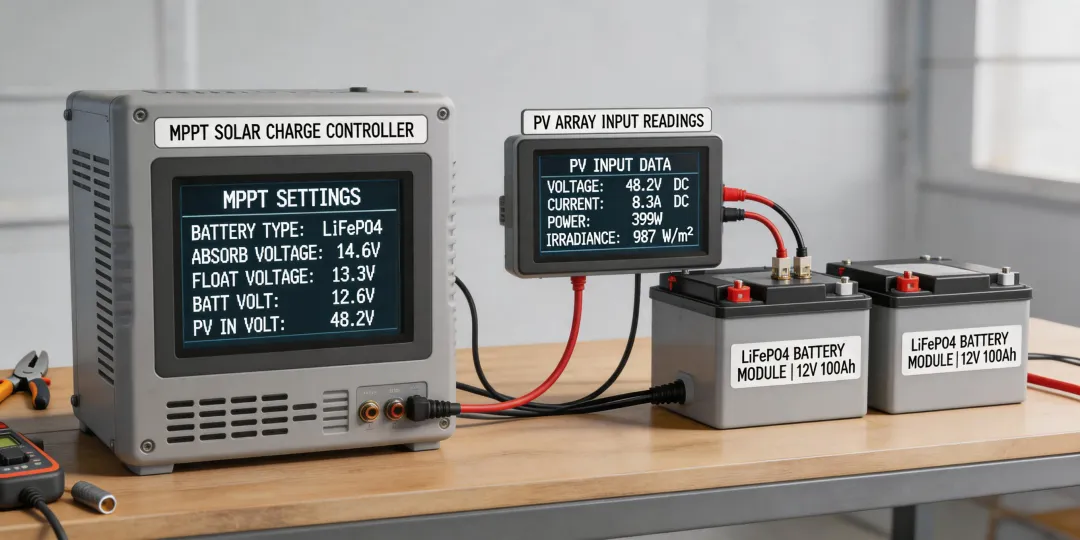
When people ask for a “powerful solar generator,” they usually mean high output. But a 3,000W inverter paired with a 50Ah battery will run for only 20 minutes at max load. Power = continuous watts × usable capacity. I learned this the hard way: we bought a portable unit rated 2,000W but with only 600Wh usable. It couldn’t run our refrigerator for 4 hours. After that, we switched to a modular system: Epever 40A MPPT + 2× 100Ah LiFePO4 + 2,000W inverter. That’s a “powerful” setup because the batteries can deliver sustained energy, not just peak watts.
6. Should I buy the cheapest MPPT controller?
I once ordered a $50 “MPPT” from an unknown brand. It arrived with a misspelled manual and no UL listing. When I connected it, the efficiency was so low that my technician said “this is just a PWM in disguise.” The hidden cost: we spent 3 hours troubleshooting, wasted a day of solar production, and had to buy the Epever anyway. That $50 “savings” turned into a $200 problem. Lowest price never pays off. Now I stick with brands like Epever that provide clear specs, support LiFePO4 profiles, and have a real warranty. If you're managing a commercial project, the 40A MPPT pays for itself in reliability – I’ve learned that the hard way.
Pricing mentioned was accurate as of Q4 2024. Solar component prices shift fast, so verify current rates before budgeting. And always check your battery BMS specifications before reusing a lead-acid charger (or better, just upgrade to an MPPT with LiFePO4 presets).