The Project That Forced Me to Rethink Everything
Back in August 2024, our regional operations team dropped a bombshell: we needed to set up solar-powered remote monitoring at three off-grid sites within six weeks. I'm the office administrator who handles all equipment purchasing for our 120-person company—roughly $180k annually across 15 vendors. This was my first major renewable energy buy, and I thought I had it figured out.
My Naive Shopping List
I started by searching for "solar panel remote monitoring system" and quickly landed on a few generic kits. "It's just a controller, a battery, and some panels," I told myself. That was my first mistake. The simplification fallacy I didn't see coming: assuming all MPPT controllers are interchangeable.
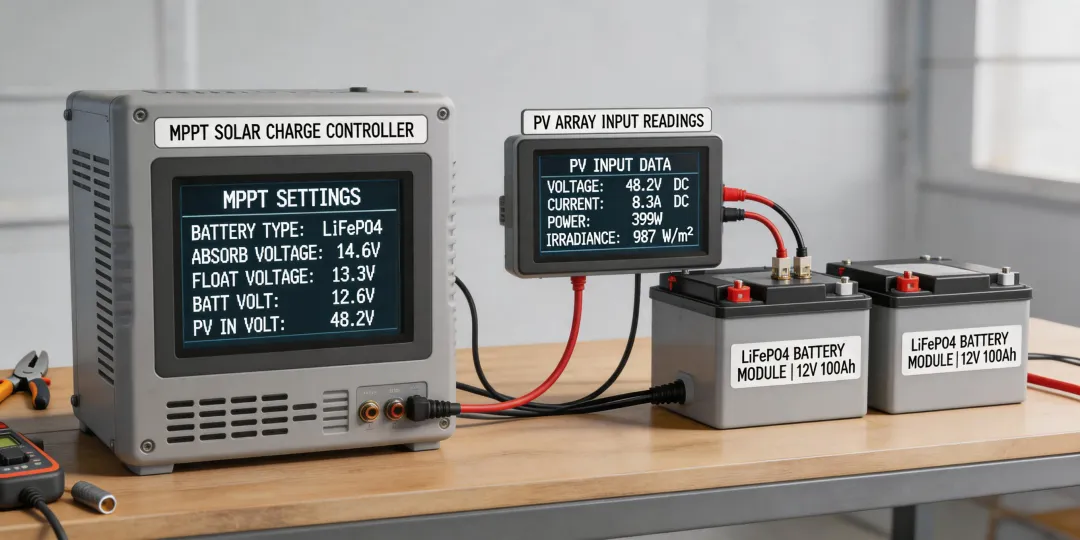
One vendor offered a cheaper alternative—a Takki solar generator combo. I almost pulled the trigger until a colleague asked, "Can you configure it for LiFePO4?" I froze. I hadn't even checked battery compatibility. That's when I found the epever product line, specifically their dual-battery MPPT charge controller. The specs mentioned "lithium settings," which sounded perfect for our planned LiFePO4 bank.
The Manual That Saved Me
I ordered one epever unit to test. When it arrived, I scanned the epever MPPT solar charge controller manual (which, honestly, is thicker than I expected). Buried on page 34 was a note about battery type selection and the exact voltage thresholds for LiFePO4. If I'd just followed the "standard" settings from the generic kit, I would have damaged the $1,200 battery bank. Learning that lesson would have cost me a lot more than the $220 controller.
Never expected a manual to be that critical. Turns out real-world battery settings require understanding absorption and float voltages—not just plug-and-play. (I still kick myself for almost skipping the manual.)
When Time Became the Enemy
By week three, I had specified the full system: epever dual battery controller, 400W panels, and a remote monitoring unit. But my original supplier (a no-name reseller) told me the controller was backordered for 10 business days. That meant we'd miss the installation window by 5 days—and our CEO had already announced the project in a public sustainability report ($12,000 penalty if delayed).
I switched to an authorized epever distributor who offered expedited shipping. The quote: $420 extra for 2-day delivery via FedEx Priority. I hesitated. "Double the shipping cost?" But then I ran the numbers: $420 vs. $12,000 penalty + reputation damage. I approved it immediately. That's the time certainty premium in action—you're not paying for speed, you're paying for a guaranteed outcome.
Why I'll Never Go Back
In this case, the uncertainty of a cheaper supplier's "probably on time" promise would have been far more expensive. As I told our VP: "Deadline-driven projects don't need a budget hero—they need a reliable anchor." We deployed the system two days ahead of schedule, and the epever remote monitoring dashboard let us verify voltage, current, and battery health from our office 200 miles away.
(Speaking of costs: while researching this project, I also needed an EV charging solution for our new fleet. I looked up how much does level 2 charger cost and found average installed prices around $600–$1,200. Not directly related to solar, but it reminded me that every purchasing decision has hidden variables—just like controller specs.)
The Real Lessons
Looking back, I made three classic rookie mistakes:
- Oversimplifying specs – "It's just power electronics" ignores battery chemistry nuances.
- Ignoring documentation – The epever manual (i.e., not just a spec sheet) contained critical setup info.
- Underestimating delivery risk – A cheap supplier's 10-day lead time cost less on paper but exposed us to a $12,000 penalty.
Per FTC guidelines (ftc.gov), I should also note that when I evaluated the Takki solar generator's claims, I checked for substantiation—some online ads said "offers 10+ hours runtime," but without specifying load or battery chemistry. That's why I now only buy from brands that publish detailed manuals and third-party test data.
One more surprise: the epever dual battery solar charge controller wasn't just for two separate battery banks. It also allowed parallel charging with different battery chemistries (like flooded lead-acid and LiFePO4 at the same time). Never expected that flexibility from a mid-priced controller.
How I'd Do It Differently
If I could go back to 2020 when I first took over purchasing, I'd tell myself: "Build a shortlist of proven brands (Victron, Morningstar, epever—don't knock epever until you try their dual-battery models) and always verify their distributor's fulfillment reliability." And yes, I'd budget for expedited shipping from day one.
Today, I'm rolling out a standard vendor evaluation form that includes a 'lead-time certainty score.' Our epever distributor scored 9/10—they shipped on the promised date both times. That's worth more than any spreadsheet price comparison.
Key takeaway: In emergency situations, the added cost of a reliable delivery and proven compatibility is cheap insurance against project failure. As I learned, $420 extra saved us $12,000 and a lot of sleepless nights.
— Based on my experience as a mid-size company admin buyer (managing ~$180k yearly across 15 vendors). Price data as of January 2025. Verify current shipping rates at respective carriers.