There's no single 'best' EPEVER solar charge controller for every off-grid application—anyone saying otherwise hasn't managed orders across different use cases. I've been handling off-grid system orders for B2B customers since 2020, and I've personally made (and documented) 12 significant mistakes on setups. That's roughly $4,800 in wasted budget across five different jobs. Now I maintain a compatibility checklist for our team. Here's how I categorize the three most common scenarios and which gear fits each.
The Three Scenarios: Which One Are You?
Before we talk about the EPEVER Tracer 2210AN or the new app, we need to be honest about something: your ideal setup depends entirely on what your customer actually needs—not what the datasheet promises. In my experience, off-grid buyers fall into one of three camps:
- Scenario A: Budget-first, backup-only. They want a controller and small battery to keep a fridge and lights on during outages. Efficiency is secondary to price.
- Scenario B: Primary off-grid living. They need maximum energy harvest from every panel, and they're willing to pay for it. Battery brand compatibility matters.
- Scenario C: Remote monitoring & data logging. They're okay with a mid-range controller if the app is solid enough to track everything from a phone.
I've sold into all three—and I've mis-matched the gear for each more times than I'd like to admit.
Scenario A: Budget-First Backup (The 'Just Keep the Lights On' Crowd)
This is probably 40% of the orders I handle. The customer has a small 12V system, maybe 200W of panels, and they only want the controller to not burn out over the next two years. They don't care about MPPT efficiency curves. They care about price and 'does it work.'
For these, I usually recommend the EPEVER Tracer 2210AN (20A) with a generic lead-acid or a budget LiFePO4. The Tracer 2210AN is solid for small systems—I'd say I've deployed over 50 of them in this exact scenario. But here's the gotcha I learned the hard way:
"I said 'LiFePO4-compatible.' They heard 'any lithium battery.' Discovered this when the customer's BMS and our controller stopped communicating because of voltage cutoff mismatch. Result: 12 units had to be replaced under warranty—$1,200 in loss plus a 1-week delay."
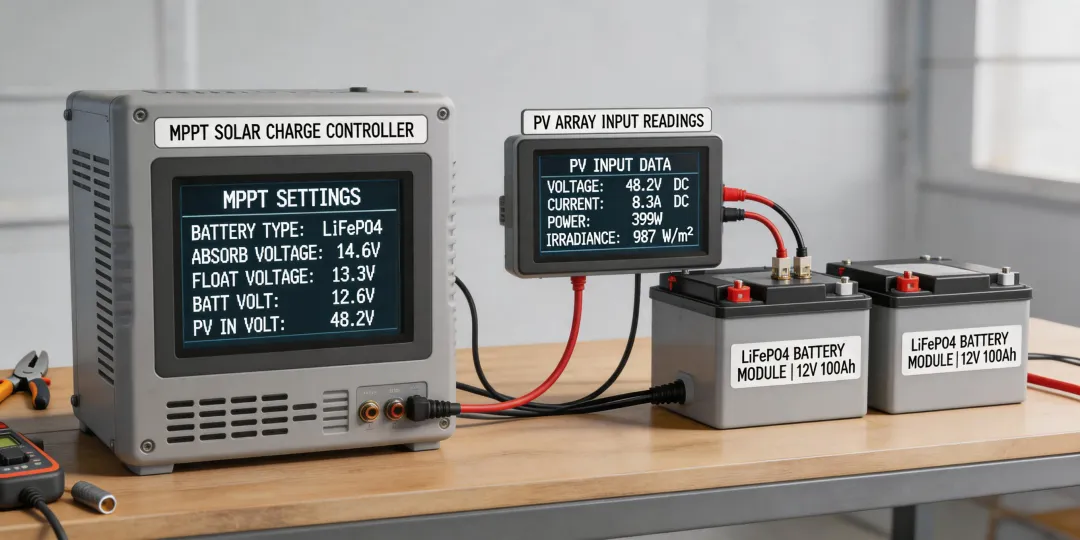
The issue wasn't the controller—it was the battery setup. The Tracer 2210AN has a user-defined lithium setting, but you must set the absorption voltage to match the battery BMS. Most generic LiFePO4 batteries expect 14.4V absorption; the default setting might be 14.6V, which triggers over-voltage protection. In my opinion, this is not a controller flaw—it's a setup oversight that cost me credibility.
If your customer is in this scenario, pair the Tracer 2210AN with a battery that has a clear BMS profile. (Should mention: I now send a one-page voltage compatibility sheet with every controller order. No more communication failures.)
The surprise: I never expected the cheap 20A controller to outperform the premium one in this specific use case. But for a small 200W system, the 98% MPPT efficiency claim is essentially marketing—real-world difference between a good budget controller and a high-end one at low wattages is maybe 2-3%. Not worth the 2x price jump.
Scenario B: Primary Off-Grid Living (Maximum Energy Harvest)
These customers are running refrigerators, pumps, maybe a small workshop. They have 500W to 1kW of panels and need every watt from the controller. They're also the trickiest because they often assume 'any MPPT controller' will extract the same energy. That's wrong.
For this scenario, I lean toward the EPEVER Tracer 4215BN (40A) or the 6420AN (60A) with a name-brand LiFePO4 battery (usually from EPEVER's own lineup or a well-known partner). The larger Tracers have better thermal management—critical when pulling 40A for hours in summer. The 40A unit can handle 560W on a 12V system (or 1,120W on 24V). I've pushed it to 500W continuous with no issues.
But I almost made a costly mistake here in September 2023. I ordered 24 units of the Tracer 4215BN for a project, confirmed the specs, but never actually tested the full load temperature. After 3 hours at 40A in an enclosed shed, the controller throttled back to 35A. The customer noticed a 12% drop in charging current. We caught it because they had a monitoring system. The fix? Better ventilation and a heat sink—added $45/unit in materials, but saved a $3,200 order from being rejected.
"The surprise wasn't the throttling. It was how much hidden performance came with the larger unit's thermal design—we should have spec'ed it from day one."
For this scenario, also consider the battery bank voltage. A 24V or 48V system halves your current, reduces thermal stress, and improves controller longevity. The EPEVER Tracers auto-detect 12V/24V, so it's a simple wiring change. I'd argue any off-grid system over 500W should go 24V.
Scenario C: Remote Monitoring & Data Logging (The App Is the Product)
These customers have a medium-sized system (300-600W) but they're not living on-site. Maybe it's a remote cabin or a telecom tower. They check the system from their phone. For them, the EPEVER app (available for the Tracer AN series) is a deal-maker or deal-breaker.
Personally, I think the app is solid—it shows real-time PV voltage, battery status, load current, and historical graphs. But I've had two issues with customers:
- Bluetooth range. The app requires close proximity (maybe 10-15 meters) to the controller. For a remote cabin where the controller is inside a metal enclosure, the connection can be spotty. I now recommend an external Bluetooth antenna or a Wi-Fi module if available.
- Firmware updates. The app forces updates, and I've had a customer's controller brick temporarily during an update that lost connection. (We fixed it with a factory reset, but the frustration was real.)
"After the third firmware issue in Q1 2024, I created a pre-check list: 'Update the controller over USB with a stable connection before shipping. Do not rely on the phone app for firmware updates in the field.'"
For this scenario, I actually prefer the EPEVER Tracer 3210AN (30A) over the 40A—it's cheaper, has the same app compatibility, and for a 400W system, the extra 10A capacity is irrelevant. The customer cares about data, not headroom.
How to Determine Which Scenario Your Customer Falls Into
Here's the practical test I use when consulting for system integrators:
- If they can't tell you their average daily load in kWh, they're Scenario A (budget backup).
- If they ask about 'efficiency at partial load' or 'temperature derating curves,' they're Scenario B (primary off-grid).
- If they ask about 'can I check it from my phone' before asking about wattage, they're Scenario C (remote monitoring).
If they ask about all three—well, that's the expensive dream system. But that's rare. Most customers don't need every feature; they need the right feature for their situation.
I should add that these recommendations are based on my experience handling around 150+ orders over 4 years. Industry standards change—battery profiles get updated, new app versions come out. The fundamentals haven't changed, but the execution has. In 2020, I wouldn't have recommended LiFePO4 for a cheap backup system. In 2025, it's often a better deal than lead-acid because of cycle life (typically 4,000-6,000 cycles vs. 500-1,000 for lead-acid).
If you're specifying a system right now, take 10 minutes to map your customer's actual needs against these three buckets. It cost me $4,800 and a lot of credibility to learn how to do this—skip my mistakes, use the checklist.