Stop Saving Pennies on Solar Controllers. You'll Pay for It Later.
I handle purchasing for a mid-sized engineering firm—about 70-80 orders a year, from office supplies to specialized electrical components. For the last 18 months, solar-related gear has been a growing chunk of that, mostly for off-grid test sites and mobile field offices. And I've developed a very strong opinion: if you're speccing a solar system and you're not using an MPPT controller from a brand like EPEVER, you're probably making a mistake that will cost you more than the upgrade price.
I know that sounds like a sweeping statement. Let me explain how I got here.
My First Solar Setup Was a Lesson in False Economy
When we first started putting together portable power stations for our field teams in 2023, I didn't know much about solar. I did what I thought was smart: I bought the cheapest PWM controllers I could find. Hey, they all do the same thing, right? Control the charge going into the battery? That was my thinking. A 30A PWM unit was $35. The cheapest EPEVER MPPT I could find was closer to $90. The savings felt obvious.
Fast forward six months. We had two systems that just weren't performing. Batteries weren't reaching full charge even on sunny days. One controller actually failed—started throwing error codes and wouldn't reset. The field team's equipment was running out of power by noon. I had to overnight a replacement, which cost $45 in shipping alone. The total cost of that 'savings'? Let's just say the $55 I 'saved' per unit evaporated.
From the outside, it looks like a PWM controller is a fine starting point. The reality is MPPT technology extracts significantly more power from the solar panel—especially in partial shade or cloudy conditions, which is every field site we have. I was losing 20-30% of potential power generation by going cheap.
What the EPEVER MPPT 40A Manual Actually Reveals
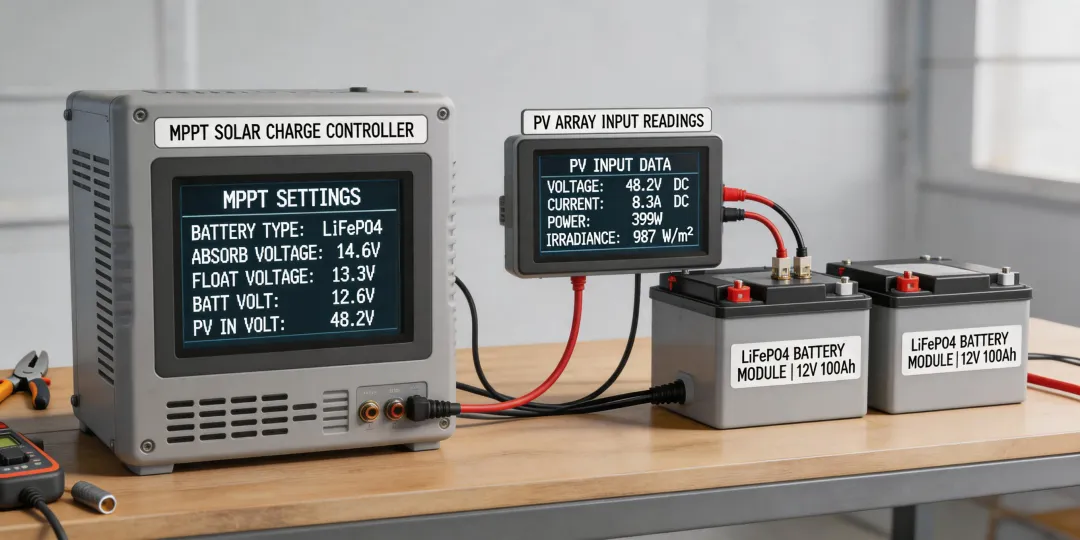
I'm not an electrical engineer. I'm the guy who reads the manual so the engineers don't have to. When I finally got our first EPEVER MPPT 40A unit (the Tracer 4210AN), I sat down with the manual. It's a chunky document. But here's what stood out to me that I didn't see in the cheap PWM manual:
- Detailed battery charging profiles—like, specific voltage settings for LiFePO4, AGM, Gel, Flooded. The cheap controller had a 'battery type' switch with three vague settings.
- PV input voltage limits clearly specified. The PWM unit just said 'Max PV 50V' with no real guidance on panel sizing.
- Temperature compensation explained—a feature I didn't even know existed. It adjusts charging voltage based on ambient temperature to prevent overcharging or undercharging. Sounds nerdy, but in practice, it means our batteries in the Arizona field office aren't getting cooked in July.
- Error code table and troubleshooting steps. The cheap one just had a flashing red light that meant 'something is wrong'.
The manual for the EPEVER MPPT 40a—which you can find on their website—isn't written for beginners, but it's comprehensive. It assumes you want to get the setup right. That philosophy carries into the hardware itself. The terminals are better, the heatsink is larger, and the build quality just feels more substantial.
The 'Lego Solar Panel' Trap (and Why Compatibility Matters)
Here's another thing I see people online messing up with, especially when they talk about 'lego solar panel' systems—mixing and matching panels of different voltages or wattages on a single controller. I've had colleagues argue that 'as long as the total wattage is under the controller limit, it's fine.' That's wrong.
With a series setup, a single shaded panel can drag down the whole string. With parallel, mismatched voltages cause inefficiencies. A quality MPPT controller like the EPEVER handles this better because it's actively tracking the maximum power point. But the manual still tells you not to do it. I made this mistake early on, thinking I could be creative with our panel arrangement. I had to rewire the whole array.
5 minutes of verifying the panel configuration against the manual would have saved me 5 hours of rework. That's the kind of thing I have a strong opinion about now. A good checklist—reviewing panel specs against the controller's input limits, checking wire gauge, verifying battery type—is the cheapest insurance policy you can buy.
Power Inverter Purpose: It's Not Just 'DC to AC'
I've also had to deal with questions about the power inverter purpose in these setups. People assume a power inverter is simple: plug it in, get AC power. The reality is that integration with the charge controller and battery is critical.
We run our field office systems with an EPEVER inverter connected to their lithium battery and MPPT controller. The inverter's low-voltage disconnect needs to be higher than the battery's BMS cutoff. If it's not, the inverter can drain the battery to a dangerous level before the BMS kicks in. The EPEVER documentation actually spells this out, and you can configure the inverter's cut-off voltage. The cheap inverters I tried earlier didn't offer that control. One of them just shut off at a random voltage, leaving our team without power but with plenty of charge still in the battery.
That brings me to another point people ask: 'how much is solar inverter' for a small system? Based on the quotes I've been getting for 1000-2000W units as of Dec 2024, a basic modified sine wave inverter is $100-200. A good pure sine wave unit from a brand like EPEVER is $300-500. But if the $150 inverter fails or damages your equipment because it can't communicate with your charge controller, you'll spend more on replacement and downtime than you would have just buying the better unit upfront.
Addressing the Obvious Pushback: 'Not Everyone Needs EPEVER'
I can already hear the objections. 'My buddy has a $40 PWM controller and it's been running for 3 years.' 'EPEVER is overkill for my tiny setup.' 'I don't need a manual for a charge controller.'
And you know what? Those points are valid if you have a simple, predictable, small system that you monitor constantly. If your battery is a car battery you're okay replacing every two years, and you're never in a hurry to get a full charge, a basic controller might work.
But in my experience—managing equipment for multiple teams across different climates and usage patterns—that situation is the exception, not the rule. I've seen too many failures from underspecced components. I've eaten too many rush shipping charges and replacement costs.
I'm not saying EPEVER is the only brand that makes good MPPT controllers. But I am saying that for any system that needs to be reliable, investing in a quality MPPT controller like the Tracer or Triron series is not an expense—it's an insurance policy against rework and failure. Skip the 'lego' mentality of throwing random panels together. Read the EPEVER MPPT 40a manual before you wire anything. Match your inverter properly. And don't ask 'how much is solar inverter' without asking 'will it work with my controller and battery for the next 5 years?' Because the upfront cost of getting it right is always, always cheaper than the cost of getting it wrong.