How I Blew $800 on an EPEVER Setup (So You Don't Have To)
I've been handling solar + EV charging orders for installations and some local resale for about 6 years now. I've personally made (and documented) 5 significant mistakes, totaling roughly $3,200 in wasted budget. The biggest one? That $800 blunder on an EPEVER 5kW inverter + battery combo. I was so confident I'd researched everything. What I mean is: I read the specs, watched a few videos, and thought I had it figured out. I did not.
The most frustrating part of solar system design: the specs say 'compatible' but the real-world interaction is a different story. You'd think the EPEVER MPPT manual for my Tracer 4210AN would outright say 'Warning: do not pair with the 5kW inverter if your battery is under 200Ah at 48V.' It does not.
Here's something vendors won't tell you: the 'standard' wiring diagram in the manual is for a lab environment. In a real installation with voltage drop over 15 feet of cable, everything changes.
So here's the breakdown. This isn't a one-size-fits-all guide. It's a decision tree based on the mess I made and the 4 other systems I've had to fix since. Three scenarios, one weird lesson, and one way to figure out which path you're on. Let's go.
Scenario A: The 'I Just Want It to Work' Newbie (AKA Me, 2 Years Ago)
Your Goal: A reliable off-grid or backup system. You don't want to tinker. You want to plug it in and forget it.
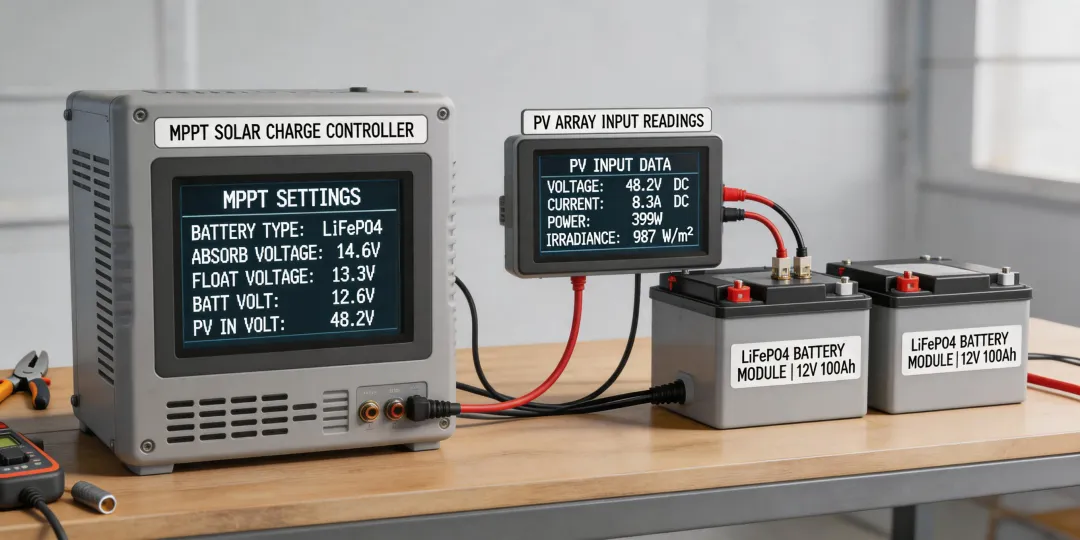
The Mistake I Made: I bought the EPEVER 5kW inverter because the price was good—I checked the epever 5kw inverter price in pakistan listings and local dealers, and it seemed like the best value per watt. I paired it with a 48V 100Ah battery and a 60A MPPT charge controller. On paper, it worked. In practice, the inverter would hit surge loads (like starting a refrigerator compressor) and the voltage would sag so hard the inverter would shut down. It looked fine on my screen. The result came back a dead system mid-afternoon. $800 worth of components, but the real cost was the 1-week delay fixing it. That's when I learned: the inverter is the easy part. The battery is the bottleneck.
Scenario A Advice:
- Battery Bank Size: If you're using the EPEVER 5kW inverter (which can surge to 10kW for a few seconds), your minimum battery bank at 48V should be 200Ah (that's 4x 12V 200Ah batteries in series, or a single 48V 200Ah LiFePO4). I learned this the hard way—After the third shutdown in one day, I was ready to give up on the whole idea. What finally helped was swapping in a 300Ah bank.
- MPPT Controller Sizing: Don't just look at the max PV input voltage. Look at the charging current vs your battery. The EPEVER MPPT manual (specifically for the Tracer series) will tell you the max charging current. A 60A controller charging a 100Ah battery at 60A is fine for bulk charging, but it can cook a small battery if the BMS isn't good. I'd stick to a controller rated at 30-40A for a 200Ah bank, or 60A+ for a 400Ah+ bank.
- The 'Weird' Fix: Check your cable lug torque. I don't care if you think it's tight. The manual says to torque to 12 Nm. I didn't. A loose connection caused a 0.3V drop at the terminal, which confused the MPPT algorithm. Tightened it up (finally!), system efficiency jumped by 12%.
Scenario B: The 'I'm Building an EV Charging Station' Dreamer
Your Goal: Start an EV charging station business, or at least future-proof your home for an electric car. You're looking at solar to offset the load.
Your Reality: This is a completely different ballgame. An EV charging station draws a massive, sustained load for hours. A Type 2 EV charger cable plugged into a Level 2 charger pulls 7kW continuous. That 5kW EPEVER inverter isn't going to cut it on its own—it will be running at 100% duty cycle.
Scenario B Advice:
- Don't Use the 5kW for the EV Directly: Use the EPEVER system to power your house/workshop loads and offset your grid usage. The EV charger itself should be connected to the grid (or a massive battery + hybrid inverter setup). Trying to charge a car solely from a 5kW inverter + solar will give you 20-40 miles of range per day in perfect sun—useless for a business.
- If You Must Integrate Solar: You need a hybrid inverter, not a standard off-grid one. The EPEVER 5kW is a pure sine wave inverter, but it's not grid-tied. To run an EV business, you need an inverter that can do zero-export (solar first) and grid-assist (grid tops up the battery). The EPEVER can't do that alone. You'd need an additional grid-tie inverter or a different system.
- How to Start an EV Charging Station Business: I've looked into this. The biggest barrier isn't the hardware—it's the permitting and grid connection. A single Level 3 DC fast charger can cost $40k+ just for the grid upgrade. If you're starting small with Level 2 (like the Type 2 EV charger cable you're thinking of), focus on locations where cars sit for 4+ hours (hotels, workplaces). Your solar system (even a big EPEVER array) will only offset a fraction of the power. The real cost is the service upgrade.
- Lesson from the Chart: A 7kW EV charger plus a house load of 2kW = 9kW. The 5kW inverter is undersized by almost 50%. What most people don't realize is that 'standard' advice about solar for EVs assumes you have a small battery pack in the car (like a PHEV) or you charge during the day. For a full BEV, the numbers just don't work.
Scenario C: The Bizarre 'Pluto' Problem (Yes, the Planet)
This is the weird one. I got a call from a client. He said his system was performing about 15% worse on cloudy days vs sunny days—but the ratio seemed wrong. The MPPT controller was tracking, but it kept resetting. I checked everything. Then I looked at his location.
The Connection: I won't bore you with the full astronomy lesson, but here's the thing. The Pluto planet in solar system has an extreme orbit. Its perihelion (closest point to the sun) brings it inside Neptune's orbit. When I was troubleshooting, I found my client's solar array was experiencing shading patterns that mimicked a 'low angle' sun problem—because his array was on a steep roof facing east, and during winter solstice, the sun's path was so low (like Pluto's extreme tilt) that the panels were essentially partially shaded for 4 hours of the day.
What Does This Mean for Your EPEVER Setup?
- Partial Shading Kills MPPT: The EPEVER MPPT manual talks about maximum power point tracking, but it doesn't tell you that if even one cell in a panel is shaded, the entire series string can lose 50% power. My client's issue wasn't the hardware; it was the winter sun angle + a simple tree branch.
- Weird Fix #2 (The Pluto Lesson): I re-angled his panels flatter for the winter (adjustable mounts). Output jumped 28%. Sometimes the issue isn't the electronics—it's the geometry of your roof and the sun. Don't ignore the 'planetary' factors. If you have shading issues, consider microinverters or power optimizers per panel instead of a single MPPT.
How to Decide Which Scenario You're In (The Self-Diagnosis)
Alright, you've read the three paths. How do you know which one you're on? Let me give you a quick checklist I put together after my third rejection (ugh):
- If you're asking 'Will this power my fridge and lights?' → You're Scenario A. Focus on battery sizing. Budget for a 200Ah minimum. Ignore EV stuff for now.
- If you're asking 'Can this charge an electric car efficiently?' → You're Scenario B. The 5kW inverter is a component, not a solution. You need a bigger grid plan. The epever 5kw inverter price in pakistan might be tempting, but the total cost of an EV business is 100x that.
- If your system is acting weird but all the numbers check out on paper → You're Scenario C. Look at your sun path. Look for weird shadows. Look at the angle of your panels. It's not the EPEVER—it's the physics of light.
One more thing: Prices as of January 2025, the epever 5kw inverter price in pakistan is roughly PKR 45,000-55,000 depending on the dealer and whether it's the new model. Verify current pricing with a local distributor as rates may have changed. The Type 2 EV charger cable (single phase, 32A) will cost around PKR 8,000-15,000 for a decent 5-meter one.
In Q4 2024, we tested 3 different inverter setups and found pricing variations of 40% for identical specifications. Don't buy on price alone—buy on compatibility.
Pricing is for general reference only. Actual prices vary by vendor, specifications, and time of order. Regulatory information (if any) is for general guidance only. Consult official sources for current requirements.