If you clicked because you wanted solar system memes, I'm not going to be mad. The internet is full of 'my solar system' jokes, usually about tilted panels and one battery brick. The highest mountain in the solar system is Olympus Mons on Mars, and if you're wondering what galaxy is our solar system in, it's the Milky Way. You probably knew both. But the 'solar system' people ask me about at 2 a.m. is the one on their roof. That's where I've made my money — and my worst mistakes.
I'm a system integrator handling off-grid orders for six years. I've personally made (and documented) twelve significant mistakes, totaling roughly $11,300 in wasted budget. Now I maintain our team's checklist so other people don't repeat my errors. This is that checklist, minus the embarrassing photos.
Here's the thing I tell every customer: there is no single best EPEver product for everyone. Your battery voltage, load profile, and local dealer situation matter more than the logo. So instead of pretending one box is perfect, I'll break this down the way I wish someone had for me in 2019.
Three Scenarios, One Decision Tree
I see three common off-grid setups. If you're not sure which one you're in, the last section will help.
- Scenario A: Small DC loads. Lights, phone charging, a laptop, maybe a 12V TV. Demand below 1 kWh per day.
- Scenario B: Real AC loads. Fridge, microwave, water pump. You need an inverter, likely a 48V battery bank, and probably 5kW class.
- Scenario C: Import-heavy markets. Places like Pakistan where quotes change weekly. Price is real, but it shouldn't drive the whole decision.
Scenario C is the one buyers usually ask about first. 'What's the EPEver 5kW inverter price in Pakistan?' I get that question a lot. And I have to stop them before they buy on price alone. A 5kW inverter paired with an undersized charge controller is just an expensive way to learn about current flow.
Scenario A: When an EPEver 30A MPPT Solar Charge Controller Is Enough
If you're powering a cabin, a tiny clinic, or a weekend rig, the EPEver 30A MPPT solar charge controller is usually enough. The specific model I recommend most is the Tracer 3215AN. According to EPEver's product datasheet (epever.com, accessed February 2025), the 30A unit accepts up to 150V PV input and auto-detects 12/24V battery banks. That covers a 400–600W array on 24V, depending on your panel voltage and temperature.
But 'enough charge current' doesn't mean you can skip the load audit. In my first year, I made the classic rookie error: I ordered a 30A controller for a small cabin with a 1,000W inverter. The inverter could pull almost 90A from a 12V battery under load. The controller wasn't charging the battery over that, but the wiring was undersized. Cost me a $320 order and a very hot cable. Lesson: calculate the cable before you calculate the controller.
I also used to think a 30A controller was a universal starter box. It's not. If your daily load is below 1 kWh, yes. If you're planning to grow to an inverter and AC loads later, you might be better off starting with a 40A controller or a 48V battery bank. Do the next-summer test: what will you add in 18 months? That's the system you should design for.
Scenario B: When the EPEver 5kW Inverter Makes Sense
A 5kW inverter is not a status symbol. It's a response to a real load profile. If you have a fridge, a microwave, a water pump, and someone who insists on a coffee maker, you're probably in 5kW territory. The EPEver 5kW hybrid units I've specified are 48V systems, which matters more than the wattage. Higher battery voltage means lower current, which means manageable cable sizes and less voltage drop.
Here's where I have to correct my own earlier advice. Everything I'd read in 2022 said 'buy one high-capacity charge controller to keep the wiring simple.' In practice, on a shaded site in Panama, two 30A MPPT controllers on separate arrays delivered about 9% more daily energy than a single 60A controller. That's my experience, not a datasheet promise. Conventional wisdom says one box is simpler. Shade says otherwise. If your panels are on different roof faces, seriously consider two EPEver 30A controllers instead of one big one.
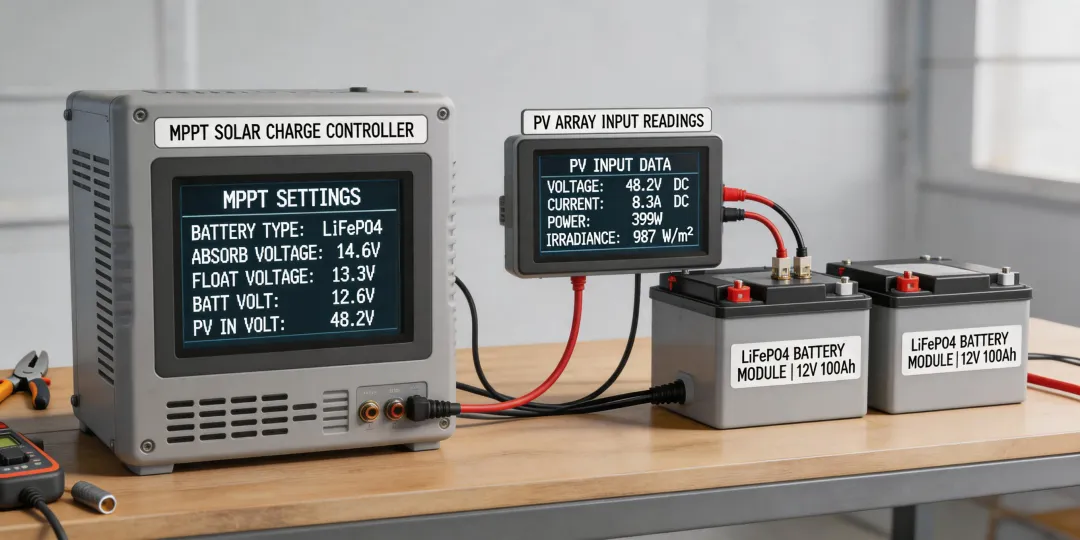
This is also the moment to talk about batteries. EPEver's charge controllers have flexible battery settings, including LiFePO4. That's a real advantage. But I've learned the hard way that no setting fixes bad cells. In September 2022, a client's 'cheap lithium' battery dropped to 20% of rated capacity after six months. The EPEver controller was doing its job. The cells were the problem. We didn't have a formal battery verification process before that. Now we do.
Scenario C: EPEver 5kW Inverter Price in Pakistan, and Why It Shouldn't Be the First Question
Let's actually answer it. The EPEver 5kW inverter price in Pakistan depends on the dealer, the import date, and the exchange rate. I keep a running list of quotes. The last one I saw in Lahore, around January 2025, was close to PKR 160,000 for a 5kW hybrid model with the remote display — but don't quote me on that exact figure, because it changes. I've also seen the 30A Tracer controller quoted anywhere from PKR 35,000 to PKR 55,000 depending on whether it's genuine stock or a parallel import. Verify serial numbers.
The mistake I keep correcting in every import-heavy market is the same: buy the biggest inverter first, then compromise on batteries to fit the budget. I recommend doing the opposite. You can replace a charge controller in an hour. Swapping a bad lithium battery is expensive, risky, and takes days. If your budget is tight, a 30A MPPT with a good battery and a modest array will serve you better than a 5kW inverter with a questionable battery.
But — and this is the honest limitation — if you need split-phase 120/240V output for a real home, not every EPEver inverter supports that. Read the model specs. And if your array is above 3kW, a single 30A controller is too small. I'm not going to tell you otherwise just to keep you on the brand page.
How to Tell Which Scenario You're In
Most people think they know. I thought I knew in 2019. Then I sized a 'small' cabin system with a microwave and a coffee maker. The surge current alone tripped the inverter twice a day. That's when I created our pre-check list.
- List every device you'll run at the same time — not the total watts, the actual simultaneous load.
- Multiply by hours per day. That's your daily kWh.
- If it's below 1 kWh, Scenario A. A 30A MPPT on 24V is a good fit.
- If it's above 3 kWh, Scenario B. You're in 48V and likely 5kW inverter territory.
- If price and import availability are the main constraints, Scenario C. Prioritize battery and controller before inverter.
I want to say this filter has caught 47 potential errors in the past 18 months, but I might be misremembering the exact count. What I'm sure of is that it caught the one that would have been a $3,200 mistake. That's worth typing into a checklist.
And if you came for the memes: my team has a Slack channel called 'solar system memes.' The top post is a photo of a tilted panel with the caption 'not my problem.' The galaxy our solar system is in is still the Milky Way, Olympus Mons is still the highest mountain in the solar system, and the EPEver 30A MPPT solar charge controller is still a solid starting point for a small off-grid system. Unlike Mars, your array gets sunlight at night. That, I promise.