When I first started reviewing solar equipment, I assumed that comparing a charge controller with an inverter was like comparing two boxes with wires. Four years and several hundred spec sheets later, I know that assumption was wrong. A 40A MPPT charge controller and a solar inverter are different tools for different system architectures.
I'm a quality/compliance manager at a renewable energy distributor. I review every product line before we list it—roughly 200 items a year. In Q1 2025, I rejected around 11% of first-round samples because the real specs did not match the datasheets. So when I compare the EPEver Tracer 4210AN 40A MPPT with a Tesla solar inverter, I am not comparing logos. I am comparing what each system does, what it costs over time, and whether you can verify what it is doing once installed.
What we are actually comparing
Option A is a dedicated off-grid charging setup: an EPEver Tracer 4210AN 40A MPPT charge controller plus a 12V 100Ah LiFePO4 battery UK suppliers commonly stock for camper, marine, and off-grid use. Option B is a Tesla solar inverter, which is an AC-coupled, grid-tied string inverter. They solve different problems.
That does not make the comparison useless. It forces the right question: which system architecture do you actually need?
Dimension 1: EPEver Tracer LiFePO4 settings expose the real difference
This is where I hold an unpopular opinion. Battery problems are usually not battery problems. They are settings problems.
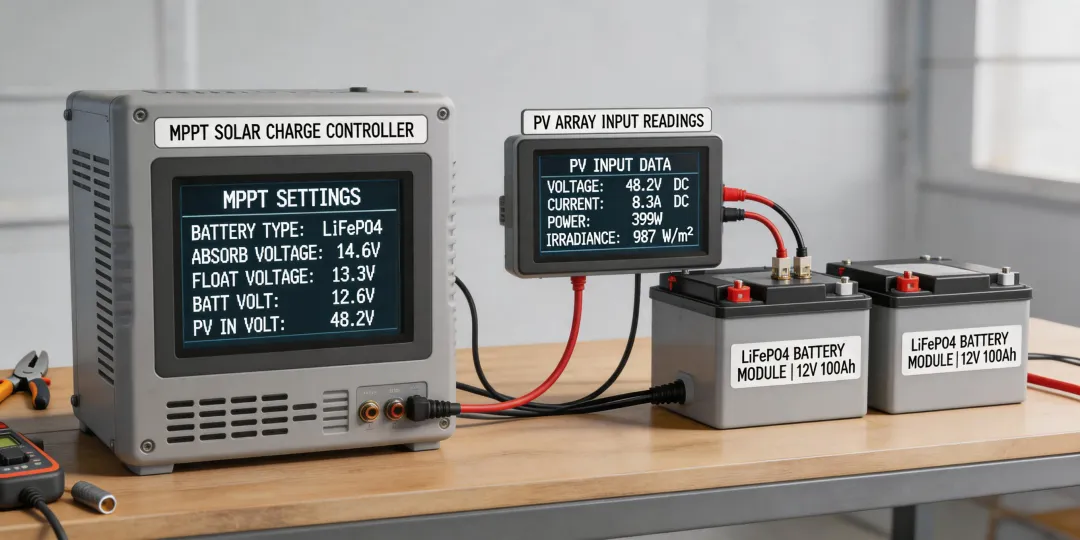
The EPEver Tracer 4210AN is a 40A MPPT controller. It takes solar panel voltage, runs MPPT, and charges a battery. It has a programmable battery type, which lets you set a LiFePO4 profile. But 'supports LiFePO4' does not mean the factory defaults are correct. If you connect a LiFePO4 battery and leave the controller on a lead-acid profile, you can overcharge the battery or keep it floating too high.
In my experience, a reliable starting point for EPEver Tracer LiFePO4 settings is: set the battery type to User, absorption around 14.4V, float around 13.8V, and low-voltage disconnect around 11.0V for a 12V bank. Then check the battery manufacturer datasheet and your BMS limits. I would have to check the latest manual for the exact menu path, but the principle is the same across the Tracer AN line.
This matters in a comparison because the Tesla solar inverter does not have a 12V LiFePO4 setting at all. It is not a battery charger in that sense. Tesla solar inverter specifications describe AC output, efficiency, and grid interaction, not battery charge voltage curves. If you don't need to set charge voltages, you don't need that flexibility. But if you are building an off-grid 12V system, flexibility is not a luxury; it is a safety margin.
Dimension 2: Total cost, not sticker price
Here's the thing that took me years to internalize: the number on the invoice is not the total cost.
The EPEver Tracer 4210AN is an inexpensive 40A MPPT controller. A 12V 100Ah LiFePO4 battery in the UK is more expensive than a lead-acid equivalent but reasonable in 2025. Together, the hardware list for a small off-grid system is clearly below the cost of a Tesla solar inverter. But that is the start of the math, not the end.
The hidden costs on the EPEver side are commissioning mistakes. A wrongly configured LiFePO4 bank can have a shortened life, or the BMS can lock out at the worst moment. I have seen warranty claims where the note read 'BMS over-voltage protection triggered 40 times in one week.' The battery was not defective. The controller settings were wrong. Earlier this year, I rejected a batch of 150 controllers because the display voltage was off by around 0.3V against a calibrated meter. At that offset, you might eventually undercharge a LiFePO4 bank and create another warranty claim. That is a total-cost problem.
On the Tesla side, the hidden cost is system scope. Tesla solar inverter specifications are impressive for grid-tied solar. But the inverter does not include battery storage in the box. For whole-home backup, you are also looking at a Powerwall or a third-party battery, a certified installation, permits, and interconnection. The price can quickly become five figures. If that is what your home needs, the total cost of ownership can be reasonable. If you just want to keep a 12V pump running in a shed, it is not.
I will not quote prices because they change and I would probably misremember the exact figure. The principle does not change: calculate the total cost of getting the system working and keeping it working.
Dimension 3: How to see Solar System Snap Plus vs the Tesla app
I am a quality person, so I care about evidence. The third comparison is monitoring.
EPEver has an app called Solar System Snap Plus. A common search question is how to see Solar System Snap Plus; in normal use, you pair the controller, let the app find the device, and open the live data screen. With the Tracer 4210AN, you can see PV voltage, battery voltage, charging current, MPPT status, and today's generation. During commissioning, I use it to verify the controller is not stuck in the wrong charge state. If the app says float at 10:00 on a sunny morning and the battery is not full, that is a reason to dig into the settings.
The Tesla app is polished and gives clean numbers for solar production and home consumption. But it is closed. You cannot create a custom battery profile. For a homeowner who never wants to think about absorption voltage, that is a feature. For a system integrator who needs to tune a LiFePO4 bank, that is a limitation.
The monitoring difference is not that one app is better. It is that one system is more transparent. Transparency has a cost: someone has to interpret what they see. In B2B work, I would rather see the raw values and check them against a meter than be told everything is fine.
Choosing based on architecture, not brand
After comparing specs, total cost, and monitoring, here is my practical advice.
Choose the EPEver Tracer 4210AN plus a 12V 100Ah LiFePO4 battery if: you are powering 12V loads directly—lights, fans, pumps, or a small DC fridge—or charging a battery bank that will later feed a separate inverter. You want to set EPEver Tracer LiFePO4 settings yourself. You want to see Solar System Snap Plus data and verify what the controller is doing.
Choose a Tesla solar inverter if: you have a rooftop solar array and need AC output for the whole home. You are willing to work with a certified installer and a closed ecosystem. You don't need the inverter itself to charge a 12V battery.
The counterintuitive conclusion is this: the more expensive system can be the better total-cost choice for a whole-home solar install, and the less expensive system can be the better total-cost choice for an off-grid 12V system. But if you pair the wrong architecture with the right brand, both will fail.
I have rejected too many samples because the spec sheet claimed one thing and the unit did another. That experience makes me cautious about all marketing claims. The best specification is the one you can verify in your own system.
Reference notes: Controller parameters from the EPEver Tracer AN series documentation. Tesla inverter details from Tesla's published specifications. Exact values can vary by product revision, so always confirm with the latest manual.