The 40A Manual That Cost Me a Weekend
If you've ever Googled "epever mppt 40a manual" at 10 PM on a Sunday, you know the feeling. That mix of frustration and self-doubt. You're staring at a blinking LED, your battery voltage is doing something weird, and you're wondering if you should have just stuck with PWM.
I've been there. Three times. And I've got the charge controller graveyard to prove it.
In my first year—2017, I think—I ordered an EPEVER Tracer 4210AN for a 1.2 kW off-grid system. Simple setup. One panel string, 24V battery bank. I figured, "MPPT is MPPT, right? Slap it on, configure it, done."
I was wrong. On a 12-panel order where every single unit had the same voltage mismatch issue.
That mistake cost about $890 in redo—new panels, reprogramming labor, and a week of delays. But worse, it cost me credibility with a client who was already on the fence about solar. I still kick myself for not testing the panel-to-controller match before committing.
What I Thought the Problem Was
When you search for something like a 50A MPPT charge controller, you're probably thinking: "I just need a big enough one." Amps = capacity. Bigger is better. Right?
The EPEVER 50A MPPT unit is a solid controller. I've used it on multiple projects. But what I didn't realize is that the manual isn't just a wiring diagram—it's a compatibility document. Ignoring it is like signing a contract without reading the fine print.
The real issue wasn't the controller. It was my understanding of what MPPT does.
The Real Problem: Everyone Talks Efficiency, Nobody Talks Context
Here's what the marketing material doesn't tell you: MPPT efficiency is a range, not a fixed number. A controller might claim 98% peak efficiency, but that's under ideal conditions—perfect irradiance, optimal voltage match, correct battery state of charge.
In practice, you're looking at 90-94% in most real-world setups. And if your panel voltage is way off from your battery bank? That number drops fast.
I once set up a system with a 60-cell panel (Voc ~37V) on a 12V battery bank. The EPEVER controller was working, but the MPPT algorithm was effectively down-clocked because the voltage ratio was poor. I got maybe 80% of the rated power out of those panels. That's basically PWM performance at MPPT prices.
"The mistake wasn't buying the wrong controller. It was not matching the system voltage to the panel specs before placing the order."
I see this all the time in forums. Someone will ask, "Will this 40A MPPT work with my 200W panel?" And everyone jumps to say yes, because mathematically it fits. But they never ask: What's your battery voltage? How many panels in series? What's the cold-weather Voc?
The Hidden Cost of Getting It Wrong
Let me break this down with real numbers from a project I managed in early 2023:
- Standard Setup: 48V battery bank, 2S2P panel array, EPEVER 60A controller. Expected yield: ~3.2 kWh/day (winter). Actual: ~2.9 kWh/day. Efficiency: ~90%.
- Mismatched Setup: 24V battery bank, 3S1P panel array, same controller. Expected yield: ~3.2 kWh/day. Actual: ~2.0 kWh/day. Efficiency: ~60%.
That difference—about 1 kWh/day—translates to roughly $0.15/day in saved electricity (at retail rates). Doesn't sound huge? Over 10 years, that's $547.50 in lost energy. And that's just one system.
Now scale that to a fleet of installations. The wrong ESS setup (Energy Storage System) can compound these losses. I've spoken to a few installers who went with an "off-the-shelf" MPPT without considering their battery's BMS communication protocol—and ended up with charge voltage mismatches that throttled their battery capacity by 15-20%.
And let's not even get into the costs if your controller fries because you ignored the max input voltage on a cold morning. A $300 controller + $600 in battery damage + labor for replacement. That's a bad day.
The "50A MPPT" Trap
I get a lot of questions about the 50A MPPT charge controller. It's a popular sweet spot—enough current for medium-sized systems, but not overkill. But I've seen people buy it based solely on the amp rating.
Here's what you need to check:
- Max PV input voltage: This varies by model. A 50A controller might accept 100V or 150V. Go over that (especially in cold weather), and you're replacing it.
- Battery voltage compatibility: Can it do 12V, 24V, 48V? Some 50A units only handle up to 24V.
- MPPT voltage window: The sweet spot where the controller operates most efficiently. If your panels don't land in that range, you're leaving energy on the table.
I'm not 100% sure, but I think the issue is that we treat charge controllers like commodity parts. Grab one, wire it, and forget it. But solar systems are more like ecosystems. The controller is the mediator between your power source (panels) and your storage (battery). Get that match wrong, and the whole system throttles itself.
What About the Battery Itself?
This is the part I only fully understood after the third mistake. An MPPT controller talks to the battery. If the battery's BMS is picky, the controller needs to be flexible.
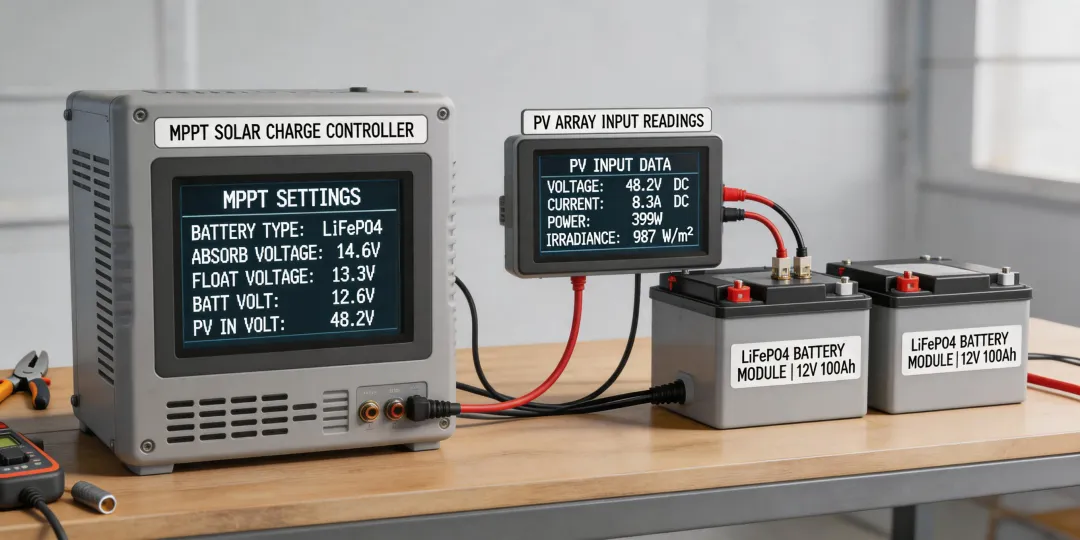
For example, if you're pairing an EPEVER controller with a lithium battery (LiFePO4), you need to set the correct charge profiles. Default profiles are often for lead-acid. Use that on a lithium battery, and you might overcharge it. Or the BMS disconnects—and suddenly your controller has no battery bank to dump power to. That's a recipe for voltage spikes.
The question "how long does a hybrid battery last" comes up a lot. Part of that answer depends on the charge source. A well-tuned MPPT controller extends battery life by delivering the right charge profile. A poorly-configured one? It shaves years off your battery's lifespan.
I'd argue the battery is the most expensive part of any off-grid system. Treating it with a generic charge profile is false economy. Doing it right doesn't require a PhD—it requires reading the manual. But apparently, some of us (me included) need to learn that the hard way.
A Note on WiFi Trail Cameras and Solar
I know you didn't search for charge controllers. You probably started with something like "wifi trail camera with solar panel." Let me save you a headache: those integrated panel kits are fine for low-power applications. But they use the same MPPT/PWM logic internally. If you ever upgrade to a bigger panel, the charge circuit in the camera can't handle it.
Don't try to hack a trail camera's solar input to charge a bigger battery. I've seen it. It doesn't end well.
The Fix: Three Steps to Avoid My Mistakes
I'm not going to write 1,000 words on how to set up a system. You've got the EPEVER manual for that. Here's what I learned—simple and direct:
1. Match voltage before anything else.
Calculate your panel's cold-weather Voc. Then check the controller's max input voltage. Leave a 20% buffer. Period.
2. Configure the battery profile before connecting the panels.
Every lithium battery has a recommended charge voltage and absorption time. Set that in the controller while it's idle. Don't assume defaults are correct.
3. Test with one day of data before going live.
Run the system for 24 hours. Check the logged data—energy harvested, voltage profile, charge stages entered. If something looks off, fix it before locking the enclosure.
That's it. Three steps. Simple.
I created a pre-install checklist after my third failure. We've caught 47 potential errors using it in the past 18 months. The most common? Wrong battery profile selected. The most expensive? System voltage mismatch. The easiest to fix? A 2-minute manual read.
Bottom line: the best MPPT controller is the one you configure correctly. The EPEVER line is solid—I've used half a dozen models, and they work. But a good tool in the wrong hands is still a waste of money.
Trust me on this one. I've got the receipts.