Last March, a 200W foldable solar panel landed on my desk with a sticky note: 'Need 10 portable charging kits before the field season.' I'm the procurement manager at a 40-person solar integration company. I've managed our equipment budget for six years and reviewed enough vendor quotes to know the cheapest one usually becomes the most expensive one by the end.
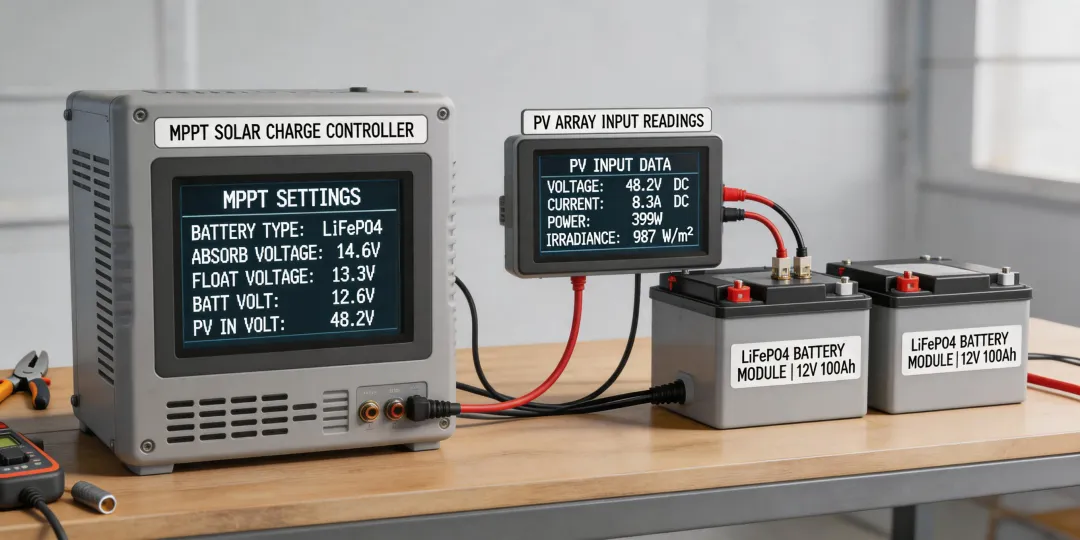
The brief was simple: a solar panel foldable enough to fit in the back of a pickup, a 24V LiFePO4 battery, and a controller that would manage the charge. If you've ever searched 'solar controller Tracer EPEver' or '24v lifepo4 battery charger,' you already see why it gets complicated. Not every 12V/24V controller can actually talk to a lithium battery properly.
The Quote That Almost Slipped Through
Vendor A came in with the lowest price by a wide margin. I sent my usual request with a line that said '24V LiFePO4 battery charging required.' I assumed that was enough.
I said, 'We need 24V LiFePO4 battery charging.' They heard, 'We need a 24V battery system.' Result: they quoted a controller with only sealed, gel, and flooded charge profiles.
Maybe that controller could be reprogrammed with a laptop. That wasn't the point. The field tech doesn't carry a laptop. If the battery charger can't be configured from the front of the unit, it's not the '24v lifepo4 battery charger' we asked for.
Honestly, the first quote made me feel like the easy part was solved. It did not last.
Why the EPEver MPPT 30A Made the Shortlist
Once I started asking about battery chemistry, the list narrowed fast. The EPEver MPPT 30A solar charge controller kept coming up, and not because it was the cheapest. It had a user-defined battery profile, an LCD screen, and a manual that explained voltage settings instead of hiding behind 'factory setting only.'
One quote included 'MPPT efficiency up to 99%.' Fine. But per FTC advertising guidelines (ftc.gov/business-guidance/advertising-marketing), a claim like that should be substantiated. I asked for the test report. The response was a marketing PDF, not a test report. That told me more than the spec sheet did.
The cheaper controller vs. EPEver decision kept me up for a couple nights. On paper, the cheaper option made sense. But my gut said we would lose too much control in the field. The EPEver Tracer line had already been in some of our smaller projects, and support answered a lithium-setting question in one day. The other vendor needed a second phone call before they responded at all.
Then the project manager set a deadline: order in two hours or we miss the installation window. Normally I would bench-test both units side by side. There was no time. I made the call based on the spec sheet and that support email. It felt like a risk. In hindsight, I should have locked down the battery requirement earlier. But with that constraint, EPEver was the decision with the most information behind it.
I also had to remind myself what the '30A' actually means. The EPEver MPPT 30A solar charge controller can deliver up to 30A to the battery. It is not the panel input current. That sounds basic, but when you are comparing controllers side by side, it is easy to mix them up and pick a controller based on the wrong number.
To be fair, the cheaper controller is probably fine for someone with sealed lead-acid batteries and a fixed installation. I'm not saying it's a bad product. It was a bad fit for a portable lithium kit.
The Level 2 Charger Question That Made It Click
While the purchase order was moving through our system, the facilities guy texted me: 'how many amps does level 2 charger use?' It sounds unrelated. It's not.
A Level 2 EV charger is an AC device. Its amp rating is on the nameplate—16A, 32A, 48A, whatever the unit is rated for. A 32A unit should usually be on a 40A circuit because it is a continuous load. But I'm not an electrician, so my honest answer was: check the nameplate, then have a licensed electrician verify the wire and breaker.
The real question isn't 'what amp rating do I need?' The real question is, 'which specification are we actually sizing?' Put another way: the number only matters when it is connected to the right component. You can't answer 'how many amps does level 2 charger use' without knowing which charger. Same with solar charge controllers.
The TCO Lesson
All ten kits went out. The only field call was because I hadn't told the crew to cover the foldable solar panels before connecting the battery. That one was on me. The controller did what the spec said it would do.
When I audited our 2023 spending, I found that avoidable mistakes—wrong specs, rush shipping, second dispatches—had cost us about $12,000. Not because the products were bad. Because verification happened after the purchase, not before. This project was different.
The EPEver controller cost more than the other quote, but the total cost of ownership was lower. If we had bought the cheaper controller, I estimated at least one extra site visit per kit to reconfigure or explain the settings. At $85/hour for our crew, ten site visits would have erased any savings. The potential rework cost looked like $8,400—about 17% of that project's budget. That was the spreadsheet moment.
The 5-Minute Spec Check
The 12-point checklist I created after this project now goes out with every RFQ. It's the cheapest insurance I know. Basic items like:
- exact battery chemistry and charge voltage range
- what the controller shows without a laptop
- whether the amp rating refers to battery current or solar input
- where the manual is, and whether it matches the shipped firmware
- how long support took to answer a real technical question
It sounds basic. But basic gets skipped when a quote is cheap.
Trust me on this one: five minutes of verification beats five days of correction. That's not a slogan. It's the line I put at the top of our procurement policy after this project.
So if you're searching for 'solar controller Tracer EPEver,' or 'solar panel foldable,' or '24v lifepo4 battery charger,' or even 'how many amps does level 2 charger use,' the answer isn't just a number. It's a spec sheet. The number only matters if it matches the system around it.
I didn't choose the EPEver MPPT 30A solar charge controller because it was the most exciting product. I chose it because it could be verified before we shipped it. That made it the most cost-effective option in the long run.