The Two Paths to Off-Grid Power
I'm a quality compliance manager at a renewable energy distributor. I review every charge controller and inverter that enters our warehouse—roughly 200 units per year. In 2024, I rejected about 3% of first deliveries due to calibration drift or cosmetic defects that would've turned into customer complaints. So when someone asks me whether to buy a pre-built portable solar unit or assemble a system from components, I compare them on four standards: cost per usable watt, battery charging flexibility, expansion room, and what actually breaks in the field.
The comparison usually comes down to two names: EPEver on the component side, Goal Zero on the portable side. And the first thing people ask is: what makes up a solar system anyway?
Every solar system has four blocks, regardless of size:
- Solar panel(s) — the energy source
- Charge controller — regulates voltage and current from panels to battery
- Battery bank — stores power for when the sun isn't out
- Inverter — converts DC to AC when you need household plugs
A Goal Zero unit packages all four into a single product. The EPEver path builds each block separately. Both work. But they answer very different questions.
Dimension 1: Cost Per Usable Watt
People assume the pre-built route is cheaper because the sticker price is lower. That's actually backwards.
The Goal Zero Nomad 20 solar panel runs around $100–150. It's a 20W portable panel with USB output—tiny, clean, and genuinely useful for charging a phone. The EPEver 20A MPPT solar charge controller is about $70–90. On its own it doesn't generate power. You still need a panel and a battery. Once you add them, though, you have a real 12V or 24V system that powers DC loads and pairs with an inverter charger for AC.
You're not buying watts with the Nomad 20. You're buying portability and simplicity. That's fine. But the component path delivers more usable energy per dollar. It's not close.
Dimension 2: Battery Charging Flexibility
This is where I get picky, because I've watched customers destroy batteries and then swear the gear was to blame.
Entry-level solar gear treats batteries like a single category. Preset profiles for sealed, gel, flooded—maybe a 'lithium mode' that's fixed and not actually calibrated. That's dangerous with cells that need specific voltage windows. For a universal lithium battery charger—one that genuinely works across lithium chemistries—you need to set absorb and float voltages yourself.
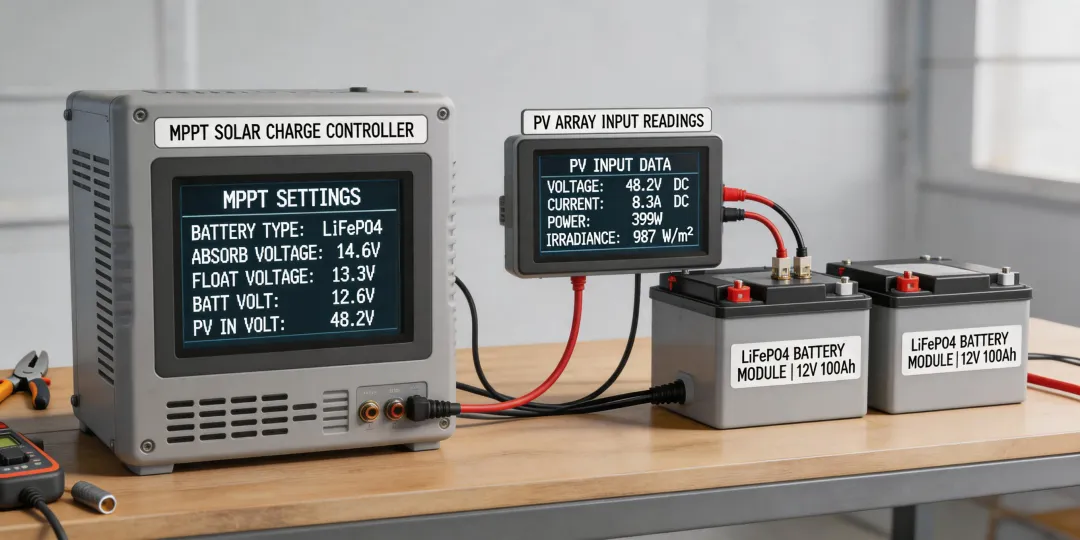
The EPEver 20A MPPT controller (Tracer AN series) does exactly that. Choose battery type. Adjust absorb voltage. Adjust float voltage. Set charge duration. For a 12V LiFePO4 bank, that typically means absorb at 14.2–14.6V and float low, which you can dial in precisely. On a pre-built portable unit, you get whatever profile the factory chose, with no way to see it or change it.
More configurable means more complex. That's the assumption. I've come to believe the opposite—flexible settings prevent mistakes because you can match the charger to the battery's data sheet. It took me about 4 years and 150 or so project reviews to land on that conclusion.
Dimension 3: Expansion Without Rebuying
Start with the EPEver 20A controller, one panel, and a 100Ah LiFePO4 battery. That's a solid weekend cabin. Next year, add a second panel in parallel. Later, move the bank to 24V—the same controller handles 12V and 24V automatically. When you want AC outlets, wire in an EPEver inverter charger. Nothing gets thrown away.
The Goal Zero route is a closed box. The Nomad 20 charges via its own ecosystem, and when you outgrow it, you start over. Not necessarily wrong. Just finite.
I should add a caveat: if your power needs are truly static, the closed box is fine. I've seen over-engineered tiny systems built 'for expansion' that never expanded. That's its own kind of waste. Context matters.
Dimension 4: What Actually Fails in the Field
Pre-built portable systems show a consistent failure pattern in my inspections: the wear-out items are the battery, the proprietary connectors, and the integrated electronics. The battery management is automatic, so nobody notices degradation until performance drops. Connectors in a proprietary line get harder to source each year. And because everything is integrated, a single failure often means sending the whole unit back.
Component-based systems fail in different places. Wrong battery settings, PV input beyond the controller's maximum, undersized wire between battery and inverter. The controller itself? Rarely the problem.
I want to say around 80% of remote field failures I've reviewed trace back to installation issues, not component defects. But don't quote me on that number—it's from memory, not this year's formal aggregation.
The EPEver Tracer line has been consistent for us. (Should mention: we've stocked it for three years now.) The PCB quality, heatsink design, and current calibration all came within spec across our sample checks. I've cracked open generic-brand controllers where the guts didn't match the spec sheet. I can't say that about the EPEver units we receive.
Which Path Should You Choose?
Here's my scenario-based take, not a blanket verdict.
Choose the Goal Zero / pre-built route if:
- Your loads are USB-level: phones, power banks, small gadgets
- You want zero configuration and zero learning curve
- Your power needs won't grow over time
- Upfront ease matters more than lifetime cost per watt
Choose the EPEver component path if:
- You're outfitting an off-grid cabin, RV, van, or small business backup
- You need genuine 12V/24V DC output and AC via an inverter charger
- You're running lithium batteries and want proper charge control
- You plan to expand the system over time
- You're a small installer or integrator serving clients with custom setups
One more thing that often gets overlooked: how vendors treat small buyers. I've seen distributors ignore a $500 order entirely. That's not how we operate, and it's not how the EPEver channel has treated us. An order for one 20A controller gets the same documentation and delivery discipline as a larger order. Today's $500 customer is often next year's 50-unit project. Small doesn't mean unimportant—it means potential.
Before you buy, download the manual and the spec sheet. EPEver publishes full documentation for the Tracer AN series on its site—battery parameter tables, PV input limits, everything. The manual tells you more than any sales page. If a vendor can't produce a proper spec sheet, that's a red flag on its own.
As of January 2025, the EPEver 20A MPPT controller lists around $70–90 depending on vendor. I'd verify current pricing before ordering, since rates shift. The Goal Zero Nomad 20 sits around $100–150, but I don't track that market closely—that's from memory, not current data.
Four blocks, two philosophies: panel, charge controller, battery, inverter. Neither path is wrong. But I do not think you should choose based on packaging alone. Specs, battery control, and expansion plans matter more—and any vendor that can't show you a proper spec sheet isn't worth your order.