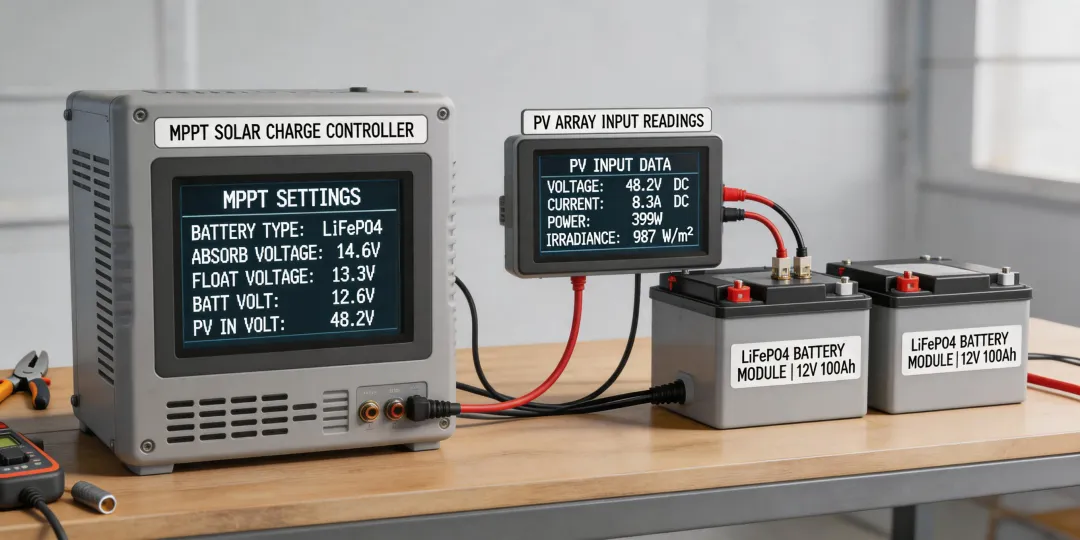
I'll say it plainly: the EPEVER 30A MPPT solar charge controller is the first thing I spec on most 12V and 24V off-grid rush jobs. Not because it's the most expensive option, and not because EPEVER knows my name. It's because in my line of work — coordinating off-grid solar supplies for installers who have run out of time — this controller causes the fewest late-night phone calls.
I've handled north of 200 rush orders in nine years. Maybe 212? I'd have to check the log. Actually, 212 — I started counting in 2019. Around 80 of those orders involved an EPEVER controller, and I can count the failures where the controller was the problem on one hand. This is a praise piece, but it's also a warning: the 30A EPEVER is not the right controller for every system.
Why I Keep the EPEVER 30A MPPT Solar Charge Controller Manual on My Truck
In March 2024, a client called at 7:30 p.m. needing a 30A MPPT controller for a cabin install that had to be live by noon the next day. A wedding party was arriving, and the property's well pump was attached to a solar battery bank that had never been turned on. Normal supplier lead time was three days. We found the last EPEVER Tracer 3210AN in a distributor warehouse 420 miles away, paid $92 in overnight freight, and had it on the jobsite by 6:45 a.m. The client's alternative was a $1,800 generator rental.
That story is not about the hardware. It's about the EPEVER 30A MPPT solar charge controller manual being clear enough that I could confirm the load terminal rating, battery voltage settings, and MPPT behavior at 8 p.m., without guessing. When you're under a deadline, a manual that actually tells you the limits is worth more than a controller with a higher peak efficiency number.
What Most People Get Wrong: The 30A Rating, Solar Modules vs. Solar Panels, and Small Lithium Batteries
Here's the most common mistake I see with this controller. People read '30A' and assume it means the PV input can handle 30A from the solar array. That's not how MPPT controllers work. The 30A is the maximum current the controller can push into the battery bank — not the limit of the PV input side. The array side has its own voltage and power limits, and they depend on whether you're on a 12V or 24V system.
This is also where the difference between solar module and solar panel stops being a vocabulary question. In a standard engineering sense, a module is the physical PV unit you buy; a solar panel can be the same thing, or in some legacy quotes, a group of modules wired together. If you size your controller using 'panel wattage' from a sales sheet, you might miss the raw Voc of two modules in series on a cold morning. The EPEVER manual includes a table for max PV voltage, but you have to read it before you wire, not after you let the smoke out.
Oh, and another small detail that trips up new installers: the lithium battery setting on the EPEVER is designed for rechargeable lithium chemistries like LiFePO4. It is not for the CR1620 lithium battery you might find inside a wireless remote display or a sensor. A CR1620 is a non-rechargeable 3V coin cell. If you put that in a charging circuit, it can leak, swell, or fail violently. I know that sounds basic, but I've seen a brand-new controller blamed for a dead coin cell that was never meant to be charged.
Where the 30A EPEVER Is Not the Right Call
Here's the honest limitation part. If you're building a 48V battery bank or a large array for a full-time homestead, the 30A model is too small. You want a 60A or 100A EPEVER, or a different platform entirely. The 30A unit is a workhorse, not a universal answer. I don't sell it to someone who needs 5kW of solar charging. I tell them to move up.
And if you're in Oklahoma, I'd tell you the same thing about a solar-plus-EV setup. The Oklahoma EV charger rebate can make the whole project more affordable, but it doesn't change how you size the charge controller. The controller follows the solar array, the battery bank voltage, and the current those batteries can accept. The EV charger sits on the AC side; it doesn't care which MPPT controller you chose. Still, if the rebate changes your math, it's worth building the system the right size from the start.
What About 'Just Buy a Bigger Controller'?
Whenever I mention the 30A limit, someone says 'why not oversize to a 60A controller so you have room to grow?' I've made that mistake. In 2022, I specified a 60A controller for a small off-grid clinic that only pulled about 10A of charge current at peak. The controller worked, but it cost twice as much, and its minimum charge current was less efficient at that low load. Oversizing is not the same as future-proofing. The right size is the size that matches your battery voltage, your array voltage in cold weather, and your maximum charge current — not your anxiety.
I should also address the 'is EPEVER the best brand' question. Per FTC guidelines (ftc.gov), if I claim something is the best, I need to substantiate it. I cannot substantiate that. I can substantiate this: in 212 rush orders, the EPEVER 30A MPPT has consistently shipped, installed, and behaved the way the manual says it will. That's a claim I can stand behind.
Bottom Line
So would I recommend the EPEVER 30A MPPT solar charge controller? For about 80% of the 12V and 24V off-grid jobs I get called about, yes. If you're on a 48V system or you're planning a big solar array, no — buy the larger EPEVER model or a different solution entirely. At least, that's been my experience with systems up to about 3kW. Larger builds are a different game.
Before you order anything, open the EPEVER 30A MPPT solar charge controller manual and check three numbers: max PV input voltage, max battery charge current, and battery voltage settings. If those match your system, you're probably fine. If they don't, don't force it. The right controller is the one that fits the project, not the one with the most attractive box.