It started with a water heater that made a sound I never want to hear again. A metallic groan, a pop, and then a thin wisp of smoke from the electrical panel. Our office hot water system had croaked. And because I'm the office administrator, the whole thing landed on my desk.
I manage facilities-related purchasing for a 50-person consultancy. I process roughly 60-80 orders a year across 8 or so vendors, and I report to both operations and finance. I'm not a solar engineer. I'm not an electrician. But when my VP said, 'see what renewable options cost,' I didn't pretend I had all the answers. I went looking.
When I took over purchasing in 2020, I learned that a vendor who can't produce a proper invoice is a liability. During our 2024 vendor consolidation project, I cut three vendors for exactly that reason. That history shaped how I bought the solar system: I needed someone who could give me a real quote, a real invoice, and a real warranty.
The Search for a Solar System Water Heater
My VP's exact phrase was 'solar system water heater.' I quickly learned that phrase means different things to different people. Some people hear it as a solar thermal panel on the roof. Others, including us, mean a solar-electric system that powers the water heater's pump and controls. We didn't need to turn sunlight into hot water directly. We needed the existing electric water heater to use less grid power and keep running during outages.
I called four suppliers. One stopped replying after I mentioned our expected order size—about £4,200, not £42,000. That's a red flag I've learned to notice. Another sent a quote with no letterhead, no model numbers, and a photocopy of a handwritten invoice example. If you've ever had finance reject an expense because the vendor couldn't produce a proper invoice, you know that sinking feeling.
The supplier who won our business was the one who asked smart questions: how many people use the office, what voltage is the circulation pump, do we want battery backup, and do we need the system to run at night. He proposed a small off-grid PV setup using Epever gear: two 300W panels, an Epever 20A MPPT solar charge controller, and an Epever 48V 100Ah lithium battery.
Why the Epever 20A MPPT Solar Charge Controller Made the List
At first I thought the charge controller was the least glamorous part of the system. It's a small box with screws and a display. But the supplier spent an hour explaining why MPPT mattered for UK weather. In simple terms: a PWM controller connects the panel voltage directly to the battery, so you lose the extra voltage above the battery's charging level. An MPPT controller converts that extra voltage into extra current. On grey days, the difference is real.
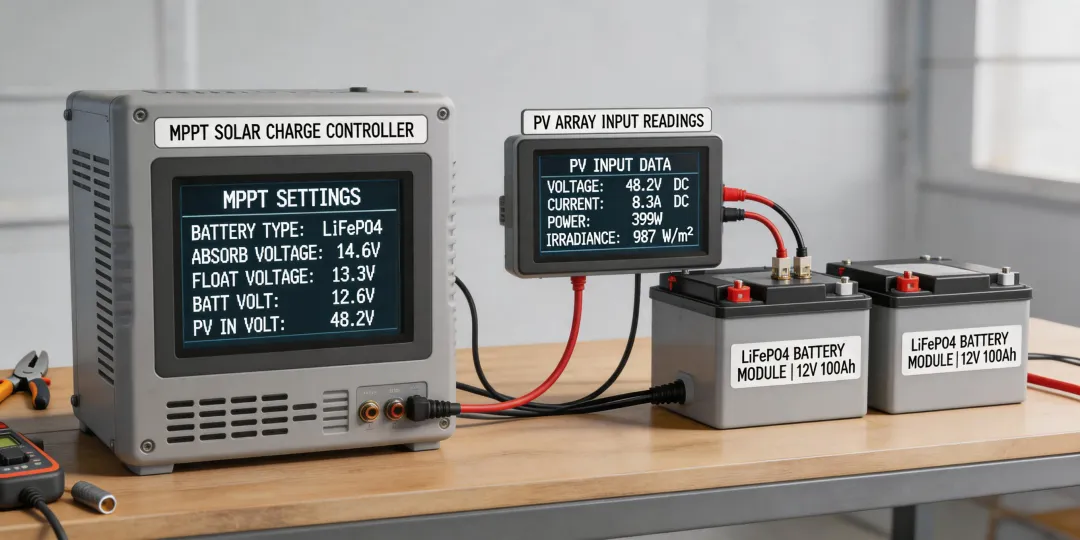
Paying the small premium for MPPT over PWM was a no-brainer once I saw the numbers. The Epever 20A MPPT solar charge controller also has a setting for lithium batteries. That turned out to be a game-changer, because we didn't have to guess a charge profile.
What Is Qualified Battery Storage Technology? I Asked.
Before we committed, I found the phrase 'qualified battery storage technology' on a grant-related website and typed it into Google. Spoiler: the top results were not exactly clear. So I asked the supplier directly.
'What is qualified battery storage technology?'
He laughed that kind laugh you get when you admit you don't know something. Then he explained: a qualified battery is one that meets the safety and performance standards expected for installation in the UK. For us, that meant CE marking, UN38.3 transport certification for lithium cells, and an MCS-compliant installation. It also means the installer can give you a certificate, not just a brochure.
That conversation stuck with me. 'Qualified' is one of those words that gets thrown around in marketing. It was kinda the moment I realised we needed a standards checklist, not a slogan. If a seller says their battery is 'green' or 'storage-ready,' ask for the paperwork. Per the FTC Green Guides (ftc.gov), environmental claims need to be specific and substantiated. That's a US guideline, but the principle translates: if you can't point to the standard your battery meets, it's probably not a qualified battery storage technology package.
This gets into compliance territory, which isn't my expertise. I'd recommend checking with your own installer or legal team before relying on a grant. But the bottom line is: do not accept vague claims. Missing certification would have been a deal-breaker for us.
Installing the Epever 48V 100Ah Lithium Battery
Installation day was not perfect. The controller that arrived was the PWM version, not the MPPT we ordered. I caught it because the model number was printed on the side, and I'd already read the datasheet. The supplier apologised, sent the correct Epever 20A MPPT solar charge controller, and paid for the electrician's second visit. That mistake actually made me trust them more, because they owned it and fixed it fast.
Once the correct controller was in, the Epever 48V 100Ah lithium battery was surprisingly easy to set up. The controller already had a LiFePO4 preset, so the installer didn't need to input custom voltages. That's a big deal. Some batteries require you to dig into manuals and guess at absorption voltage. With this Epever setup, the hard work was done in the firmware.
To be clear, I'm not an electrical engineer, so I can't tell you exactly how the BMS communicates with the controller. What I can tell you from a purchasing perspective: the battery came with a proper datasheet, a clear terminal layout, and a manufacturer whose name I could verify.
There is something satisfying about opening the monitoring app on a grey Tuesday and seeing the battery hold charge instead of burning through grid power. After all the spreadsheets and phone calls, that feels like a small win.
The UK Solar Battery Storage Wrinkle
People usually imagine a massive wall battery when they hear 'UK solar battery storage.' Our system is small by home-install standards. It stores maybe 4.8 kWh in the Epever 48V 100Ah lithium battery, and that's enough to run the water pump and controls through the night. If we had tried to power an electric kettle or a 3kW heater, it would be gone in an hour. You have to size the system to the load.
We also learned that 'solar system water heater' can lead you astray if you only search for solar thermal panels. A PV-powered pump setup is not the same as a solar thermal system. It's a solar-assisted electric water heater. The two have different costs, different incentives, and different maintenance needs. Know which one you're buying.
Not every battery sold online is appropriate for fixed solar storage. Some are RV batteries with different terminals and no mounting approval for wall installation. Ask if the product is certified for stationary storage. That's the beginning of the 'qualified battery storage technology' answer.
Does a Small Order Matter? Yes.
There was a moment when I nearly cancelled the project. The old water heater had a scorched smell, the budget was in flux, and part of me wondered if we were overcomplicating a £500 repair. Another part liked the idea of a renewable system that wasn't just a token solar panel on a window.
What got me through was the supplier's attitude. We were a 50-person company with a modest budget—£4,200 ballpark. They still measured the roof, sent a real quotation, and prepared a wiring diagram. That matters. Small doesn't mean unimportant—it means potential. The vendors who treated my initial small orders with respect are the ones I've stayed with as our budgets grew.
I have mixed feelings about the upfront cost. On one hand, a new electric water heater alone would have been less. On the other, the solar system gives us resilience and a visible sustainability selling point for clients. I justified it by treating it as a pilot: if the data says it's not working, we can expand or stop later.
Lessons I'd Pass Along
If you're a buyer like me, here's what you need to know:
- Verify product numbers before installation. A '20A controller' is not automatically an Epever 20A MPPT solar charge controller.
- Ask for the battery certification sheet. 'Qualified' should mean standards, not adjectives.
- Get a proper invoice before you get a proposal. Finance will thank you.
- Size the system to the actual device. A battery bank is not magic.
Don't hold me to the exact payback math—ours is still too new—but I think this will be one of the smarter facility decisions I've made. It wasn't a perfect project. It had one wrong controller and a lot of doubts. But it works, it's measured, and it's ours.