Ask an Astronomer, Then Ask Yourself
Ask an astronomer "who created the solar system?" and you'll get a long story about gravitational collapse, a spinning cloud of gas and dust, and about 4.6 billion years. The short version: physics created it.
Ask an off-grid solar owner the same question, and the answer is guiltier: "I did. I bought the parts and wired them together."
That second answer is usually where the trouble starts.
I'm a quality and compliance manager at a renewable energy company. I review every system design that reaches our customers—roughly 250 designs a year, between commissioning checklists and spec confirmations. I've watched people spend serious money on premium parts, only to watch their system limp along at 70% capacity. Not because the parts were bad. Because the system was never designed.
The Problem You Think You Have
When a charge controller underperforms, or an inverter trips, or a battery drops voltage faster than it should, the immediate assumption is always the same: "I bought the wrong brand."
Last month, a customer wrote to me with a classic symptom. It went something like this:
"My brand-new MPPT charge controller says it's delivering full current, but my batteries are sitting at 31% every morning. The lights flicker, the inverter beeps in the afternoon. I think the controller is garbage."
He wasn't the first, and he won't be the last. Here's the issue: the controller was nowhere near the actual problem. It was a 20A unit connected to a 100Ah 12V battery—healthy enough. But his panels were wired in parallel, feeding only 18V into the controller's input—below the MPPT window's lower limit for a proper charge. The controller was doing exactly what it was built to do with the conditions it was given. The design was wrong, not the device.
This is the surface problem: you think you made a purchasing mistake. What actually happened is a system design mistake.
What Most People Don't Realize About System Design
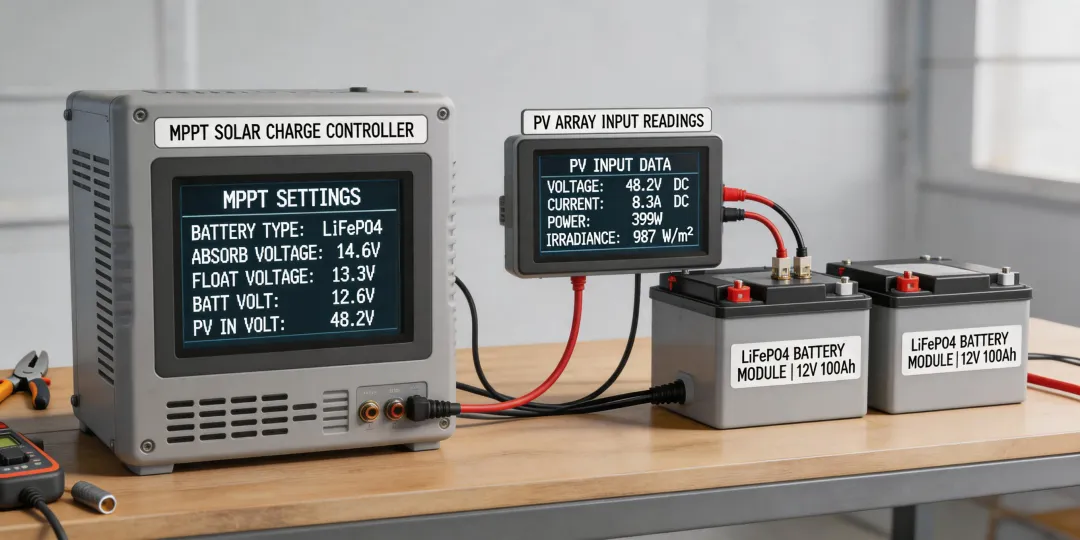
Every component in an off-grid system makes assumptions about the other components. The MPPT controller assumes the PV array voltage stays within its operating window. The inverter charger assumes the battery bank can safely accept its charge current and supply its surge current. The battery management system assumes the charge profile matches the battery chemistry—especially if you're running LiFePO4, which behaves nothing like lead-acid.
When those assumptions break, the system doesn't usually die on the spot. It degrades. It's like a 60A fuse quietly carrying 50A for six months. Everything looks fine until you actually check the numbers.
What most people don't realize is that a lot of the "solar system diagrams" you find online are drawn by marketing folks, not engineers. They show panels on the left, a controller in the middle, an inverter on the right, and tidy arrows pointing forward. They don't show voltage drops, operating temperatures, charge states, or the difference between an inverter's steady-state rating and its surge behavior.
I could blame the diagrams, but honestly, the industry lets them exist because selling components is easier than selling engineering.
Here's something vendors won't tell you: the same inverter that runs your lights and refrigerator without breaking a sweat can trip the moment a home EV charger level 2 demands 32A at startup. If the inverter's surge rating is marginal—or the wire run is a bit undersized—your "10kW system" will behave like a 3kW system every time you plug the car in.
That's a system-level problem. No upgraded component will fix it if the design assumptions underneath are wrong.
What a Mismatched System Actually Costs You
Let me give you a concrete example. In Q1 2024, we audited a 5kW off-grid setup. The owner was charging a Nissan Leaf with a Level 2 home EV charger. He'd picked parts from three different vendors based on price: a 20A MPPT controller, a 3kW inverter, 200Ah LiFePO4 batteries, and a 32A EV charger.
Individually, every component was fine. Together, they were a train wreck.
The charge controller was sized for a 24V battery bank, but the owner ran a 48V bank—so the PV current was half what it should have been. The inverter could surge to 6kW, but only for two seconds, which wasn't enough to spin up the EV charger plus the household baseline. And the LiFePO4 battery was running a lead-acid charging profile because, in his words, "the settings menu is confusing."
The result:
- Battery capacity dropped to roughly 60% of spec after 300 charge cycles. Replacement cost: about $2,400.
- Daily charging efficiency was about 18% lower than a matched system.
- The Level 2 charger almost never worked during the day, because the system couldn't cover the load without dipping into the damaged battery.
In total, he spent an estimated $6,800 for a system that delivered maybe $4,000 of value. He "saved" about $900 upfront by buying cheap parts piecemeal.
That audit changed how I think about system-level failure. The physical components aren't what fails. What I mean is that the interface between them fails—and the interface isn't sold by any single vendor.
In my experience, the cost of design mistakes isn't obvious on day one. It shows up at day 90 or day 140, and by then it's baked into your daily yield. A 15% efficiency loss plus battery degradation will silently eat more money than you saved on the "good deal" component. It's just slower, so you don't notice it at first.
The Specialist's Approach: Know the Boundaries
So what do you do about it?
The solution is boring, and that's the point: work with a specialist who knows where their capability ends. A generalist who says "we handle everything" usually means "we'll sell you everything regardless of whether it fits." A specialist who says "this is our strength—and this is what you should buy elsewhere" earns trust for the parts they do sell.
In practice, that means:
- The solar system diagram should include real operating ranges—not just boxes and arrows, but PV input voltage, MPPT range, charge current, battery chemistry, and inverter surge values.
- The charge controller, the inverter charger, and the battery must share the same design premise. If you're running LiFePO4, every charging stage should follow the battery manufacturer's recommended voltage and current limits.
- If you're powering a load like a home EV charger level 2, size the inverter for surge, not steady-state. A few hundred watts of headroom is not headroom. And check the wire gauge—voltage drop over a long run at 30A+ can cripple a system that looks perfect on paper.
I'm not going to pretend epever sells every link in the energy chain. We don't. What we do well is the critical middle of it: professional MPPT charge controllers, the epever inverter charger line, and batteries with flexible settings built for LiFePO4 chemistry. You can—and should—buy a dedicated EV charger from a company that specializes in EV charging. That's not a weakness in our lineup; it's a boundary we respect.
I'd rather work with a specialist who knows their limits than a generalist who overpromises. That mindset is what saved our clients from the trap I described in that Q1 audit.
If your system is underdelivering, don't start with "which component should I upgrade?" Start with the system diagram. Verify the assumptions. Check the input voltage, the charge profile, the surge rating. The people who truly created your solar system aren't the ones who bolted the panels to the roof—they're the ones who picked the numbers in the specifications.
Make sure those numbers were chosen by someone who understands the system, not just the parts. I can only speak to the mid-size off-grid systems we audit—if you're building a megawatt-scale solar array, the calculus is different and you need an engineer. This was accurate as of late 2024; battery chemistry and EV charging standards evolve fast, so verify current specifications before you commit.