-
Should we use an Epever MPPT 20A charge controller for workplace EV charging?
-
Can solar inverter work without battery?
-
Where is the Epever solar charge controller manual and what should I check first?
-
What does a public EV charging station parking lot project actually cost?
-
EV charging station at work: should it be employee-only or public?
-
What does “solar-powered workplace charging” really mean?
-
Do we need battery storage for solar EV charging at work?
I'm the office administrator for a company of about 50 people. I handle facilities purchasing—maybe $600k a year across a dozen vendors—and I report to both operations and finance. I am not an electrical engineer. In early 2024, our operations director asked me to scope out EV charging for the parking lot. My first search was for what I already knew: epever mppt 20a. That's how I spent a week learning the difference between a solar charge controller, a solar inverter, and an EV charger. This article is the FAQ I wish someone had handed me that day.
Should we use an Epever MPPT 20A charge controller for workplace EV charging?
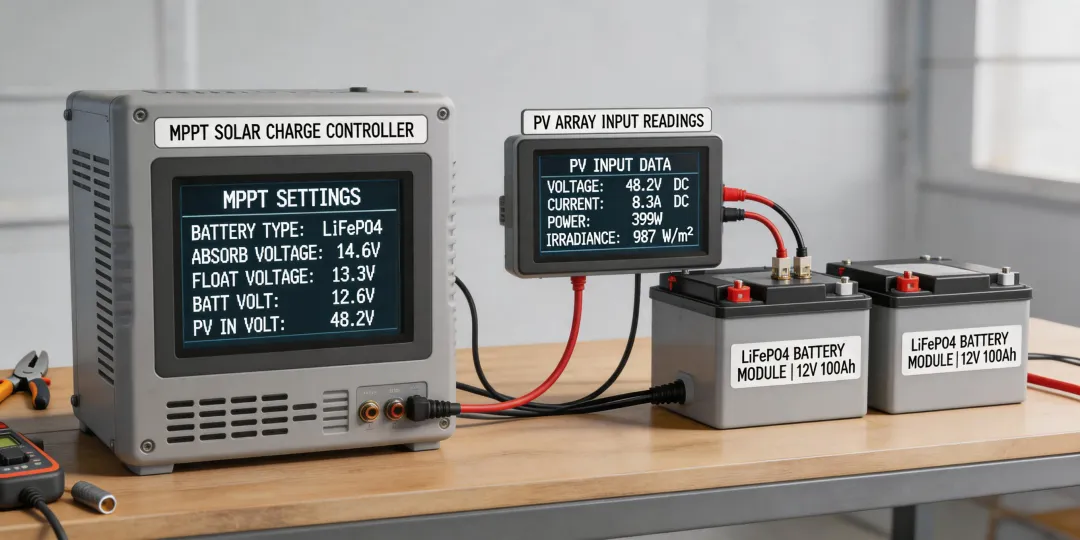
No—not for Level 2 EV charging. The Epever MPPT 20A is a battery charge controller. It takes DC from solar panels and regulates it into a 12V or 24V battery bank. A Level 2 EV charger needs 208V or 240V AC. The typical path for solar and EV charging in a commercial building is: PV panels → inverter → electrical panel → EV charger. An MPPT controller is a different part of the universe.
That doesn't mean Epever products are bad. We use a 20A MPPT controller on the gate and security trailer batteries, and it has done what it should. But when I first searched for an MPPT 20A for the EV project, I was choosing the wrong device. Our electrical engineer finally put it simply:
You're sizing a battery charger, not a station supply.
That moment changed how I read every solar quote since.
Can solar inverter work without battery?
Yes, but only for the right type of inverter. Grid-tied solar inverters are designed to work without a battery. They sync to the grid and shut down if the grid goes down—that's called anti-islanding. No battery, no backup, but perfectly legal and common.
Off-grid inverters usually need a battery bank because they generate a stable AC frequency themselves. Some hybrid inverters can run battery-less, but you lose backup functionality and sometimes surge capacity for loads. A quote that says “solar EV charging, no battery needed” can be legitimate or misleading. Ask for the inverter model and check the manual's wiring diagram. In our case, the term “battery-less” in the marketing material didn't match the manual's “battery required for normal operation” note. Not a salesperson's lie; just an easy thing to miss.
No battery. No magic. It's a design decision.
Where is the Epever solar charge controller manual and what should I check first?
The manufacturer's manual is available on epever.com under support documents. Find the exact model from the label on the side of the controller—ours is a Tracer 2210AN—and download that specific PDF. A search for “epever solar charge controller manual” will get you close, but the model number matters more than the product family name.
If you are using LiFePO4 batteries, know this: the controller's default battery type may not be lithium. Epever gives you a User setting so you can set absorption voltage and float voltage to match your battery datasheet. If you leave it on sealed or gel, you might charge the battery wrong. Also check max solar input voltage and max PV power. The 20A rating is the charging output, not the PV input limit. A 20A MPPT controller is not a 40A controller, and it is not an excuse to hook up a huge array.
I printed the manual and kept it in the electrical cabinet. Field techs still ask for it.
What does a public EV charging station parking lot project actually cost?
The phrase “public EV charging station parking lot” gets quoted with a very misleading per-charger price. I'm going to give you our actual numbers, not a market average. In 2024, we installed four Level 2 chargers in our parking lot.
The charger hardware was roughly $3,400. That's the only line item most quotes advertise. The rest was electrical labor at $8,600, trenching and conduit at $4,200, a panel and service upgrade at $6,100, permits and inspections at $780, and the first year of network service at $2,400. Because EV charging is a continuous load under the National Electrical Code, the electrician also had to run a building load calculation. That is what revealed the main panel was undersized in the first place.
Final total: around $25,500. No, $25,480. I had to double-check because I kept telling finance it was $24,900. The per-port number came out to about $6,400. That still excludes future network fees, maintenance, and the eventual EVSE replacement.
If a vendor quotes you a per-charger price without load calculations, trenching, and utility service work, the TCO will surprise you. The $750 charger quote isn't the cost. The $750 charger quote is the appetizer.
EV charging station at work: should it be employee-only or public?
Employee-only worked best for us. We wanted reliable workplace charging, not a business that sells electricity. Calling it a public EV charging station in the parking lot adds more expectations: payment options, network uptime, signage, ADA considerations, and a utility rate decision. If you charge money, you also get credit-card availability questions and a larger set of state and local rules.
We started with employee and visitor access on an app-based network, but we don't charge a fee yet. The network subscription gives us status data and user management. The hardware also supports paid mode later. That was part of the TCO decision: paying a network fee now is cheaper than replacing dumb chargers later.
What does “solar-powered workplace charging” really mean?
This is the question I didn't know I needed to ask. We have solar panels on the roof that offset the building. We also have EV chargers in the parking lot. A marketing person could call that solar-powered chargers, but the chargers aren't plugged into a dedicated solar battery. They draw power from the building panel. The solar array reduces the building's net imported energy, which indirectly supports the chargers. That's good, but it's not the same as a solar canopy DC-pumping current directly into a car.
We use the phrase “solar-supported workplace charging” instead. Per the FTC Green Guides (16 CFR Part 260), environmental claims need substantiation. A broad claim like “100% solar-powered EV charging” is hard to defend if the building and charger are on the same net-metered service. “Solar-supported” is accurate, safe, and still useful for employee communications.
Part of me wants the clean story of solar directly charging cars. Another part knows the grid is the battery in most commercial buildings. I reconcile that by being precise about what we can prove.
Do we need battery storage for solar EV charging at work?
Not necessarily. For grid-tied solar, you can run the EV chargers from building power and let the grid absorb the solar output. The solar inverter does not need a battery to function. I almost approved a battery add-on because I thought solar without battery was incomplete. The engineer stopped me: “No battery is not a failure. It's a different architecture.”
Battery storage makes sense when you are chasing outage resilience, demand charge reduction, or time-of-use savings. If you don't have a specific electricity bill problem, adding a battery is a cost with no payback. Start with solar and chargers. Run the office for a year. Then decide if storage is worth it.
The Epever charge controllers we use on small systems were not part of the EV station sizing, and that's the main lesson: pick the architecture first, then the equipment.