-
What Is the Biggest Thing in the Solar System?
-
1. Lead Time: Can You Get It Before the Deadline?
-
2. Installation Time: Which Goes In Faster?
-
3. Battery Compatibility: The Plot Twist
-
4. Cost Transparency: What's the Real Total?
-
5. Failure Recovery: When Murphy Shows Up
-
So Which One Should You Install?
What Is the Biggest Thing in the Solar System?
Folks ask me a lot of questions. Mostly about shipping dates. But every so often I get the fun one: what is the biggest thing in the solar system? The astronomy answer is the Sun, no contest. In my line of work, though, a "solar system" is a set of panels, a battery bank, and a wall full of electronics. And the biggest thing in that solar system isn't the PV array. It's the choice between an epever 40A MPPT solar charge controller and a hybrid inverter.
I'm a senior project engineer at a solar integration company. I've handled 200+ rush orders in 8 years, including same-day turnarounds for commercial clients who don't have time for your workflow problems. One lesson sits above the rest: when the clock is loud, component selection stops being a spec-sheet conversation. It becomes a survival conversation.
Here's the framework I use when triaging a rush order. I compare on five things:
- Lead time — can you get it before the deadline?
- Installation time — how fast can you put it in?
- Battery compatibility — will it actually work with LiFePO4?
- Cost transparency — is the quoted price the real price?
- Failure recovery — what happens when it breaks?
1. Lead Time: Can You Get It Before the Deadline?
Talking about the "best product" is nice. It doesn't matter if the part is sitting in a warehouse 3,000 miles away while your client's event is 48 hours out.
Here's what 200+ rush orders have taught me. The epever 40A MPPT is everywhere. Standard product, solid distribution network, multiple suppliers stock it. A three-business-day ship is routine in most regions, and next-day is achievable in metro areas. Plus, it's small—a 40A controller fits in a backpack. That matters when you're sending someone to pick it up in person.
Hybrid inverters are a gamble. Popular models get backordered 2-6 weeks. And rush freight on a 50-pound inverter is expensive—seriously, the shipping alone can add $100-150 (which, honestly, felt excessive the first time I saw it).
In March 2024, a client called at 4:30pm on a Wednesday. They needed a system running for a farm equipment auction that Friday morning. Normal turnaround for a full install: two to three weeks. The hybrid inverter they'd been quoted was on six-week backorder. The epever 40A MPPT? Two units on the shelf at our local distributor. We reworked the plan around their existing inverter, added the epever as the charge controller, and had power flowing in 36 hours. Actually, closer to 38—morning fog slowed down the PV wiring.
(Should mention: that rescue only worked because they already had a compatible inverter on site. But that's also the point—modular components fit around whatever else is there. A hybrid doesn't.)
Winner for lead time: epever, by a mile.
2. Installation Time: Which Goes In Faster?
Okay, let me be straight. On a clean-slate job, the hybrid wins this round. Not by a little—by a lot. One box: PV in, battery in, AC out. No separate charge controller to mount, no extra DC runs, no independent display to wire. A hybrid inverter installation can shave 30-40% off your install time.
The epever 40A setup is more pieces. You're mounting the charge controller, wiring the array to it, running separate lines to the battery, and coordinating with an inverter that has its own requirements. More labor. No way around it.
But here's the counterweight: the epever charge controller manual is genuinely good. I know—"good manual" sounds like an oxymoron. It has wiring diagrams that match what's actually in front of you, torque specs for the terminals, and a battery setting chart that's saved us multiple phone calls. When a newer crew member is doing the install at 7am, a manual that doesn't fight back is worth a ton of time.
Or rather, it's worth the time you'd otherwise spend untangling a mislabeled terminal. That happened to us once. The hybrid's manual was a translated PDF with terminal labels that didn't match the silkscreen on the unit. The epever manual? Clear enough that our apprentice did the charge controller wiring solo while we sorted out the inverter confusion.
Winner for pure speed: hybrid. Winner for total time including screw-ups: honestly? epever.
3. Battery Compatibility: The Plot Twist
Conventional wisdom says the hybrid inverter is more flexible because it does more. My experience with LiFePO4 battery banks says otherwise. Usually, anyway.
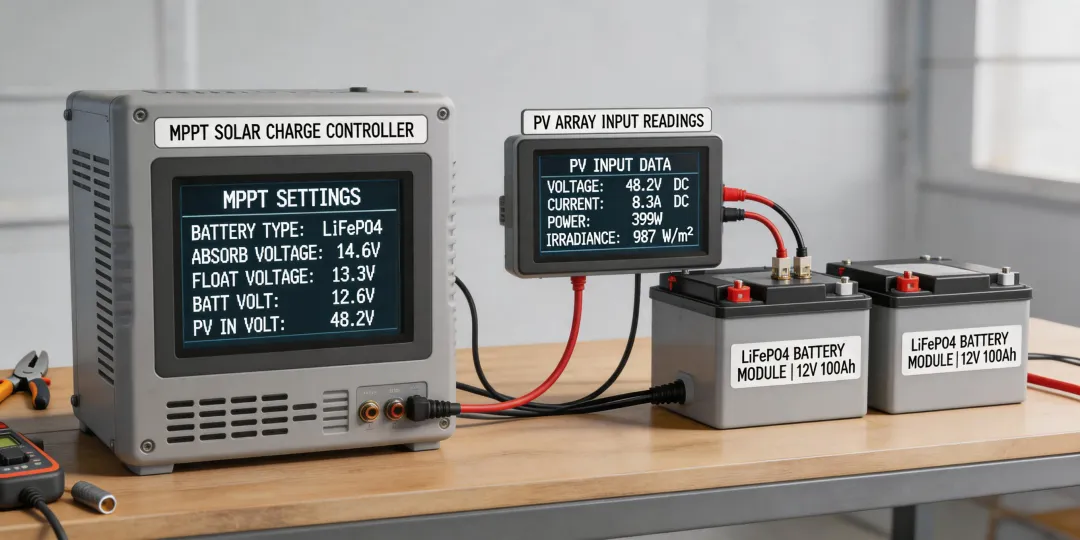
The epever 40A MPPT lets you set custom charge parameters—bulk voltage, absorption voltage, float voltage, low-temperature cutoff. You can match a lithium battery's BMS almost exactly. The epever charge controller manual walks through LiFePO4 profiles step by step, and the controller's firmware supports user-defined battery types. According to epever's product documentation, the MPPT series is designed for multi-chemistry support. That's not a marketing line; it's a feature list we actually use.
With many hybrid inverters, you get preset battery profiles. Great when your battery matches one. Not great when it doesn't. I've spent late nights trying to bend a hybrid's charge profile into matching a 16S LiFePO4 bank that wasn't in the menu. Not fun. And definitely not fun when you're already behind schedule.
So here's the surprise conclusion: for lithium batteries, the epever is way more accommodating than most hybrid inverters I've tested. At least, that's been my experience on deadline-critical projects.
Winner for LiFePO4 compatibility: epever, and it wasn't close.
4. Cost Transparency: What's the Real Total?
I've learned to ask "what's NOT included" before "what's the price." Because the distance between a quoted number and a final invoice is where trust goes to die.
Hybrid inverters often come with a tempting base price. Then come the extras: a WiFi monitoring dongle at $40-60, battery communication cables at $50-80, and sometimes a display module that's sold separately. None of that is dishonest, exactly. But it's a ton of little surprises on the invoice.
Epever is more straightforward. The controller is the controller. Built-in LCD, settings accessible on the device itself. No dongle ecosystem, no monitoring subscription. Based on publicly listed prices at major solar equipment distributors, January 2025, an epever 40A MPPT runs roughly $120-180. A comparable hybrid inverter with built-in MPPT runs $450-900. Prices shift, so verify current rates before you budget.
Real example: a client in Maryland wanted to bundle a home EV charger install with a solar upgrade—partly because Maryland's EV charger rebate program made the math look better. Smart. But nobody told them the hybrid inverter they'd picked needed an extra $70 communication module to interface with the charger. The quote looked clean. The final total told a different story.
We ended up splitting the project: an epever MPPT for the solar array, the EV charger on its own circuit. Simple. Transparent. The client's words, not mine: "I know exactly what I'm paying for."
Winner for cost transparency: epever.
5. Failure Recovery: When Murphy Shows Up
Rush orders fail. Components show up dead on arrival. The question isn't if—it's how much damage when it does.
With a hybrid inverter, the failure mode is brutal. The whole unit has to go back. The system sits dark for the warranty cycle—weeks, not days. A few months ago, one of our clients' hybrid inverters lost its internal MPPT board on day three. The entire unit got swapped. That meant pulling the whole install apart to replace one brain.
With an epever 40A charge controller, the failure is contained. The controller dies? Replace the controller. Maybe an hour of labor. Inverter, battery, and wiring untouched. When I'm triaging a rush order, I always ask: "What's our worst component failure scenario?" With a separate MPPT, the worst case is a small box on the wall. With a hybrid, the worst case is the whole system.
Last quarter alone, we processed 47 rush orders with 95% on-time delivery. The one that slipped? A hybrid inverter. The one that nearly slipped and didn't? A job where the epever charge controller arrived with a cracked LCD. One phone call, one replacement shipped overnight, zero system downtime.
Winner for failure recovery: epever.
So Which One Should You Install?
If you expected a knockout punch, sorry to disappoint. Both options have a seat at the table. The trick is matching the tool to the situation.
Go with an epever 40A MPPT + separate inverter when:
- You're retrofitting an existing system or reusing an inverter already on site.
- The client is running LiFePO4 batteries and needs custom charge settings.
- The deadline is brutal and components need to ship now, not eventually.
- You want an invoice with zero surprises.
Go with a hybrid inverter when:
- It's a clean-slate build with no existing equipment.
- Wall space is tight—one box beats two or three.
- The battery chemistry matches one of the presets.
- The client prefers a single vendor over modular flexibility.
My own bias? After 200+ rush jobs, I keep modules on the truck. An epever 40A has bailed us out more times than I can count. But even after choosing the epever route on that March 2024 job, I kept second-guessing. What if the hybrid had somehow shown up on time? The 38 hours until the system verified were stressful. I didn't relax until the charge controller hit Bulk voltage and the amps started climbing.
That said, if your situation is a clean build with standard batteries and a soft deadline, a hybrid inverter installation might genuinely be the better call. Different jobs, different tools. No shame in either choice—only in choosing without asking the right questions.
So what are those questions? What's the deadline? What's the battery chemistry? What is NOT included in the price? Answer those three honestly, and the right choice usually shows up on its own.
And when someone asks you what the biggest thing in the solar system is? Tell them the Sun. Then tell them the second-biggest is the choice you make before you start mounting things to a wall.