It started with a dead controller
Last March, I was sitting on a plastic crate in a customer's equipment shed, staring at a charge controller that had stopped charging a 12V system. The customer wasn't angry, just confused. We had installed that controller less than a year earlier. I had one thought: this is going to be expensive.
I'm the procurement manager at a 24-person renewable energy company. I've tracked every component order we've placed for six years, and I've negotiated with dozens of vendors. Our annual budget for solar components is about $480,000, maybe a little more with freight. So when something fails in the field, I don't just replace it. I try to find out where my process broke.
That controller wasn't an Epever. After we pulled the data logs, the issue was clear: it had been configured for a sealed lead-acid battery bank, but the customer had changed out their batteries a few months earlier without telling us. The old controller's battery profile was never updated, so it treated the lithium bank like lead-acid. It wasn't a hardware failure. It was a setup error. That mistake cost us a weekend visit, a $350 swap, and $200 in lost labor.
It was also the reason I started looking at Epever in a completely different way.
The hidden world solar system buyers don't see
When you buy an MPPT solar charge controller, the spec sheet only tells you part of the story. You see voltage, current, efficiency, and price. But there's another world underneath: battery profiles, temperature sensor support, remote monitoring, software, and how easy it is to set the device up correctly. I call it the hidden world solar system installers deal with. It rarely shows up in a supplier's quote.
In April, we quoted a replacement for a remote livestock water pumping system. The customer wanted a new controller and a new battery bank. I started with a shortlist of three MPPT controllers. One was a premium brand. One was a lower-cost brand with mixed support reviews. And one was the Epever MPPT solar charge controller model we'd been testing in our shop.
To compare them honestly, I didn't just look at price. I downloaded the manuals for each controller from each manufacturer's site. The epever official website had the full manual, setting tables, and connection diagrams for all three models in the product line. That sounds like a small thing, but it matters. A controller is only as good as the person who configures it.
Why the MPPT solar charge controller Epever won the comparison
Our cost comparison didn't end with the unit price. We had a spreadsheet that included the controller, the remote display, the temperature sensor, shipping, and the estimated time it would take our installers to set it up. The Epever controller was not the lowest-priced unit in the shortlist. It was just the one that made the rest of our work cheaper.
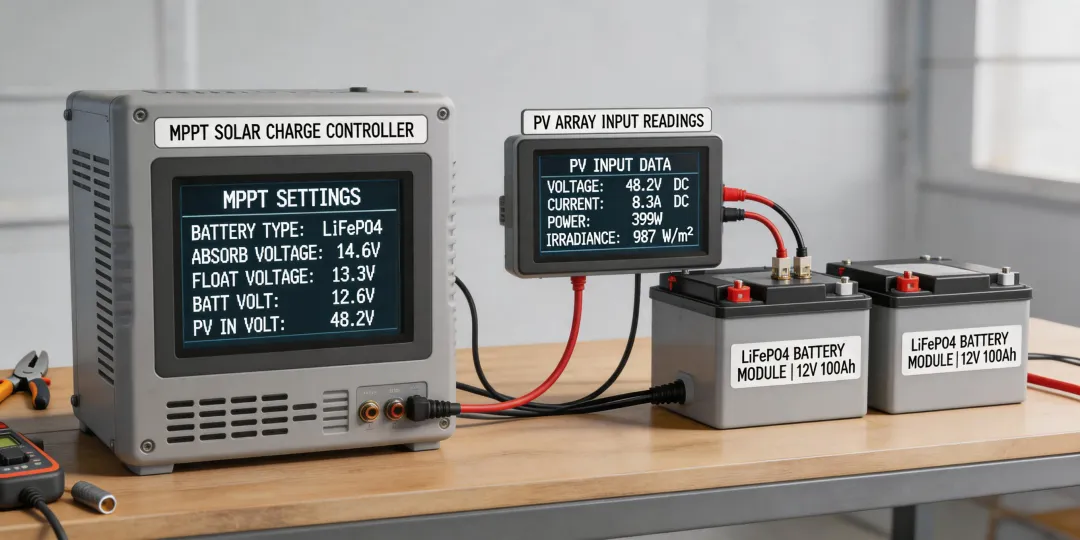
Specifically, I liked that the MPPT solar charge controller Epever model we tested had a dedicated LiFePO4 setting. That might sound basic, but some controllers treat lithium as one generic option. That can be a problem because not all lithium batteries are the same.
LiPo battery vs LiFePO4: not a marketing detail
People often ask me to explain the difference between LiPo battery vs LiFePO4. I get why it's confusing. Both are lithium. Both are used in solar and backup systems. But they're not interchangeable.
LiPo, or lithium polymer, is common in drones, RC vehicles, and lightweight electronics. It offers high discharge rates and compact packaging. LiFePO4, or lithium iron phosphate, is heavier and has lower energy density. But it's more tolerant of heat and doesn't have the same thermal runaway risk as other lithium chemistries. For a hot shed in the middle of a field, that difference is huge.
I have mixed feelings about the lithium marketing we see in this industry. On one hand, lithium solar batteries are genuinely better than lead-acid for many off-grid systems. On the other hand, some vendors oversimplify the chemistry and call everything just a lithium battery. That's dangerous.
According to the FTC's Green Guides, environmental and safety claims have to be substantiated. I don't expect every distributor to have a chemistry degree, but I do expect them to provide test reports and spec sheets. If they can't tell me whether the cells are LiFePO4 or LiPo, I won't put them in a customer's house.
For this project, we chose LiFePO4. It wasn't the lightest option, and it wasn't the cheapest on paper. But it had the cycle life and thermal stability we needed for a remote site with no climate control.
Install day: the part I almost forgot
The install started smoothly. The site had a small car battery wired in as a temporary source to keep the old controller alive while the rest of the system was switched over. Before we started, I showed the new tech how to safely disconnect car battery. The rule is simple: negative terminal first, then positive. This prevents the wrench from shorting against the frame if it contacts something metal. We disconnected it, moved it to a plastic crate, and then connected the new LiFePO4 bank.
Then the Epever controller didn't show the expected charging numbers. My stomach dropped. I thought we had either picked the wrong controller or damaged the solar panels. We checked the wiring. We checked the fuse. We measured battery voltage. Everything checked out.
Then I noticed the battery type indicator on the screen. It was still set to the default AGM profile. We had updated the settings in the office when we bench-tested the controller, but I didn't realize the unit had reset during shipping. Or maybe we just missed it. Either way, it was my mistake.
I opened the manual from the epever official website on my phone, followed the three-step battery setting procedure, and set it to LiFePO4. The controller refreshed, the charging voltage jumped, and the display started showing the correct bulk and float values. Five minutes. That's all it took.
Result: fewer service calls, better budgets
We finished the install that afternoon. Since then, we've installed the MPPT solar charge controller Epever on 11 more off-grid systems. We still use other brands on projects where a customer specifically asks for them, but Epever is now our default for most 12V, 24V, and small 48V systems.
One more thing: I should add that the first Epever units we bought included temperature sensors. That seems small, but for a cold climate, it prevents overcharging and adds a lot of peace of mind.
In the nine months after the install, our field service callbacks related to charge controller configuration dropped by more than half. I estimated the savings at around $8,000. Maybe $7,000, I'd have to check the service ticket totals. But the direction is clear.
As of January 2025, I still verify every lithium battery shipment on usps.com because the rules change, and a forgotten requirement can cost a whole day at the counter.
The real lesson: prevention is a process, not a personality trait
I used to think checklists were for people who didn't know their job. Now I think the opposite. The 30-minute compatibility check I skipped in the office cost us a weekend service call. The 5-minute battery chemistry setting I almost skipped on site would have turned a successful install into a failure.
Prevention doesn't mean checking everything twice. It means having a repeatable process and updating it every time you learn something new.
After this project, I added two lines to our controller commissioning checklist:
- Confirm battery chemistry is set correctly after the controller powers on, not just before it ships.
- Verify that no temporary batteries are connected before final system startup.
That second one came from the car battery moment. It's the hidden world solar system installers rarely mention: the easiest way to avoid a mistake is to make the mistake impossible next time.
If I could go back, I'd spend 30 more minutes reading the manual before the install. I still kick myself for not doing that. But I don't need to make the same mistake again. And if you're a fellow procurement person, that's the lesson I want you to take from this: the cheapest controller is not automatically the cheapest system. The right documentation, the right battery chemistry, and the right checklist are part of the total cost.
Final thought
We now use the Epever MPPT solar charge controller as a reference point for every off-grid quote. It's not because the brand is perfect. It's because the total cost of ownership, including support information and setup time, made sense for our company.
And if you're wondering where to start, go to the epever official website first. Read the manual for the model you are considering. If the setup instructions are clear, that tells you more about the product than any spec sheet.
Then build your checklist. And update it after your first mistake. The second one is optional.