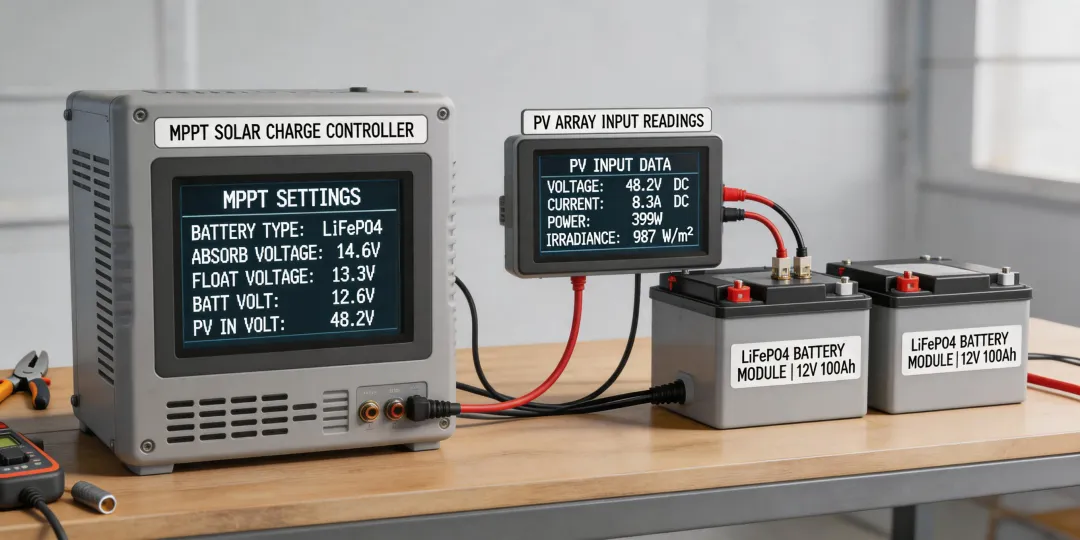
Start with the battery bank, not the panels. That's the single most useful thing I can tell you about ordering a small off-grid solar system. For most 12V cabin, trailer, and job-site setups, the most cost-effective path is a properly sized LiFePO4 bank, an EPEVER Tracer MPPT charge controller, and an EPEVER inverter charger only if you actually need AC power. In my procurement spreadsheets, this combination has cut total cost of ownership by about 18% over three years compared to mismatched kits—not because EPEVER is the cheapest brand, but because it removes the expensive service calls that come from incorrect voltage and battery chemistry settings.
Here's the thing: the order of solar system components you install is solar array → charge controller → battery → inverter. But the design order is the reverse. Loads first. Battery second. Inverter third. Controller and array last.
Why You Should Listen to a Cost-Controller
I've been procurement manager at a 14-person solar installation company since early 2022. I manage roughly $180,000 in annual equipment buys and have logged over 100 orders in our cost-tracking system. That doesn't make me the only voice you should listen to. It means I've been burned enough times to stop trusting the cheapest quote.
I can't tell you exactly what your installer will quote. I can tell you what we see on invoices. The cheap system that fails costs more in service calls than the money saved. In Q3 2023, one customer's price-conscious build required three return trips because the controller and lithium battery couldn't communicate in a safe charging profile. That became a $1,200 redo on what was supposed to be a $600 system. The hidden cost didn't show up until the first cloudy week.
The Order of Solar System Components Matters More Than Brand
Why does this order matter? Because a solar panel doesn't care what you paid for it. A 400W array will happily feed voltage into a controller that doesn't support your battery voltage, and a cheap PWM controller will turn an expensive lithium bank into a chronically undercharged problem. I've seen both happen.
Design it in this order:
- List every load and its daily run time.
- Size the battery to cover your worst-case cloudy day.
- Size the inverter, or inverter charger, from the largest surge load.
- Then pick a solar array and charge controller to refill that battery in your local sunlight.
All-in-one kits are tempting because they promise no thinking. But they often pair a 20A PWM controller with a small panel and a tiny battery. That's not a system; it's a toy. Spec'ing components separately gives you a longer list of parts, but it lets you match every piece to the actual load and battery chemistry.
That last step is where EPEVER's Tracer MPPT line makes a strong argument. As of January 2025, the EPEVER Tracer MPPT series is one of the few controllers in its price range that lets me set a LiFePO4 profile without extra modules. EPEVER datasheets list peak efficiency around 98%, and our own install logs back that up within a reasonable margin.
EPEVER Tracer MPPT: Sometimes the More Expensive Option Is Cheaper
I went back and forth on this exact decision for a 12V trailer system last spring. PWM controller: $32. EPEVER Tracer MPPT: $110. On paper, the PWM controller looked fine. But the trailer sat under oak trees, and in partial shade the MPPT controller harvested noticeably more. Over a 14-day test, the Tracer delivered 17% more amp-hours than a comparable PWM setup in the same location. That extra energy does not show up on the invoice, but it shows up in battery state of charge every morning.
Would I buy PWM again for a single 100W panel with no shade? No. Actually, maybe. If the load is tiny and the panel faces full sun, PWM is fine. But the moment the system has real loads or partial shade, the Tracer MPPT earns its premium. The risk calculus is simple: an undercharged lithium bank loses capacity over time, and replacing a 200Ah LiFePO4 battery costs far more than the difference between a PWM and an MPPT controller.
There's something satisfying about seeing a controller hold a lithium bank at 14.4V all afternoon without me touching a laptop. But there's also a technical boundary: the MPPT's maximum PV voltage must be higher than your panel Voc × 1.25, per NEC 690.7. I once saw a 150V controller connected to an array that peaked over 170V on a cold morning. It didn't survive. That's not an EPEVER problem; it's an ordering problem.
EPEVER Inverter Charger vs. a Portable Inverter
If you only need to run a few devices occasionally, the Endurance 400 watt power inverter is fine. I used one to run a router and security camera at a shed for six months, and it never complained. But there's a hidden catch: a portable inverter doesn't charge the battery. So when the same customer asked for generator backup, I had to add a separate battery charger. That's an extra $70–150, plus more wire, plus more failure points.
An EPEVER inverter charger removes most of that. It turns DC into AC and, when shore power or a generator is present, turns AC back into DC to recharge the bank. It also has selectable battery type settings, which is the detail that finally convinced me to standardize on it for small cabins.
I still remember the afternoon I stressed over the extra $90 for an inverter charger instead of a plain inverter. The plain one ran the loads fine. But the batteries hit 40% every evening because the fridge was pulling more than the panels brought in. The inverter charger meant that when the customer ran a generator for two hours, the battery went back up instead of limping through another night. In an emergency, that certainty is worth paying for.
How Do You Charge a Jackery Portable Power Station?
If you already have an EPEVER-based solar system, the shortest answer is: charge the Jackery from the battery, not from the solar panels directly. Use a 12V car adapter cable from your battery bus into the Jackery's DC input. If the Jackery only has AC input, plug it into the AC output of the EPEVER inverter charger. It's a double conversion—DC to AC, then AC to DC—so not ideal, but workable.
The most frustrating part of this setup is the connector chaos. Every portable station seems to use a different Anderson, MC4, or barrel plug configuration. I keep a labeled box of adapters in the truck now. But the principle is the same: the EPEVER Tracer MPPT maintains the system battery, and the Jackery pulls from that maintained battery when needed.
This matters if you're preparing for a deadline. In March 2024, we had a film crew leaving at sunrise and their Jackery was at 4%. We couldn't rely on direct sun. Charging it from our 12V system while the generator ran through the inverter charger was the only option that guaranteed a full unit before they left. Could we have done it more efficiently? Yes. But the efficiency loss was trivial compared to sending them out with a dead battery.
When This Advice Falls Apart
If you're building a tiny RV system with one solar panel and an LED light, don't spend the extra money on an EPEVER Tracer MPPT. A $20 PWM controller does that job. If you're installing a grid-tied system, this entire ordering process is wrong, because the grid is the biggest battery you'll ever get. And if you need truly portable power for occasional camping, a Jackery or similar power station may be simpler than building a modular system from scratch.
The order of solar system components I described is for small off-grid systems where someone's daily work depends on the batteries being full. In that world, the cost of being wrong is not the purchase price—it's the day of lost work when the system can't keep up.