I'll say it straight: the cheapest solar component is the one you buy twice. After 200+ emergency off-grid rescue calls over four years, that's the lesson that keeps proving itself. Not defective parts. Not undersized panels. Not even cloudy weather. The most expensive mistake in off-grid solar is buying components as individual deals instead of as a matched system.
In my role as field service coordinator for a renewable energy systems company, I'm the person who gets called at 7 PM on a Friday when an off-grid system goes down. Event venues, cabins, RV builds, the occasional construction trailer. The pattern is always the same. A system that "worked for months" suddenly trips. A battery won't hold a charge. A controller reports weird voltages. And nine times out of ten, the root cause isn't one failed part. It's a mismatch between components that were never meant to work together.
That's why I believe component matching beats price shopping every single time. If you ask me, it's not even close.
The battery is the real bottleneck
Here's something vendors won't tell you: battery capacity, not charge controller wattage, is the bottleneck in nearly every underperforming system I've rescued. People pick the controller first because it has impressive specs on the box. But the battery defines what that controller can actually do with the solar harvest.
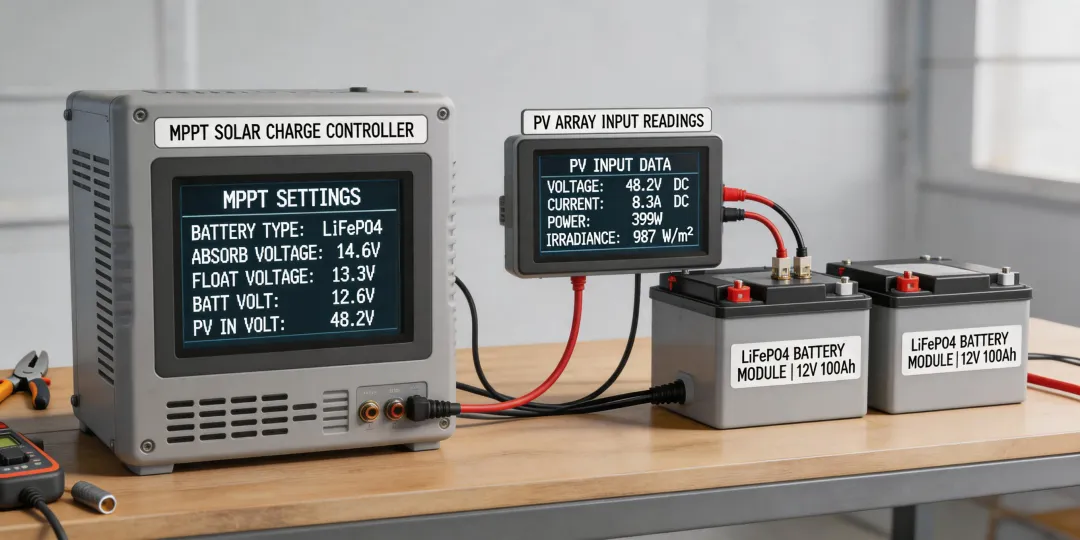
Take a 12.8V 200Ah LiFePO4 battery — the chemistry we've been installing a lot more since 2023. Its flat discharge curve keeps the whole system at 12.8V until it's nearly empty, which is completely different from a lead-acid bank slowly sliding from 12.7V down to 11.5V. Lithium also accepts higher charge current much later into the charge cycle, so your MPPT controller stays productive for a bigger portion of the day.
In March 2024, a client called at 6 PM needing a system fixed before 9 AM the next morning. Missing that deadline would have meant a $5,000 event cancellation — a wedding at their off-grid venue, during a rainy stretch that was about to get worse. Their system was tripping every two hours. The 30A MPPT controller was throwing over-voltage errors on a lead-acid bank that had been "temporary" for two years.
We arrived at 8:30 PM, swapped in a 12.8V 200Ah LiFePO4 battery, opened the EPEver 30A MPPT solar charge controller manual, changed the battery type from Sealed to LiFePO4, and set the absorption voltage per the chart. The system ran the whole weekend. The controller wasn't defective. The battery chemistry and charging profile were fighting each other. A $0.50 parameter change saved a $5,000 event.
The 40A MPPT controller is a sweet spot most people miss
Here's the counterintuitive part: in my experience, people oversize the charge controller because they think a bigger number means more power. In a 12V system, it doesn't. It just means bigger cables, more cost, and wasted harvest on most days.
Let me show you the math I keep coming back to. The EPEver Tracer 4210AN is a 40A MPPT charge controller, and honestly, it's the sweet spot for most mid-size off-grid builds. 40A multiplied by a 14.4V charge voltage works out to roughly 576W of maximum throughput. If you're running a 12.8V 200Ah LiFePO4 battery, that's about a 0.2C charge rate — which lithium actually prefers. Go bigger, and you're paying for headroom you won't use until you add panels. Go smaller, and you clip production on sunny days, exactly when the battery wants the most current.
Don't hold me to the exact wording, but EPEver's Tracer AN series manual (rev. 2023-06) lists a 100V maximum PV input for the 4210AN. In practical terms, a 2S panel configuration on a 12V bank is fine. A 3S configuration on a cold winter morning can exceed that limit, and I've watched experienced installers learn that lesson the expensive way. This is one of the reasons I tell people to read the EPEver 30A MPPT solar charge controller manual before wiring, not after. Ignoring temperature-corrected Voc is one of the most common causes of a controller coming back with a popped input stage.
Nobody budgets for the boring parts
Here's another issue that blows deadlines and budgets: mounting hardware. The solar panel holder — a bracket, rail, or Z-foot, whatever keeps the array attached to the roof or ground frame — is the least glamorous line in the bill of materials. So it gets swapped for whatever's cheap at the supply house.
Last fall, a client pulled two panels loose in a windstorm because their "temporary" panel holder was never upgraded. The repair cost them three days and around $900. The proper mounting would have been a $120 difference at build time. (Mental note: never assume a client will follow up on a "we'll fix the mount later" suggestion.)
The same logic applies to loads, which is where I hear the most unrealistic planning. A client emailed me two weeks ago with a simple question: "How many amps needed for level 2 charger?" Straight answer: a Level 2 EV charger runs on 208–240V AC and draws 16A to 80A, with most residential units in the 32A to 40A range. Per NEC 625.41 (2023 edition), continuous loads are capped at 80% of the circuit rating, so a 50A circuit delivers 40A continuous — roughly 9.6kW.
Let me put that in perspective. A 12V 40A MPPT system with a 12.8V 200Ah LiFePO4 battery stores about 2.56kWh. Derate that for healthy lithium cycling and call it 2.3kWh usable. A Level 2 charger drawing 40A continuous at 240V is 9.6kW — meaning it would drain that entire battery bank in roughly 15 minutes. So no, you can't "add an EV charger later" to a 12V system without rebuilding most of it. That decision changes the whole system class, and it needs to be made before the controller and battery are sized.
But what about "start small, upgrade later"?
Some installers recommend starting small and expanding later to keep upfront costs down. I understand the logic. I've also watched more than one project turn into expensive rework because of it. The problem is that "later" rarely works out the way people expect.
I made this mistake myself in early 2023. I approved a 20A controller for a cabin to keep the quote competitive. The client added a small fridge a year later, plus a trickle charger for an electric scooter. The 20A unit couldn't sustain the combined load. We ended up replacing the controller, rewiring the PV input, and swapping a breaker — three hours of labor plus the cost of a new unit. The upside of buying the 20A instead of the 40A was saving about $90. I kept asking myself: was saving $90 worth the rework and an upset client? In my opinion, no. And since the decision was mine, we covered the labor.
Even after the swap, I kept second-guessing the choice. What if the cabin needed even more load headroom next summer? Didn't relax until the system ran three straight weekends without a single fridge-related cutoff. We eventually made load audits a company policy for every quote — no exceptions. We also built in a 48-hour buffer on any install where a component swap was involved. Since then, our rush orders have an on-time rate of 95% (47 orders in Q3 2024 alone), and that's something I'm actually proud of.
Buy the right component once
So let me leave you with my actual opinion: buying the right component once beats buying the cheaper component twice. Right doesn't mean the most expensive option. It means the component that matches your battery chemistry, your real loads, your mounting conditions, and your growth plan — all considered together.
I'm not 100% sure the whole industry will ever buy into this mindset. There's always going to be a market for the lowest possible price. But after 47 rush orders in a single quarter and enough battle scars to fill a warehouse, I can tell you this: the most expensive word in off-grid solar isn't "premium." It's "rework." I'll take a properly matched system that's a little over budget over an emergency service call that lets a client down. In the end, the right components are the cheapest ones you'll ever buy.