-
Why I got involved
-
The Browning solar battery pack was a dead end
-
Choosing the EPEver MPPT solar charge controller 40A
-
Reading the EPEver inverter reviews
-
Installation day and the battery terminal lesson
-
A small purchasing mistake, in case you thought I had it all figured out
-
The first real-world test
-
What this taught me about buying solar
-
So would I buy it again?
Why I got involved
It was a Tuesday in March 2024, and I was standing in the parking lot behind our office with the facilities manager, staring at a used travel trailer. It smelled like stale coffee and radiator fluid. The trailer was going to become our mobile demo unit for trade shows, and someone had decided it needed a real RV solar system with lithium and inverter. That someone was not me. But by the end of the week, I was the one buying it.
I should explain my role. I'm the office administrator for a 40-person company. I process anywhere from 60 to 80 orders in a normal year, manage eight vendor relationships, and report to both operations and finance. Usually that means printer paper, safety gear, and replacement batteries for drill packs. It does not usually mean solar power. But when the facilities manager pulled a folded off-grid solar diagram out of his pocket and asked how much it would cost, I didn't have an answer.
The Browning solar battery pack was a dead end
The first attractive option was a Browning solar battery pack we already had in storage. A marketing vendor left it after a trade show two years earlier. It was blue, it had wheels, and it called itself a solar battery pack. A Browning solar battery pack, to someone who approves office supply invoices, looked like the easiest possible solution: bring it in, plug in the fan, charge the phones, done.
I am not an electrician (clearly). So I ran the idea past the same facilities manager who had handed me the solar diagram. He looked at the Browning unit, then at me. 'What happens when the demo has to run a laptop, a 27-inch monitor, and a wireless router for eight hours?' I didn't know. The Browning solar battery pack might have handled that if it was fully charged and the sun cooperated, but might isn't a procurement strategy.
Choosing the EPEver MPPT solar charge controller 40A
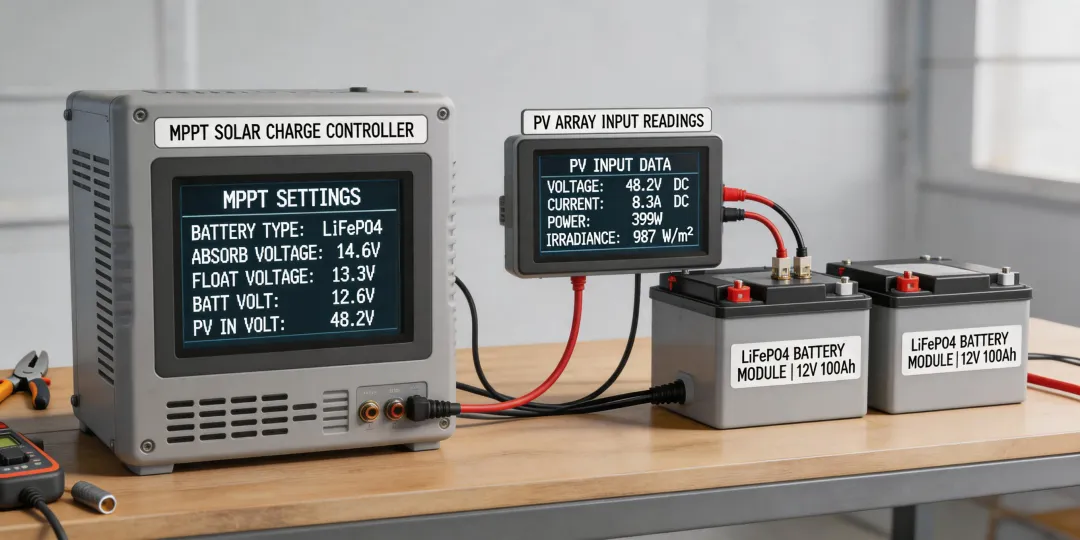
So I did what any overconfident administrator does: I opened a spreadsheet and built a solar system. The centerpiece was the EPEver MPPT solar charge controller 40A. It was one of the few charge controllers I could find that had three things we needed:
- MPPT charging instead of the older PWM approach
- Adjustable battery settings, including a LiFePO4 profile
- A manual that I could print and keep in the trailer
The EPEver MPPT solar charge controller 40A also had enough solar input for two 200W panels. That meant we didn't need to upgrade the controller later. That was a deliberate choice. I'd rather buy more capacity than we needed now than have to rewire the roof rack at a customer event.
Reading the EPEver inverter reviews
Before ordering the inverter, I spent two evenings reading what looked like every EPEver inverter review on the internet. Some were too polished. The one that helped was from a guy who installed an EPEver inverter in a food truck. He complained the terminal screws were small and the cooling fan got loud under load. He also said the unit ran for nine hours at a food festival without tripping. That sounded real. I didn't need a perfect component; I needed a predictable one.
Installation day and the battery terminal lesson
Installation was scheduled for the first week of April. Our contractor arrived with a cardboard box of cables, a DC-rated fuse, a battery monitor, and a very serious look. The first thing he did was open the battery compartment and disconnect the battery terminals. Before I could ask if we should turn something off, he had the negative terminal off and covered, then the positive terminal.
That was my first real lesson in how to disconnect battery terminals safely. I had assumed you just unbolt whatever is in your way. The correct sequence is: turn off the inverter and the solar charge controller; remove the negative battery terminal first; then remove the positive terminal; and keep the cable ends isolated so they can't touch each other or the chassis. When it's time to reconnect, do the reverse — positive first, negative last. It sounds simple, but the reason matters. A lithium battery can deliver enough current to weld a wrench to a frame if you short it.
The EPEver manual makes the same point in capital letters: 'always disconnect the battery before changing any connection.' I wish I had read that before the install, not after. (Note to self: read manuals before purchasing.)
Here's where I prove I'm not an expert. After the contractor finished, he left to grab his meter from the truck. I climbed into the trailer, picked up a pair of pliers, and accidentally touched the positive battery terminal with the tip. There was a loud spark and a small black mark. It didn't set anything on fire. It did, however, make me understand why the very first instruction on the manual is to disconnect battery terminals first.
A small purchasing mistake, in case you thought I had it all figured out
There was also a classic procurement failure on this project. I saved $60 by buying a busbar from a seller I'd never used. It arrived with corrosion on the plating. I threw it away, ordered a proper distribution block from a solar distributor, and paid $25 in shipping. Net loss: about $85, not counting my embarrassment.
The first real-world test
In May, the trailer went to its first three-day trade show. The RV solar system with lithium and inverter ran two laptops, a portable printer, and a mini-fridge. The EPEver MPPT solar charge controller 40A kept the lithium battery full by mid-morning, and the EPEver inverter carried the loads without complaining. The only issue was the fan noise when the printer ran, which was exactly what the food truck review had mentioned.
I don't have hard data on long-term reliability. Ten months is not a trustworthy sample, and we didn't install a proper energy meter until after the first event. What I can say anecdotally is that the system performed when it needed to. We had one rainy weekend where the solar panels produced almost nothing, and the lithium battery still got the team through two presentations before they had to plug into shore power.
What this taught me about buying solar
The biggest lesson wasn't about a specific brand. It was about how much has changed in the last five years. What was best practice in 2020 for a small RV solar system was often a PWM controller, a flooded lead-acid battery, and a 12V cooler. That combination would be the wrong starting point for a modern RV solar system with lithium and inverter. Lithium batteries charge at higher currents and require different voltage setpoints. An MPPT controller, like the EPEver MPPT solar charge controller 40A, is no longer a premium upgrade — it's the sensible baseline for a system that runs real equipment.
The fundamentals haven't changed: use the right wire size, fuse everything, and know how to disconnect battery terminals before working on any of it. The execution has transformed. New buyers don't need to learn the old workarounds for AGM batteries or cry over charging profiles. They need a controller that can be set for LiFePO4 and an inverter that doesn't ruin a customer presentation.
So would I buy it again?
If the whole project taught me one thing, it's this: buying solar equipment from a spreadsheet is possible, but only if you respect the parts that don't show up in the specs. I still care about price and invoice accuracy. But I also care about whether the controller can handle a lithium low-temperature cutoff, whether the terminal screws fit a standard torque wrench, and whether the manual is readable at 6:00 AM in a parking lot.
So, a formal EPEver inverter review? I'm not equipped to give you one. But the unit I bought has run for roughly 250 total hours without an issue. The EPEver MPPT solar charge controller 40A has been equally boring. For someone who buys toner cartridges and business cards, boring is the highest compliment.