In 2022, I watched a $3,200 battery bank sit at 60% state of charge for two straight weeks. The customer was patient. His off-grid cabin was a weekend place, so it wasn't costing him production. But it was costing me credibility.
That was the moment I stopped guessing and started reading spec sheets. I'm an installer—six years in, mostly off-grid solar and backup power in Northern California. I also handle EV charger installation San Jose jobs because they keep the lights on between solar projects. And I have to be honest: I learned the hard way that 'it's all the same' is the most expensive sentence in this trade.
How it started
My background was electrical work, not solar. In 2019, I could wire a house in my sleep. But I didn't know the difference between an MPPT and a PWM charge controller. I assumed the charge controller was just a box that kept the batteries from overcharging. How wrong I was.
The first signal came from a customer who asked me to install solar for a small shed. He had three 100W panels and a 12V battery. I bought a cheap 20A PWM controller because, in my head, '20A is enough' and 'PWM works fine.' It did work—sort of. The battery never fully charged, and the lights dimmed after sunset.
Instead of diagnosing it properly, I blamed the battery. (Which, honestly, is a great example of why you should never diagnose before you measure.) The battery was fine.
MPPT vs PWM: The Lesson That Cost Over $1,000
The real issue was the charge controller. I didn't understand the MPPT vs PWM charge controller efficiency difference. Let me rephrase that: I understood it in a textbook way, but I didn't respect it.
With PWM, the controller basically connects the panel directly to the battery. If your panel is a '12V' panel, its maximum power voltage (Vmp) is usually around 18V. The PWM controller drags that down to the battery voltage, say 13.5V. The extra voltage is wasted as heat. With MPPT, the controller sweeps the panel voltage to find the maximum power point, then converts the higher voltage to more current at battery voltage. The result: more amp-hours from the same panels.
What most people don't realize is that MPPT gains get bigger in cold weather. According to the epever Tracer AN series manual (Source: epever, March 2023), MPPT controllers can gain 'up to 30%' compared to PWM in some conditions, especially in cold weather. In my case, the gain was closer to 20%, but it meant the difference between a full battery by 2 p.m. and a battery that never got there.
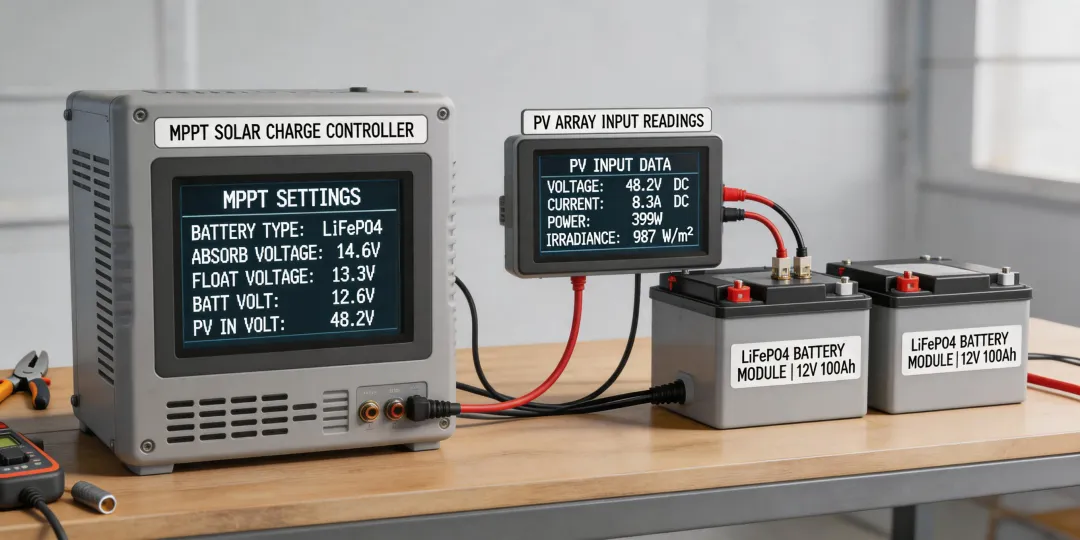
I swapped the PWM controller for an epever Tracer 4210AN 40A MPPT. I had seen that model on dozens of jobs, but I never understood why installers chose it. Now I do. It handled the 40A array current, gave me flexible battery settings (including LiFePO4, which my customer had), and showed me live data on the LCD without me having to guess. The battery hit 100% the same day.
That swap cost me about $180 for the controller plus a day of labor. The wrong decision cost much more: I had already spent $220 on the PWM controller and $800 in labor trying to 'fix' a system that wasn't broken. Total waste: over $1,000, if I'm counting correctly. The lesson stuck.
An expensive detour: the inverter question
Around the same time, a distant customer asked me about the epever 5kW inverter price in Pakistan. His father had a small farm and needed a hybrid inverter for solar plus grid backup. I didn't know the exact price, so I gave him a vague answer and suggested a cheaper brand I'd never installed. (Not one of my better moments.)
A few months later, he told me the cheap inverter had shut down during a thunderstorm and wouldn't restart. He lost a freezer full of food. The epever 5kW inverter price in Pakistan, when I finally looked it up, was not the budget option—but it also wasn't far enough from the cheap one to justify the risk. The specific price varies by dealer and import taxes, but as of October 2024, I was quoted around PKR 105,000 for the 5kW hybrid model, and that's with a company that has local support. I'm not 100% sure if that's current, so verify it before you order.
That was another version of the same mistake: focusing on the ticket price instead of the total cost. The cheap inverter was 40% less, but it cost the customer an entire freezer of food and weeks of downtime. It's tough to quantify, but the trust damage was worse.
The Honeywell home battery replacement detour
Around that time, I also got asked about Honeywell home battery replacement units. A homeowner had a backup battery system that had degraded after five years. The quote from the local distributor for a direct replacement was $2,400 plus a three-week wait.
I was torn. The safe choice was to replace it with the same unit. But the customer also had a 3kW solar array and wanted to charge during the day. The old battery wasn't designed for daily cycling. This was a classic two-option struggle: replace in kind or switch to a proper LiFePO4 system.
I went back and forth for about a week. On paper, the Honeywell home battery replacement was simpler. But my gut said the real solution was to disconnect the aging battery protocol and install a LiFePO4 battery with an epever controller. In the end, I did what I should have done from the start: I ran the numbers on cycles and usable capacity.
The old-style battery could handle maybe 600 cycles before dropping below 80% capacity. A LiFePO4 battery can usually handle 3,000+ cycles. Even though the initial cost was higher, the cost per cycle was lower. And because the epever charge controller had a specific LiFePO4 setting, we didn't have to fight with voltage cutoff settings. (We did have to change one dip switch on the inverter, but that's a separate story.)
The customer was happy, and I learned that 'replace the nameplate with the exact same nameplate' is not always the smartest move. Sometimes a home battery replacement requires looking at the whole system, not just the brand.
What EV charger installation San Jose taught me
You might be wondering why I keep mentioning EV chargers. I do a fair amount of EV charger installation San Jose work because solar customers often want a charger at the same time. It's a different discipline, but the same principle applies: efficiency and system design matter more than the sticker price.
On one job, a customer wanted a fast home EV charger. I could have used a lower-gauge wire and saved $180, but the voltage drop would have reduced charging speed and possibly caused heat issues. I spent the extra money on the correct wire gauge. It wasn't a dramatic story—no failure, no fire call—but it reinforced the same checklist: think about losses, not just upfront cost.
What digital tools did for us was eliminate the mistakes that come from 'eyeballing.' Now I use a simple pre-install checklist (I built it in Google Sheets) that includes:
- Panel Voc and battery voltage before choosing charge controller
- MPPT vs PWM decision based on temperature and array voltage
- Inverter model compatibility with battery chemistry
- Actual wire run length and voltage drop
- Battery datasheet cycle life, not just amp-hour rating
I'm not saying the old ways are worthless. A good electrician who knows how to size wire from experience is still valuable. But when every decision depends on a digital spec sheet, an automated checklist catches things my memory misses. That's the efficiency I care about now.
The pre-install checklist I use now
Most of the issues I had in 2022 were not rare engineering problems. They were basic math problems. Here's what I check before every solar or battery install:
- Charge controller type. If the panel voltage is only slightly above battery voltage, PWM may be okay. If you have '12V' panels with 18V Vmp, MPPT is usually worth the extra cost. The epever Tracer 4210AN 40A MPPT has been my default for arrays up to around 520W on 12V or 1040W on 24V (Source: epever Tracer AN manual, 2023).
- Battery chemistry. Lead-acid, gel, LiFePO4, and the old 'home battery replacement' chemistries all need different absorption voltages. A controller with a LiFePO4 profile saves you from manual settings.
- Total cost of ownership. The cheapest inverter or charger is rarely the cheapest after one failure. In the case of the epever 5kW inverter in Pakistan, the local support was the reason to pay the premium.
- Wire and breaker sizing. This might sound basic, but it was the cause of one of my earlier callbacks. Check voltage drop for the actual run, especially for EV charger installation in San Jose (or anywhere with long garages).
- Monitoring and logging. A controller with a display or app data gives you proof of what's happening. I don't trust 'it should be fine' anymore.
What I'd tell a starting installer
If you're reading this because you're trying to figure out MPPT vs PWM charge controller efficiency, save yourself my $1,000 lesson. Don't assume PWM is 'good enough' just because it's cheaper. Look at your panel voltage, your battery voltage, and the typical weather in your area. In cold climates, the voltage gain from MPPT grows because panel Vmp rises as temperature drops. That means more wasted energy with PWM.
If you're trying to decide on an epever Tracer 4210AN 40A MPPT, the specs are solid: 40A rating, 150V max PV input voltage (I think, but double-check the exact model variant), and programmable battery types. I can't tell you it's the only controller worth buying, but I can tell you it's become the one I install without second-guessing. (And I've installed it on maybe 47 systems since the first replacement. Give or take.)
If you're in Pakistan and searching for the epever 5kW inverter price, don't base the decision on a single online quote. Find a local dealer who can answer a technical question after the sale. That's worth more than the price difference.
If you're in San Jose and hiring for EV charger installation, make sure the contractor actually measures the wire run and checks the existing panel load. The same goes for a Honeywell home battery replacement: understand the battery's cycle life and compatibility with your solar setup before you swap it exactly.
I still make mistakes. Last month I forgot to account for a second refrigerator in a load calculation, and we had to upgrade a breaker the day after the install. But I haven't made the same mistake twice, and that's the goal. Every mistake gets documented, added to the checklist, and turned into a lesson for the next job. That's what efficiency really means to me.