I'll say it straight: I think the Epever Tracer MPPT solar charge controller is the right default for most 12V and 24V LiFePO4 off-grid systems—but not all of them. That caveat matters because the people who sell you a one-size-fits-all controller usually aren't the ones replacing a ruined battery bank.
I'm the procurement manager at a 40-person renewable energy distributor. I've managed our solar equipment budget for six years, negotiated with more vendors than I can count, and documented every order in our cost tracking system. When someone asks me for an epever tracer mppt solar charge controller, I don't just check inventory. I check what they're pairing it with.
Over the past six years of tracking every invoice, I've seen the same mistake repeatedly: people buy a decent lithium battery and then cheap out on the charge controller. A few months later, the battery underperforms or throws a BMS fault. Then they blame the battery. The most frustrating part is that the battery was never the problem.
Why the Epever Tracer MPPT Is My Default Recommendation
The Epever Tracer series has been the best value per dollar for us. In Q2 2024, when we switched our default from a small PWM controller to the Epever Tracer, the average price increase per unit was about $26. That's not nothing. But after tracking warranty claims in our system, the PWM option was actually costing us more in returns and support time. If a customer uses a 100Ah LiFePO4 battery with a 30A controller and the controller mischarges it, you're not replacing a $50 controller. You're explaining why a $400 battery that the group 31 12v 100ah lifepo4 battery reviews praised failed after 400 cycles instead of 4,000.
I'm not 100% sure of the exact return numbers from memory—don't hold me to this—but warranty claims dropped by roughly 17% after the switch. The total cost of ownership clearly favored the MPPT controller.
What Is Charge Voltage for LiFePO4 Battery?
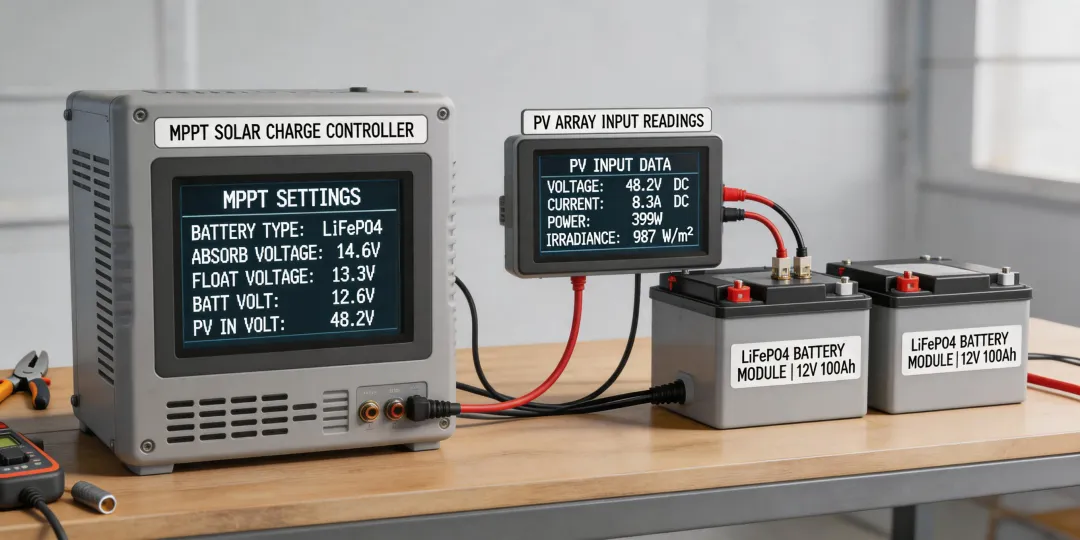
This is the question I get more than any other. For a 12V LiFePO4 battery, the charge voltage is usually between 14.2V and 14.6V for the bulk and absorption stage. The exact number depends on the battery manufacturer and its BMS. Many of the batteries we sell specify 14.4V. Float voltage is often 13.6V to 13.8V, though some BMS vendors tell you to skip float entirely.
The most frustrating part of working with LiFePO4 is that every BMS manufacturer seems to have a slightly different number. You'd think 12V lithium would be simple, but it isn't. A lot of charge controllers only have presets for sealed, gel, and flooded lead-acid. Those presets are usually too low or too high for lithium. The Epever Tracer MPPT includes a User battery type that lets you set the charging voltages yourself. What I mean is you can manually enter the numbers from your battery datasheet instead of relying on fixed presets. That flexibility is worth the price if you're building a custom 12V LiFePO4 bank.
Battery Reviews Don't Tell the Whole Story
Most of the group 31 12v 100ah lifepo4 battery reviews I've read focus on capacity and cycle life, and that's useful. But reviewers sometimes treat the battery like an isolated box. In a real off-grid system, the charge controller determines whether you get the advertised cycle life. If you set the absorption voltage too high because your controller only has an AGM preset, the BMS will protect the cells but you'll lose capacity. If you set it too low, you won't fully charge the battery.
The controller is not a passive accessory. It's the guardian of the battery. You can pair a great battery with a bad controller and get a bad system. The Epever Tracer's adjustable settings are not a nice-to-have; they're a requirement for lithium.
EV Charging Station Coimbatore Tamil Nadu: An Example I Deal With
One thing I didn't expect in this role is the number of calls about electric vehicle charging. If you're researching an EV charging station Coimbatore Tamil Nadu project, you're probably looking at solar plus battery storage to offset grid costs. The Epever Tracer MPPT can handle the solar charging side of that system. But the EV charger itself needs a proper inverter or EVSE. The charge controller doesn't manage AC output. I've seen a few installers try to wire an EV charger directly to a battery bank and it doesn't work that way. Use the right inverter, and the Tracer is fine. Expect it to run the EVSE directly, and you'll be disappointed.
When I'd Tell You to Skip the Epever Tracer
I don't want to oversell it. If you need a fully integrated energy management system where the charge controller and inverter talk to each other over a proprietary protocol, you'll probably end up with a more expensive system. The Tracer is excellent at what it does—MPPT charging—but it doesn't try to be the system brain.
The setup menu is also not beginner-friendly. If you don't know what absorption voltage means, you'll need to read the manual or work with someone who does. That's not a flaw, but it's a limitation. This works well for us because we're a B2B distributor with predictable order patterns. If you're a one-off buyer who wants plug-and-play, the calculus might be different.
What About Cheaper Controllers?
I hear the cost objection a lot. Can't I just use a $35 PWM controller? Yes, for a small lead-acid RV setup, maybe. But for a LiFePO4 battery bank that you want to cycle for years, a $35 controller is a risky savings. When I compare quotes, I look at total cost of ownership, not the sticker price. The Epever Tracer costs more than a PWM controller, but it delivers higher solar harvest, supports lithium settings, and doesn't kill batteries with a bad charging profile.
I also keep an eye on advertising guidelines because our sales quotes have to be defensible. Per FTC guidelines (ftc.gov), claims about battery life and performance need to be substantiated. The Epever Tracer makes that easy because you can set and verify the charge parameters before the system leaves our warehouse.
Bottom Line
If you're setting up a 12V or 24V off-grid system with LiFePO4 batteries, and you don't need a fully integrated energy brain, the Epever Tracer MPPT solar charge controller is the best-value choice I've found in six years of buying this stuff. Pick the right amp size, set the charge voltage to what your battery datasheet says, and check the settings after install.
But if you're not willing to learn the charge voltage for your LiFePO4 battery, or you need system-level communication, spend more money and get something with more integration. There's no shame in that. The shame is buying a $35 controller for a $400 battery and calling it a project.