Last March, A Heat Pump Changed My Spreadsheet
Last March, one of our installers dropped an email on my desk. A homeowner near Lancaster, PA had just put in a 3kw heat pump and wanted a small wind turbine for home so he could stop paying the utility. The installer needed a sanity check before quoting the job.
I'm procurement manager at a 14-person renewable energy company. I've managed roughly $210,000 a year in component purchases for six years, negotiated with more than 50 vendors, and kept a cost-tracking spreadsheet that our accountant probably loves more than I do.
I am not a wind engineer. But I have enough math skills to know when a vendor brochure does not add up.
The client's heat pump was a typical cold-climate air-to-water unit. The '3kw' on the nameplate is heating capacity, not electrical draw. Over a week of monitoring, it pulled between 290W and 950W most of the time, with short spikes above 1.8kW during defrost. So a 1000 watt wind turbine could cover a meaningful chunk of the pump on a breezy day, but not during the calm periods that made him angry.
What 'Wind Power Generator for Home' Actually Means
He wasn't asking for a portable backup generator. He was asking about a wind power generator for home, installed permanently, charging a battery that feeds his heat pump through an inverter. That distinction matters because most people search and get a messy pile of utility-scale content.
If you search for 'wind farm generator', you'll see machines with rotor diameters of 100 meters. They need high-voltage interconnection, crews, and wind that blows consistently. A backyard turbine is exactly the opposite: small, low voltage, and designed for variable conditions.
The current DOE Small Wind Guide posted under WINDExchange suggests an annual average above 4m/s, about 10 mph, before you seriously look at turbines. By early April, we had 17 days of site data from a 30-foot pole. Average wind speed at 9 meters was 4.7m/s. The turbine would sit at 18 meters, so I used our vendor calculator to estimate 5.2m/s annual average. We were just past the line, but not by a mile.
The Shortest Quote Was Not the Cheapest
I put three quotes into our cost-tracking sheet. Vendor A offered a 1000 watt wind turbine for $1,120. Vendor B wanted $2,390 for a turbine with a controller included. Vendor C said '1,200W certified' and would not reveal price until they visited the site.
Vendor A's quote looked seductive. But beneath the turbine price: no charge controller, no tower, no batteries, no freight. The turbine itself was $1,120. Tower kit, $1,350. An 80A wind turbine charge controller, $615. Freight, $240. Site work, electrical, and permits, $2,950. Total? $6,275. That number made me sit back. The 'cheap' turbine was already costing more than the heat pump install.
When I totaled the cost of delivered energy over 20 years, the gap between Vendor A and Vendor B shrank to almost nothing in dollars per kWh. Vendor B gave us a real power curve and a warranty we could actually use. Vendor A gave us a glossy brochure and a promise. So I threw out the unit-price comparison and started reviewing total installed cost, expected generation, controller compatibility, and local service support.
That spreadsheet is now our standard tool. It cut custom system procurement review from about two weeks to three days. Efficiency is not a buzzword in my office; it is the difference between being profitable and losing margin on every odd project.
The Controller Trap
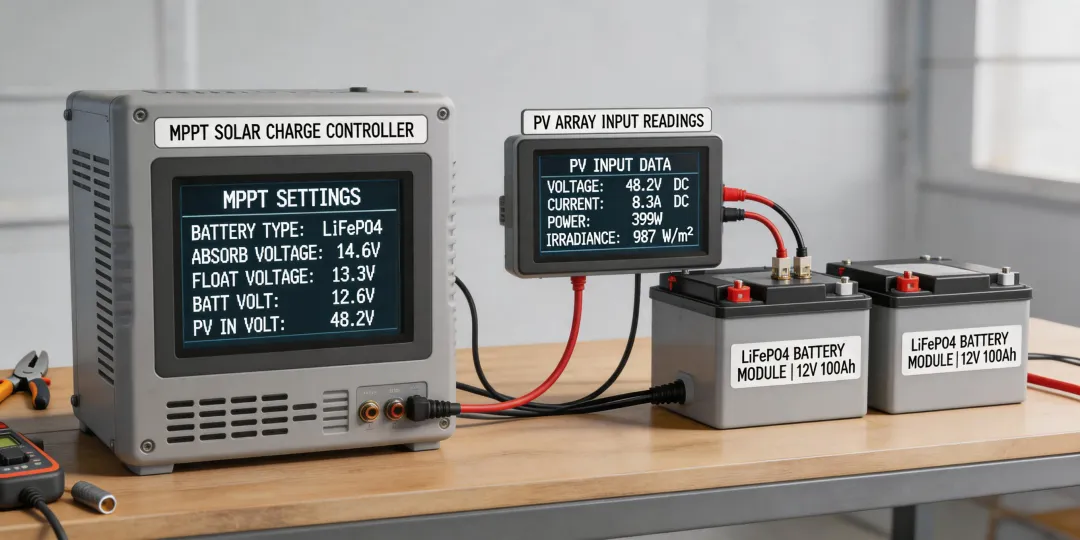
Here is where I got burned. For a battery-based system with a wind turbine, you need a wind turbine charge controller between the generator and the battery. It rectifies the three-phase AC, monitors battery voltage, and sends surplus power to a dump load. Some people try to skip it. That is how batteries overcharge on a windy afternoon.
Our standard solar components, including the Epever MPPT charge controllers we use on most of our PV jobs, are not made for this. A solar controller expects steady DC from panels. A wind turbine's output frequency changes as the wind gust dies and picks up. So we had to buy a dedicated controller.
I thought I had that covered when I ordered an 80A unit priced at $615. But our first controller order was a complete waste of two weeks. I called a vendor and said: 'The turbine is rated 1000 watts.' They heard: 'Send the same controller we sell with a 1000 watt solar array.' It arrived with a max PV open-circuit voltage spec that made no sense for wind, and the input terminals were too small for our cable. We sent it back.
After that, I built a controller checklist and put the wind turbine charge controller on every quote before the turbine. The controller is not a bolt-on. It decides battery voltage setpoints, dump load capacity, and whether the bank gets properly protected when the battery is full. For a 48V system with a 1000 watt turbine, an 80A controller gave us headroom and let us add solar later if the client ever gets panels.
Eight Months of Data
We installed the system in mid-June 2024. Turbine on an 18-meter tower, 48V Epever LiFePO4 battery bank, an Epever off-grid inverter, and a dedicated wind turbine charge controller with a ceramic dump load resistor.
By the end of January 2025, the turbine had produced 486kWh. Annualized, that is roughly 640kWh per year. At $0.19/kWh, that is $122 in annual value. Our installed cost was $7,100 including the extra wiring, grounding, and inspections. Simple payback? About 58 years. Even with state and federal incentives, it is not what I would call an investment.
Do I regret it? No. The client understood what he was buying. He wanted resilience, and he got it. One day in December, during a 40 mph windstorm, the turbine and battery together covered the 3kw heat pump's entire draw for six straight hours. That made an uncomfortable day comfortable. That is not payback. That is resilience.
What I'd Ask Before a Small Wind Turbine
After this project, I always ask three questions before I quote a small wind turbine for home:
- Do you have at least 10 mph average wind speed at your specific site?
- Are you planning a battery bank and an inverter, or do you want direct power to an appliance?
- Have you budgeted for the tower, the electrical work, and a proper wind turbine charge controller?
If a client asks about putting a wind farm generator in their backyard, I send them the turbine data instead. The honest version of a 1000 watt wind turbine is not a free ride. It is a companion to efficient equipment like a 3kw heat pump, plus a battery system that keeps the lights on when the wind dies. Price it the way you would run a business, and you won't be disappointed. Just make sure you're buying the whole system, not the pretty picture on a product page.