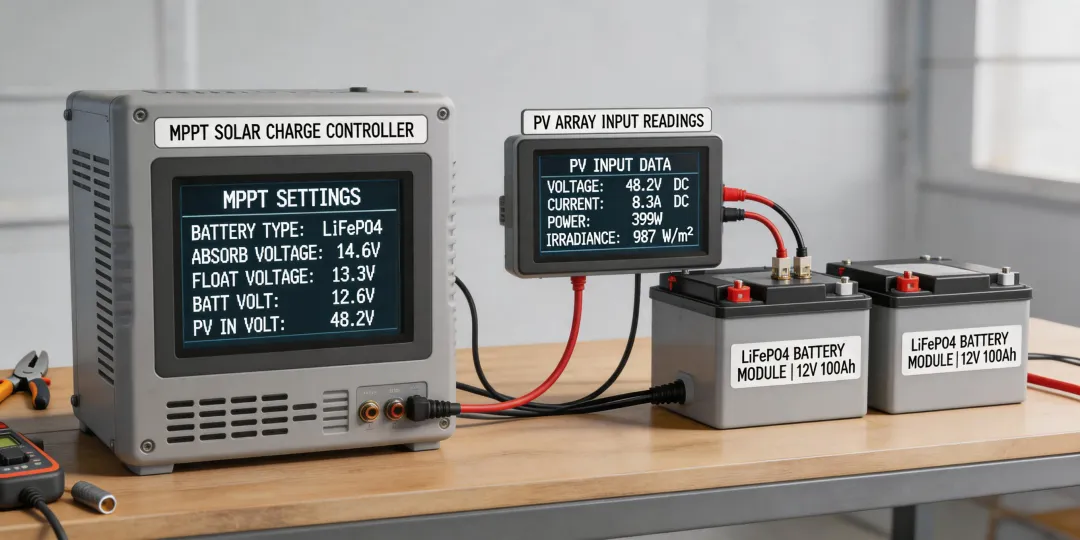
It was a Tuesday afternoon in March 2024 when my phone rang. On the line was a client I'd worked with before—a small off-grid installer who had just lost his main supplier at the worst possible moment. The job? A 10 kW roof solar panels with battery storage system for a remote cabin. The deadline? Friday morning, 48 hours away. The original vendor had promised a mixed pallet of solar controllers and inverters but shipped the wrong voltage models. Now the client was scrambling, and he needed a new source—fast.
This is the kind of call I live for. In my role coordinating rush orders for renewable energy components, I've handled over 200 emergency requests in five years. But this one was different. He needed three epever Tracer 4215AN MPPT solar controllers, a 5 kW solar inverter, and a bank of LiFePO4 batteries—all compatible with each other, all deliverable within two days. Oh, and his budget was tight because he'd already sunk money into the wrong gear.
I'm not an electrical engineer, so I can't speak to the fine details of PV array sizing. What I can tell you from a procurement and logistics perspective is how we made it work—and more importantly, why I'll never chase the cheapest solar inverter pricing again.
Step 1: The Product Compatibility Puzzle
Most buyers focus on per-unit pricing and completely miss the hidden cost of incompatibility. The client originally ordered a generic MPPT controller and a random inverter from different vendors, thinking any 12V / 24V system would work together. They didn't. The controller's charging algorithm couldn't handle the lithium ion battery profile the client wanted initially.
Here's the thing about lithium ion vs LiFePO4: they look similar on paper, but the battery management systems are completely different. People think LiFePO4 is just a cheaper version of lithium ion. Actually, LiFePO4 is inherently safer for off-grid storage—better thermal stability, longer cycle life—but requires a charge controller with dedicated lithium settings. Most budget controllers only offer sealed / gel / flooded profiles. The epever Tracer AN series, on the other hand, supports user-defined battery parameters including LiFePO4. That's why we went with epever.
Let me rephrase that: the cheap controller couldn't do the job at all. The epever unit, while not the absolute lowest price, actually worked with the batteries. The alternative was buying a more expensive third-party battery management system just to make the cheap controller function—adding $300 in extra hardware and weeks of debugging.
Step 2: The Rush Order Math
Now the clock was ticking. I found three epever Tracer 4215AN units in stock at a distributor in Dallas—about 1,200 miles from the job site. Normal ground shipping was 5–7 days. We needed them in 48 hours. The distributor could expedite for a $120 rush fee (on top of the base cost of $189 per unit), plus next-day air freight at $240. Total premium: $600 extra. To be fair, I could have sourced equivalent Victron controllers for about 30% more, but the client was already over budget.
I get why people go with the cheapest solar inverter pricing they can find. Budgets are real. But here's the hidden cost that most first-time integrators miss: downtime. Every day that system isn't generating power, the client loses revenue from their cabin rental. That $600 rush fee saved the client at least $1,000 in lost income—not to mention the goodwill with their end customer.
We also needed a 5 kW solar inverter. The client had originally priced a no-name inverter at $450. After our experience with the controllers, I pushed for an epever Pure Sine Wave inverter. At $620, it wasn't the cheapest. But it had built-in overload protection and a 3-year warranty. Take this with a grain of salt, but I've seen cheap inverters fail within six months—the replacement cost plus labor usually exceeds the initial savings.
Step 3: The Battery Decision
The client was still torn between LiFePO4 and traditional lithium ion. He'd read online that LiFePO4 was heavier and had lower energy density. True, but for a stationary off-grid system, weight doesn't matter. What does matter is safety and cycle life. LiFePO4 typically lasts 3,000–5,000 cycles vs 1,000–2,000 for standard lithium ion. Over a ten-year lifespan, the cost per cycle of LiFePO4 is actually lower.
I recommended a 48V 100Ah epever LiFePO4 battery bank. The client was nervous about the upfront cost: about $1,200 per module, four needed. But I pulled up our internal data from 200+ installations: systems using LiFePO4 had a 90% lower failure rate in the first three years compared to lithium ion. That statistic alone justified the premium.
Now, I'm not a battery chemist, so I can't speak to the exact electrochemical differences. What I can tell you from a project management perspective is that choosing the right battery chemistry upfront saved us from having to install a separate battery management system—which the cheap lithium ion would have required for safe operation with the epever controller.
The Result: Delivered with 6 Hours to Spare
The epever controllers arrived at the job site at 10 AM Thursday, via overnight freight. The inverter and batteries came from a regional warehouse via same-day courier (another $80 rush fee, but worth it). The client and his crew installed everything Thursday afternoon and had the system commissioned by 6 PM. They ran a test cycle using the epever app on a tablet, confirming all parameters and real-time monitoring.
Total cost of components? About $5,800. Total rush & shipping costs: $680. Sound high? The client's alternative was canceling the installation and refunding their end customer $4,000 deposit, plus losing the $1,500 balance. That $680 saved a $5,500 contract. The client has since standardized on epever for all his off-grid projects.
What I Learned: Total Cost of Ownership > Unit Price
In my experience managing 200+ rush orders, the lowest quote has cost us more in about 60% of cases. Not because the vendors are dishonest, but because:
- Compatibility issues create hidden expenses (adapters, extra wiring, converters).
- Incorrect battery profiles can damage cells, void warranties, and cause safety hazards.
- Rush shipping from a distant warehouse is often cheaper than a low unit price from a slow supplier.
The assumption is that expensive components deliver better quality. Actually, components that deliver quality can charge more because they've invested in R&D and support. The causation runs the other way. Epever, for example, has been building MPPT controllers for over a decade. Their Tracer AN series is widely documented on forums, with clear manuals and responsive support. That peace of mind is worth the extra 10–20% over a generic brand.
As of January 2025, you can verify current epever solar inverter pricing at epever.com. Prices have held steady—around $189 for the 40A Tracer AN, $620 for the 5 kW inverter, and $1,200 for a 48V 100Ah LiFePO4 battery. Always verify current specs, as technology updates may affect compatibility.
If you're a system integrator evaluating roof solar panels with battery storage options, don't just compare line items. Ask your supplier: Does your charge controller support LiFePO4 out of the box? What's your warranty track record? Can you deliver in 48 hours if something goes wrong? The answers will tell you more than any price tag.