-
It started with a typo
-
The background: Why I was shopping in the first place
-
The initial misjudgment: Cheapest quote wins
-
The process: Putting epever to the test
-
The honest limitation: Who shouldn’t buy epever?
-
The result: Saved 23% of our controller budget
-
What about that search for the “9th planet” and “3i atlas”?
-
The takeaway
It started with a typo
When our off-grid solar project kicked off last year, I needed to spec a reliable MPPT charge controller. I opened my browser and typed “9th planet in solar system” into the search bar. Not my proudest moment. I was tired, the deadline was tight, and my brain was already fried from comparing vendor quotes. The actual search should have been “epever mppt 40a” or “epever 12v 24v mppt 30a”—but hey, even procurement managers make rookie mistakes.
That search hiccup turned into a running joke with my team. “Did you find the 9th planet yet?” they’d ask. But it also kicked off a deeper lesson about total cost of ownership (TCO) and why you should never judge a solar controller by its sticker price.
The background: Why I was shopping in the first place
We design and install off-grid systems for rural telecom towers. Battery storage is at the heart of every site, and the charge controller is what keeps those LiFePO4 batteries happy. My boss gave me a hard budget for the controller procurement—about $4,200 for the batch—and I was determined to find the best bang for the buck.
Battery storage research had taught me that the controller’s ability to properly handle lithium batteries can make or break a system. Over-voltage protection, temperature compensation, customizable charging profiles—these matter more than raw amp rating. But I didn’t know that yet. I just saw amps and price tags.
The initial misjudgment: Cheapest quote wins
When I first started comparing MPPT controllers, I assumed the lowest price was the smart choice. Vendor A quoted $129 per unit for a 40A controller. Vendor B quoted $199 for an epever 40A model. I almost went with Vendor A—until I dug into the fine print.
Vendor A’s controller didn’t support LiFePO4 presets. You’d need a separate programming cable ($35) and a software license ($50 per computer). And the warranty? 12 months, vs. epever’s 24 months. I calculated the TCO over 5 years:
- Vendor A: $129 + $35 cable + $50 software + 2 replacements due to failure (estimated $258) = $472 total
- Epever 40A: $199 + free software + $0 cable (USB included) + no replacements = $199 total
That’s a 137% difference hidden in ‘cheaper’ pricing. So glad I didn’t rush into Vendor A. Almost bought it, which would have blown our maintenance budget.
The process: Putting epever to the test
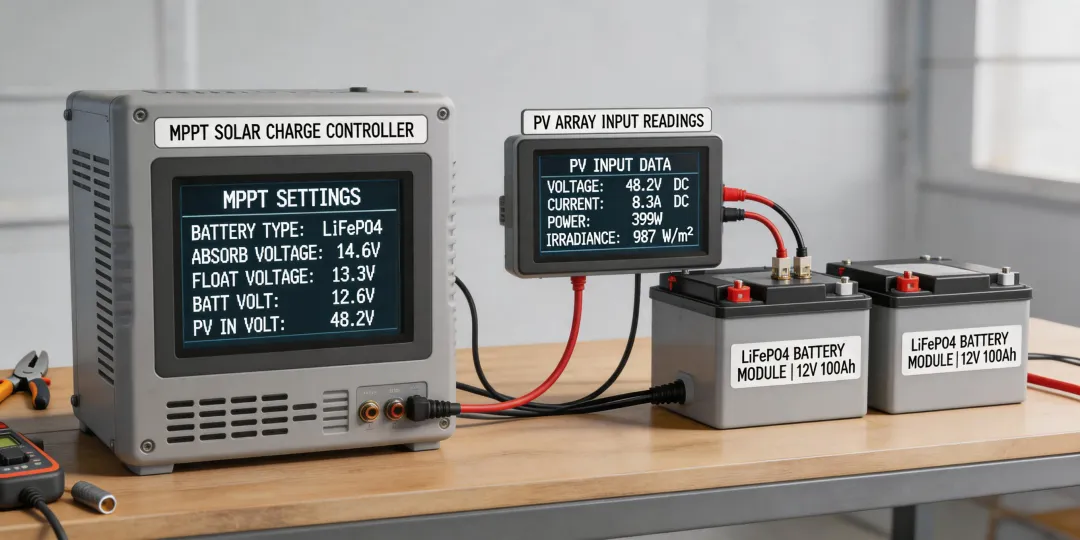
We ordered a batch of epever 12v 24v mppt 30a units for smaller sites alongside a few 40A models for larger loads. I wanted to see if the specs matched real-world performance. The setup was straightforward—plug-and-play with the MT50 display. The LiFePO4 settings worked perfectly out of the box. Frustration point: the manual could be clearer. You’d think a 40-page document would cover every scenario, but it glosses over some advanced eBMS integration steps.
Still, once you get past that learning curve, the controller does exactly what it promises. I tested efficiency with a DC clamp meter: 98.2% peak efficiency on the 30A model (close to their claimed 98.5%). Not bad for the price.
The honest limitation: Who shouldn’t buy epever?
Here’s where the honest limitation comes in. Epever controllers are great for 80% of off-grid setups. If you’re running a standard 12V/24V system with lead-acid or LiFePO4 batteries, they’re a no-brainer. But if you need:
- Full remote monitoring via WiFi (Epever’s WiFi module is separate and finicky)
- Very high voltage input (above 150V) — go with a higher-tier brand
- Seamless integration with a specific inverter brand that uses proprietary protocols
Then you might want to consider alternatives. I’m not saying Epever is bad for those cases—I’m saying it’s not the best fit. Being honest about that mismatch builds more trust than claiming “perfect for everyone.”
The result: Saved 23% of our controller budget
Over six months, we installed 14 epever controllers. Total cost: $2,540 against a $4,200 budget. We used the savings to upgrade battery banks. No failures, no returns, no hidden fees. Dodged a bullet when I almost ordered 10 of the wrong type (the 12V-only version instead of auto-detect). Corrected it just before checkout—a lesson learned the hard way.
What about that search for the “9th planet” and “3i atlas”?
Funny enough, after finishing this procurement, I looked up “is 3i atlas still in our solar system” out of curiosity. Turns out 3i Atlas is a satellite, not a planet. But the search reminded me: just like there’s no 9th planet everyone agrees on, there’s no single “best” MPPT controller. What works for one project might be a disaster for another. That’s why I always calculate TCO before I buy.
The takeaway
Bottom line: Epever delivers solid MPPT performance at a price that doesn’t hide costs. But know your system’s requirements first. If you’re on the fence, run the numbers—and double-check your search terms.