-
What every solar buyer really wants to know
-
1. Why do the same model numbers have wildly different prices?
-
2. Is an MPPT controller really necessary for lithium batteries?
-
3. Which Tracer model should I pick for a 400W panel array?
-
4. Central solar inverter vs. microinverter—does it matter for our installs?
-
5. Do I need specific panels for Epever charge controllers?
-
6. Are Epever batteries compatible with other inverter brands?
-
7. What's the one thing you'd change about your first solar purchase?
What every solar buyer really wants to know
If you're sourcing solar equipment for a project—whether it's a small off-grid cabin or a commercial install—you've probably got a list of questions. Some you'll ask your supplier. Some you'll Google late at night. And some you'll only realize you should have asked after something goes wrong.
I manage purchasing for a mid-sized renewable energy installer. Roughly $300k annually across 12 vendors. I've learned which questions matter—and which ones get you into trouble if you don't ask them.
Here are the questions I wish I'd asked from day one.
1. Why do the same model numbers have wildly different prices?
You'll see an Epever Tracer 30A listed for $179 on one site and $215 on another. The model number is identical. What gives?
Usually: gray market vs. authorized distribution. The cheaper unit might be parallel-imported stock without regional warranty support. I found this out the hard way when a "deal" from an unlisted reseller arrived with a Chinese manual and no way to submit a warranty claim.
What I do now: Verify the seller is listed on Epever's official distributor map before ordering. The price difference is often 2-3%. The difference in support reliability is 200%.
2. Is an MPPT controller really necessary for lithium batteries?
Short answer: yes. But the full answer matters more.
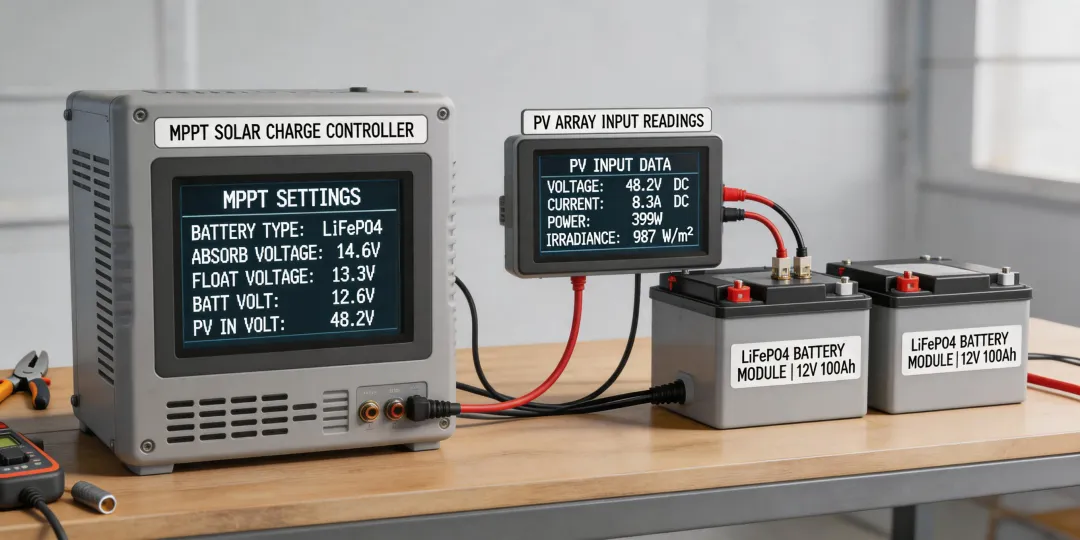
Older PWM controllers can't fully charge LiFePO4 batteries because they don't adjust voltage for the absorption phase. You'll get 70-80% capacity at best. An MPPT controller like the Epever Tracer series actively optimizes voltage for lithium chemistries.
Why this matters for buyers: Not all MPPT controllers handle LiFePO4 equally. I learned this when our first batch of Tracers arrived and we discovered the default battery profile was for lead-acid. The Epever 30A MPPT solar charge controller manual (available on their site) has a specific procedure for enabling lithium presets. We missed it—cost us a weekend of reconfiguration.
Tip: When ordering, confirm the firmware version supports LiFePO4. Most units shipped after mid-2024 do. Earlier ones might need an update.
3. Which Tracer model should I pick for a 400W panel array?
This is where spec sheets get deceptive. Let me translate.
An Epever Tracer 30A can handle a 400W array—but only at 12V battery voltage. If you're running 24V, you need the 40A model. Here's the math:
- 400W ÷ 12V = 33.3A (requires 40A controller minimum)
- 400W ÷ 24V = 16.7A (30A controller is sufficient)
First time? I ordered ten 30A units for a 12V system. After the third one hit overcurrent protection on a sunny day, I realized my mistake. Always oversize by 20-25% for safety margin.
4. Central solar inverter vs. microinverter—does it matter for our installs?
We use central inverters for projects over 5kW. They're more efficient per watt and easier to maintain at a single location. For smaller systems, microinverters simplify wiring and monitoring.
But here's what nobody told me upfront: a central solar inverter requires a dedicated location with ventilation. Solar inverters generate heat—especially during peak production. One of our early installs placed the inverter in a cramped attic without airflow. Ambient temperature hit 115°F, and the inverter throttled output by 30%.
Where is the solar inverter located? Ideally: a shaded, ventilated area near your main electrical panel. Not in direct sunlight. Not in an enclosed space without airflow. We've had great results with inverters mounted on the north side of a building (in the northern hemisphere) or under an eave.
5. Do I need specific panels for Epever charge controllers?
Not exactly—but there's a catch.
Epever charge controllers work with most 60-cell and 72-cell solar modules. The key spec is Voc (open-circuit voltage). Your panel string's total Voc at coldest temperature must stay below the controller's max input voltage.
Here's the mistake I made: I spec'd a string of T1 G1 Dallas Solar Module Trina LLC panels—72-cell, 400W each. Four in series gave a cold-weather Voc around 195V. Our Epever 50A model rated at 200V max. Too close for comfort. I should have used three in series or chosen the 100A model with 250V input.
Rule of thumb: Leave at least 15% headroom between your calculated Voc and the controller's limit. Solar panels produce higher voltage in cold weather—something I learned the week after the 2024 winter storm.
6. Are Epever batteries compatible with other inverter brands?
This is a question I get from every new installer. The answer: technically yes, practically... sometimes.
Epever's LiFePO4 batteries use standard CAN/RS485 communication protocols. They can connect to third-party inverters, but you'll likely lose some features—like per-cell monitoring and automatic charging profiles.
If you're mixing brands, manually set your inverter's charging parameters to match the battery specs:
- Absorption voltage: 14.4V (12V system)
- Float voltage: 13.5V
- Cutoff voltage: 11.0V (or whatever the BMS specifies)
Honestly? I prefer keeping the ecosystem consistent. Epever controller + Epever battery + Epever inverter means everything speaks the same language. Less troubleshooting, less finger-pointing when something goes wrong.
7. What's the one thing you'd change about your first solar purchase?
If I could go back: invest in proper wiring and connectors from day one.
It's tempting to skimp on cables—they're boring and don't make power. But undersized wire caused voltage drop that cost us 8% production on one site. Cheap MC4 connectors corroded within 18 months at another.
Spend the extra $50 on quality cabling. It's the difference between a system that lasts 15 years and one that needs repairs in year three.
After the third late delivery from the same vendor, I was ready to give up on them entirely. What finally helped was building in buffer time rather than trusting their estimates. Now I add 2 weeks to every quoted lead time. If it arrives early? Great. If it's late? Still on schedule.
Not ideal—but workable.